
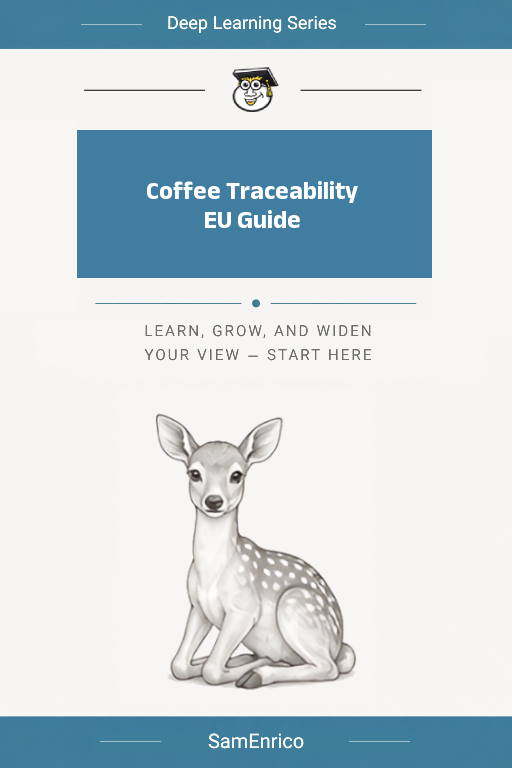
Non-FictionBusiness BriefTraceability
Coffee Traceability EU Guide eBook
Implement blockchain traceability for coffee expor
Implement blockchain traceability for coffee exports to meet EU deforestation regulations. Provide geolocation of farms to prove product not from deforested land.
Formats
Free sample
Chapter 1: The Rotterdam Seizure--The shipping container arrived at Rotterdam on a Tuesday morning in September 2024. It had traveled 7,200 kilometers from the highlands of Honduras, crossing the Atlantic Ocean over eighteen days. The coffee inside—forty thousand kilograms of washed arabica, certified organic, fair trade, and shade-grown—was worth €380,000 at market prices. The importer, a medium-sized German roaster with a reputation for sustainability, had paid a fifteen percent premium for these beans. The farmer, a smallholder named Elena who tended 2.3 hectares of land her grandfather had cleared in 1978, expected to receive her share of the payment within ninety days.The container never reached the roaster.At 10:47 AM, a customs officer scanned the shipment's entry documents into the European Union's new Information System.
The system flagged an immediate violation: no geolocation data for the farms where the coffee was grown. No polygons. No deforestation-free declaration. No Due Diligence Statement. The officer stamped a red "NON-COMPLIANT" notice on the electronic file.
The container was moved to a holding yard, where it would sit for six weeks while the importer appealed. The appeal was denied. On a cold November morning, the coffee was incinerated. The importer lost €380,000. The roaster lost a product line.
And Elena, the farmer who grew the beans, never received payment.This scenario is not hypothetical. It is the new reality of coffee trading under the European Union Deforestation Regulation, known as EUDR. And it will happen thousands of times before the end of this decade.The New Gatekeeper The European Union is the world's largest importer of coffee. European roasters purchase approximately 2.7 million metric tons of green coffee annually, accounting for roughly forty-five percent of global coffee trade. Germany alone imports more coffee than the entire continent of North America.
Italy, France, Belgium, and Spain round out a market that consumes over three billion cups of coffee every single day.This market is now closed to any coffee that cannot prove, with documented, verifiable evidence, that it was grown on land free from deforestation after December 31, 2020.Regulation (EU) 2023/1115, which took effect in June 2023 with enforcement beginning December 30, 2024, and later delayed to December 30, 2025, and finally settled on December 30, 2026 for most operators, represents the most significant transformation in agricultural commodity trade since the creation of the World Trade Organization. It applies to seven commodities: cattle, cocoa, coffee, oil palm, rubber, soya, and wood. For coffee specifically, the regulation targets a brutal statistic: the European Union's demand for coffee is responsible for approximately seven percent of all deforestation driven by EU agricultural consumption.Seven percent may sound modest. Put another way: for every fourteen cups of coffee consumed in Europe, the equivalent of one square meter of tropical forest has been cleared. That is not a sustainable equation.
The EUDR is designed to break it.This chapter is not an academic exercise. It is an urgent field guide to the legal, commercial, and operational reality of EUDR. By the time you finish reading, you will understand exactly what the regulation requires, why it matters, and—most critically—what happens to exporters, importers, and farmers who fail to comply. The answer to that last question is simple, brutal, and non-negotiable: they will lose access to the European market.The Core Problem Deforestation Defined Before diving into penalties and deadlines, we must establish a precise, legally binding definition of the problem. The EUDR defines deforestation as "the conversion of forest to agricultural use, whether human-induced or not." Two elements matter here.First, "forest" means land spanning more than 0.5 hectares with trees higher than five meters and a canopy cover of more than ten percent.
This definition includes primary forests, secondary regrowth forests, plantations, and even degraded forest areas. It excludes land that is predominantly agricultural or urban, even if trees are present. A coffee farm that has always been agricultural land is not deforested. A coffee farm carved out of a forest that existed in 2019 is deforested if that clearing happened after December 31, 2020.Second, "conversion to agricultural use" means exactly what it says. If a forest was cleared to plant coffee, that is conversion.
If a forest was cleared for a road, a housing development, or a mining operation, that is not agricultural conversion and falls under different regulations. The EUDR cares specifically about agriculture because agricultural expansion is the primary driver of tropical deforestation.The cutoff date—December 31, 2020—is crucial. Any land that was deforested before that date is irrelevant to EUDR compliance, provided no further deforestation has occurred. Any land deforested after that date is automatically non-compliant, regardless of when the coffee was planted. This creates a clear, if harsh, dividing line.
A farmer who cleared one hectare of forest on December 30, 2020, is legal. A farmer who cleared the same hectare on January 2, 2021, cannot sell coffee from that land to the EU.Forest degradation, a related but distinct concept, is also regulated. The EUDR defines forest degradation as "structural changes to forest cover that do not convert forest to agricultural use but reduce its biodiversity or carbon storage capacity." In practical terms, this includes selective logging, fire damage, and fragmentation of forest into smaller patches. The thresholds for degradation are less precise than for deforestation, creating a gray area that exporters must navigate carefully. However, the vast majority of enforcement actions will focus on outright deforestation rather than degradation.The Scope Who Must Comply The regulation applies to any operator or trader who places relevant commodities on the EU market or exports them from the EU.
An "operator" is any natural or legal person who, in the course of a commercial activity, places relevant products on the market. A "trader" is any person in the supply chain other than the operator. In coffee terms, the operator is typically the entity that first imports coffee into the EU—the roaster, the importer, or the large trading house. The trader is everyone else further down the chain.However, the due diligence obligation flows upstream. The operator must collect and verify information from every actor in the supply chain, from the exporter back to the farm.
If you are a German roaster buying from a Hamburg importer who buys from a Colombian exporter who buys from a cooperative who buys from a smallholder, the roaster is legally responsible for the smallholder's geolocation data. This is called "chain liability," and it is the single most challenging aspect of EUDR compliance.The deadlines create a two-tier system. Large operators—defined as those employing more than 250 people or having an annual turnover exceeding €50 million—were expected to comply by December 30, 2024. However, the European Commission granted a twelve-month extension, moving the deadline to December 30, 2025 for large operators, and an additional twelve months for micro and small enterprises. As of the most recent guidance, the enforcement date for all operators is December 30, 2026, with micro and small enterprises receiving simplified due diligence requirements.A micro enterprise employs fewer than ten people and has annual turnover under €2 million.
A small enterprise employs fewer than fifty people and has turnover under €10 million. If you fall into either category, your due diligence obligations are lighter—you do not need to maintain a full due diligence system, but you still must submit a Due Diligence Statement…
This is the end of the free sample. Get the eBook to keep going. Buy now
About this book
Details
- Author
- Conroy Lourdes
- Publisher
- SamEnrico
- Language
- English
- Genre
- Non-Fiction, Business Brief, Traceability
- Released
- 2026-06-01
- Pages (approx.)
- 152
- Available as
- eBook, Audiobook

Read better in the ZLOADR app
Your eBooks on your phone or tablet. Sign in with your SamEnrico account and start reading.
More by Conroy Lourdes
 Memory for JournalismConroy Lourdes$11.99
 Floating in Space GuideConroy Lourdes$11.99
 Cocaine Community Support GuideConroy Lourdes$11.99
 The Monk Mode MorningConroy Lourdes$11.99
 Commercial Property Financing OptionsConroy Lourdes$11.99
 Forgiveness for Body ImageConroy Lourdes$11.99
 Handling Coworker InterruptionsConroy Lourdes$11.99
 Household Management BlocksConroy Lourdes$11.99
 Afghanistan Green Beret MedicConroy Lourdes$11.99
 The Last Whisper of the Indus: Secrets of the Mohenjo-DaroConroy Lourdes$11.99
 The Bloomsbury Breakthrough: How Virginia Woolf and the Bloomsbury Group Redefined Modern LiteratureConroy Lourdes$11.99
 The Battle of Carrhae: Rome's Desert Disaster (53 BC)Conroy Lourdes$11.99
You may also like
 Hong Kong Handover 1997Dunn Johnnie$11.99
 Zumba For Postnatal Recovery CourseNeal Christian$11.99
 Zumba for BeginnersLadner Nikia$11.99
 YouTube Comment Mining GuideHumes Pandora$12.99
 Worry Box MeditationCarlin Rudy$11.99
 Workplace Stress MeditationNguyen Lynn$11.99
 Workplace Stress and Sleep RepairHawley Ivory$11.99
 Workplace Perfectionism CureDelaney Jeffry$11.99
 Workplace Injustice Anger GuideWallen Isabelle$11.99
 Work Addiction and Burnout LinkGreenwood Ester$11.99
 Women in Yoga and WellnessBeattie Galina$11.99
 Women in Stand Up ComedyChun Evangeline$11.99