
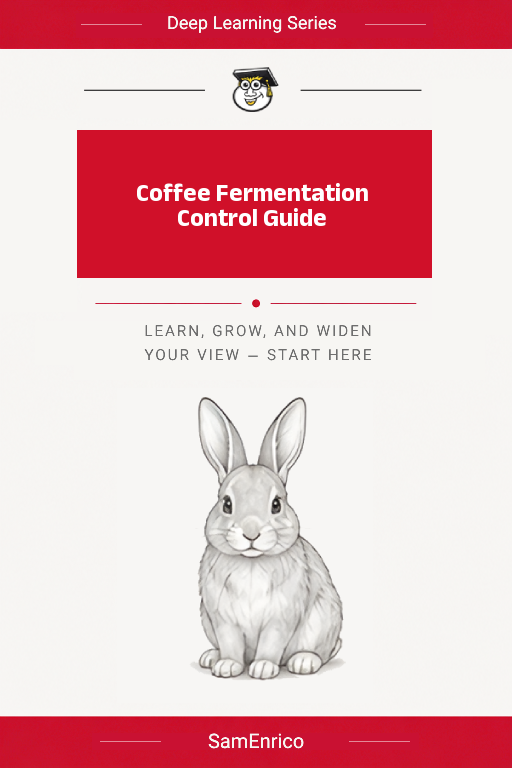
Coffee Fermentation Control Guide eBook
Control coffee fermentation time to 12 to 36 hours
by Covey Jamar
Control coffee fermentation time to 12 to 36 hours for European flavor preference. Over fermented beans produce sour taste rejected by specialty buyers.
Formats
Free sample
Chapter 1: The Invisible Clock--–- In the highlands of Antioquia, Colombia, a third-generation coffee producer named Carlos restructured his entire post-harvest process around a single number: thirty-six. He built stainless steel tanks, installed a thermometer on every unit, and trained his staff to check p H every two hours. He was meticulous. He was scientific. And in his first season under the new system, he lost forty percent of his specialty lots to sour defect.
Carlos had learned how to measure fermentation. He had not yet learned when to stop.This is not a story about bad equipment or lazy workers. It is a story about the most misunderstood variable in coffee production: time. Carlos believed that longer fermentation extracted more flavor. He had read articles about anaerobic “extended ferments” winning competitions.
He had tasted a ninety-point coffee from a neighboring farm that had fermented for forty-eight hours. What Carlos did not understand was that the winning coffee had been fermented at fifteen degrees Celsius at two thousand meters of altitude, while his own fermentation tanks sat at twenty-two degrees Celsius at fourteen hundred meters. The same number of hours produced completely different results. Time, without temperature, is meaningless.This chapter dismantles the single most dangerous myth in specialty coffee fermentation: the belief that fermentation is a “set it and forget it” process. It introduces the concept of the microbial clock—the invisible timer that starts the moment cherries hit the tank and stops only when you intervene.
You will learn why fermentation is not a linear progression from clean to complex to sour, but a U-shaped curve with a narrow peak of profitability. You will meet the microorganisms that do the work and the acids they produce. And you will understand why the difference between a fifty-dollar-per-pound coffee and a two-dollar-per-pound coffee is measured not in days, but in hours.The Myth of “More Fermentation, More Flavor”Walk into any specialty coffee conference today, and you will hear the same buzzwords: anaerobic, carbonic maceration, extended fermentation, co-ferment. These terms have convinced a generation of producers that longer fermentation equals higher quality. The logic seems intuitive—if a little fermentation adds complexity, then more fermentation should add more complexity.The science says otherwise.Fermentation is not a linear progression from “clean” to “complex” to “sour.” It is a U-shaped curve.
On the left side of the curve—under twelve hours—the coffee is incomplete. It tastes vegetal, grassy, like raw peanuts or fresh green pepper. In the middle of the curve—twelve to thirty-six hours—the coffee reaches its peak: bright, sweet, floral, and clean at the lower end; winey, berry-like, and chocolatey at the higher end. On the right side of the curve—beyond thirty-six hours—the coffee falls off a cliff. It becomes sour, acetic, vinegary.
And once it falls, there is no coming back. No amount of drying, roasting, or blending can remove the sour defect.The tragedy of Carlos is not that he did not know how to ferment coffee. It is that he did not know when to stop. He treated fermentation as a process with a fixed duration, assuming that the same thirty-six hours would work for every batch, every temperature, every altitude. He was wrong.
And his forty percent loss rate was the price of that mistake.This chapter is about why time matters—not as a vague recommendation, but as a precise, measurable, controllable variable. It is about the microbes that do the work, the acids they produce, and the invisible clock that starts ticking the moment cherries hit the tank. By the end of this chapter, you will understand why twelve hours is the minimum, why thirty-six hours is the maximum for washed and anaerobic methods, and why the difference between a specialty lot and a reject lot is measured not in days, but in hours.The Cast of Characters: Lactic Acid Bacteria and Wild Yeasts Before you can control fermentation, you need to know who is doing the fermenting. Your tank is not a sterile environment. It is a battlefield, and the victors determine the flavor of your coffee.Two main groups of microorganisms dominate coffee fermentation: lactic acid bacteria and wild yeasts.
They are not enemies—they often work in sequence. But they have different appetites, different byproducts, and different tolerances for time and temperature. Understanding them is the first step toward control.Lactic Acid Bacteria: The Architects of Cleanliness Lactic acid bacteria are the heroes of clean fermentation. They are anaerobic—they prefer environments without oxygen—which is why sealed tanks favor their growth. LAB feed on the sugars in coffee mucilage, primarily glucose, fructose, and sucrose, and produce lactic acid as a byproduct.
Lactic acid is a mild, smooth acid. You have tasted it in yogurt, sourdough bread, and sauerkraut. In coffee, it contributes to body, perceived sweetness, and a clean, rounded mouthfeel.Different strains of LAB produce different effects. Lactobacillus plantarum is the most common in coffee fermentation. It is robust, tolerant of a wide p H range, and produces high levels of lactic acid with minimal off-flavors.
Leuconostoc mesenteroides produces a creamier, buttery character but is more fragile—it dies off as p H drops below 4.0. Pediococcus species are more aggressive, producing higher acidity but also a risk of “ropy” mucilage that becomes thick, stringy, and difficult to wash off.The key insight about LAB is that they work slowly and steadily. They do not spike in activity. They do not produce sudden bursts of heat or acid. They are the tortoise, not the hare.
In a well-controlled fermentation, LAB dominate the first eighteen to twenty-four hours, gradually lowering p H from around 5.5 to 4.0 or 3.8. This slow, steady decline is what creates the clean, sweet, floral profile that European buyers prize.Wild Yeasts: The Double-Edged Sword Wild yeasts are more complicated. They are everywhere—on the surface of cherry skins, in the air, in the water. Some are beneficial. Some are neutral.
Some are disastrous.The most common yeast in coffee fermentation is Saccharomyces cerevisiae—the same yeast used in bread baking and beer brewing. In controlled amounts, S. cerevisiae produces pleasant fruity esters: isoamyl acetate, which smells like banana; ethyl butyrate, which smells like pineapple; and phenylethyl alcohol, which smells like rose. These esters are responsible for the winey, berry, and tropical fruit notes that can appear in the twenty-four-to-thirty-six-hour window.But yeasts are also fast. They reproduce more quickly than LAB, and they can raise the temperature of the fermentation mass by several degrees through their metabolic activity.
If yeasts outcompete LAB—which often happens in open tanks or at higher temperatures—they can drive the p H down too quickly, producing excessive ethanol that becomes food for Acetobacter. The result is not clean fruitiness but a chaotic, unbalanced, sometimes foul fermentation.Other yeasts are simply undesirable. Candida krusei produces butyric acid, which smells like rancid butter or vomit. Pichia anomala produces ethyl acetate, which smells like nail polish remover. Hansenula anomala produces strong solvent-like notes.
These yeasts are not common in healthy, ripe cherry—they tend to appear when overripe or damaged fruit enters the tank, or when tanks are not properly cleaned…
This is the end of the free sample. Get the eBook to keep going. Buy now
About this book
Details
- Author
- Covey Jamar
- Publisher
- SamEnrico
- Language
- English
- Genre
- Non-Fiction, Business Brief, Fermentation
- Released
- 2026-06-01
- Pages (approx.)
- 151
- Available as
- eBook, Audiobook

Read better in the ZLOADR app
Your eBooks on your phone or tablet. Sign in with your SamEnrico account and start reading.
More by Covey Jamar
 Continuing Bonds Grief GuideCovey Jamar$11.99
 Benzo Recovery Meditation GuideCovey Jamar$11.99
 Floating in Dead SeaCovey Jamar$11.99
 Bill Gates WindowsCovey Jamar$11.99
 Phone Distraction OverhaulCovey Jamar$11.99
 Daily Time Blocking WorkbookCovey Jamar$11.99
 CRE Exit Strategy PlanningCovey Jamar$11.99
 Resume Online Portfolio GuideCovey Jamar$11.99
 Nuclear Sub OfficerCovey Jamar$11.99
 The Last Broadcast of the SS ValenciaCovey Jamar$11.99
 The Last Stand of the Honey Badger: A Tale of DefianceCovey Jamar$11.99
 The Blood Alchemist: How an 18th-Century Surgeon Defied DeathCovey Jamar$11.99