
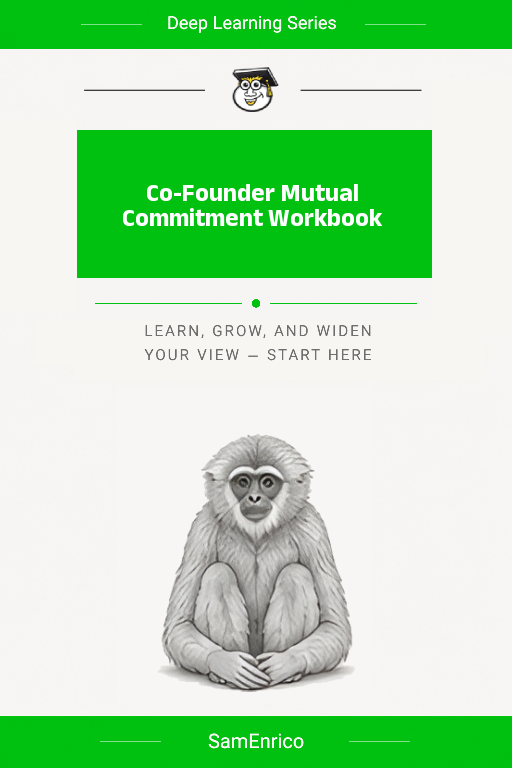
Non-FictionFirst 30 DaysCommitment Testing
Co-Founder Mutual Commitment Workbook eBook
Design trial periods and milestone based commitmen
by Darnell Mi
Design trial periods and milestone based commitments to test dedication before full partnership formation.
Formats
Free sample
Chapter 1: The Engagement Myth--Most co-founder partnerships explode not because someone lacks talent, but because the two partners never explicitly tested their working relationship before signing legal papers. The romantic narrative—“we met at a hackathon and just clicked”—ignores the brutal reality of 3 a.m. deadlines and empty bank accounts.I learned this the hard way. My first co-founder and I were perfect on paper. He was the technical genius; I was the salesperson.
We met at a startup weekend, built a prototype in 48 hours, and decided to start a company. We did not test anything. We did not discuss what happened if one of us stopped working. We did not ask the hard questions about money, risk, or ego. Six months later, I was doing 80% of the work, he was taking 50% of the equity, and we were not speaking.
The company died. The friendship died with it. The lawyers got paid. We did not.That experience taught me something that no business school class could: a successful co-founder relationship is not found. It is designed.
You do not discover your perfect partner by luck. You build them through a deliberate, structured trial period with explicit rules—just like a product beta test. Call it a Structured Courtship. Call it a pre-nup for the dating phase. Call it whatever you want.
Just do not skip it.This chapter is about avoiding my mistake. It is about identifying hidden dealbreakers before Week 1 of your trial. It is about distinguishing between skill fit (can you code? can you sell?) and operational fit (do you work at the same speed? same hours?
same definition of “emergency”?). And it is about running a systematic audit that reveals mismatches before they become lawsuits.The Two Kinds of Fit Most co-founders focus exclusively on skill fit. They ask: “Can you build the product? Can you sell it? Can you design it?” These are important questions.
But they are not the only questions. In fact, they are not even the most important questions.Operational fit is what actually kills partnerships. Operational fit answers: “Do we work at the same pace? Do we have the same tolerance for risk? Do we need the same amount of credit?
Do we recover from stress at the same speed? Can we fight without destroying each other?”Skill fit gets you to the starting line. Operational fit gets you to the finish line. You can learn new skills. You cannot learn to be a different person under pressure.I have seen brilliant teams fail because one partner needed public recognition and the other did not care—until the first press article appeared and only one name was mentioned.
I have seen talented founders destroy each other because one needed 60 hours a week to feel committed and the other needed 30. Neither was wrong. They were just different. And they never tested those differences before they signed the paperwork.The Trojan Horse Audit Most co-founders discover their dealbreakers too late because they never ask the ugly questions before the stress hits. The Trojan Horse Audit is a 30-question checklist designed to surface hidden conflicts about money, ego, and risk before you commit a single line of code or sign a single contract.The name is deliberate.
A Trojan Horse looks like a gift from the outside, but it carries destruction inside. Your co-founder relationship can look perfect on the surface while hiding mismatches that will destroy you both. The audit opens the horse and lets you see what is inside.The questions are grouped into three categories. Each partner completes the audit separately, without discussing answers until both are finished. Then you compare.
The goal is not to find a “right” answer. The goal is to see where you diverge.Category 1: Risk Tolerance These questions reveal how each partner handles uncertainty, ambiguity, and potential loss. Risk tolerance is deeply personal and nearly impossible to change. A partner who is comfortable with high risk and a partner who needs safety will fight about every major decision.Question 1: On a scale of 1 to 5, how comfortable are you with the possibility of losing all the money we invest? (1 = I need to protect my capital at all costs.
5 = I am prepared to lose everything.)Question 2: Would you mortgage your house to keep the company alive? (Yes / No / Maybe)Question 3: How long can you survive with zero salary? (Less than 3 months / 3-6 months / 6-12 months / More than 12 months)Question 4: If we had to completely change our product idea six months in, would you stay or leave? (Definitely leave / Probably leave / Unsure / Probably stay / Definitely stay)Question 5: How much of your personal savings are you willing to invest? (None / Less than 10% / 10-25% / 25-50% / More than 50%)Question 6: On a scale of 1 to 5, how much do you need a guaranteed outcome from this venture?
(1 = I need safety and predictability. 5 = I am here for the journey regardless of outcome.)Question 7: Would you take a loan from family or friends to keep the company going? (Yes / No / Maybe)Question 8: How many months of runway do we need before you start to panic? (1-3 months / 3-6 months / 6-12 months / More than 12 months / I never panic)Question 9: If an investor offered us money but wanted to replace you as CEO, would you accept? (Yes / No / Depends on the terms)Question 10: On a scale of 1 to 5, how important is it that we maintain full control of the company?
(1 = I would trade control for resources. 5 = Control is non-negotiable.)Category 2: Income Needs These questions reveal financial pressure that affects decision-making. A partner who needs 10,000permonthtosurviveandapartnerwhocanliveon10,000 per month to survive and a partner who can live on 10,000permonthtosurviveandapartnerwhocanliveon2,000 per month will fight about every financial decision. Not because one is greedy, but because their survival thresholds are different.Question 11: What is your minimum monthly salary requirement to stay in the business full-time? (Write a number.
Be honest. No judgment.)Question 12: Do you have savings that can cover your expenses for six months? (Yes / No / Partially)Question 13: Do you have a partner or spouse who is currently working? (Yes, full-time / Yes, part-time / No / Prefer not to say)Question 14: Do you have children or other dependents who rely on your income? (Yes / No)Question 15: If we had to choose between paying ourselves and investing in growth, which do you choose?
(Pay ourselves / Invest in growth / Split the difference)Question 16: Would you take a part-time job to cover your expenses while we build the company? (Yes / No / Maybe)Question 17: On a scale of 1 to 5, how stressed are you by the idea of not knowing when your next paycheck will come? (1 = Not stressed at all. 5 = Extremely stressed.)Question 18: Would you be willing to move to a cheaper city to extend our runway? (Yes / No / Maybe)Question 19: Do you have debt payments that require a minimum monthly income?
(Yes / No / Prefer not to say)Question 20: On a scale of 1 to 5, how important is it that we both take the same salary? (1 = I do not care about equality. 5 = Equal salary is essential for fairness.)Category 3: Ego Triggers These questions reveal how each partner handles criticism, credit, and power. Ego is the most common unspoken dealbreaker. No one admits to having an ego.
Everyone has one.Question 21: On a scale of 1 to 5, how do you react when your idea is rejected…
This is the end of the free sample. Get the eBook to keep going. Buy now
About this book
Details
- Author
- Darnell Mi
- Publisher
- SamEnrico
- Language
- English
- Genre
- Non-Fiction, First 30 Days, Commitment Testing
- Released
- 2026-05-29
- Pages (approx.)
- 89
- Available as
- eBook, Audiobook

Read better in the ZLOADR app
Your eBooks on your phone or tablet. Sign in with your SamEnrico account and start reading.
More by Darnell Mi
 Anger Restructuring MythsDarnell Mi$11.99
 Packaging Innovation GuideDarnell Mi$11.99
 Blue Zone Dinner GuideDarnell Mi$11.99
 EDS Joint Pain PracticeDarnell Mi$11.99
 Support Group for Baby LossDarnell Mi$11.99
 PPC for WholesalersDarnell Mi$11.99
 Overemployment Risk GuideDarnell Mi$11.99
 Gaming and RelationshipsDarnell Mi$11.99
 The Day the Internet Almost Broke: The Great Cloudflare Outage of 2020Darnell Mi$11.99
 Gallipoli: The Anzac Dream ShatteredDarnell Mi$11.99
 A Collector's Handbook to the Alfa Romeo Alfasud TiDarnell Mi$11.99
 How to Produce Reptile and Amphibian FoodDarnell Mi$11.99
You may also like
 Hong Kong Handover 1997Dunn Johnnie$11.99
 Zumba For Postnatal Recovery CourseNeal Christian$11.99
 Zumba for BeginnersLadner Nikia$11.99
 YouTube Comment Mining GuideHumes Pandora$12.99
 Worry Box MeditationCarlin Rudy$11.99
 Workplace Stress MeditationNguyen Lynn$11.99
 Workplace Stress and Sleep RepairHawley Ivory$11.99
 Workplace Perfectionism CureDelaney Jeffry$11.99
 Workplace Injustice Anger GuideWallen Isabelle$11.99
 Work Addiction and Burnout LinkGreenwood Ester$11.99
 Women in Yoga and WellnessBeattie Galina$11.99
 Women in Stand Up ComedyChun Evangeline$11.99