
Non-FictionHealth & WellnessMedia Accessibility
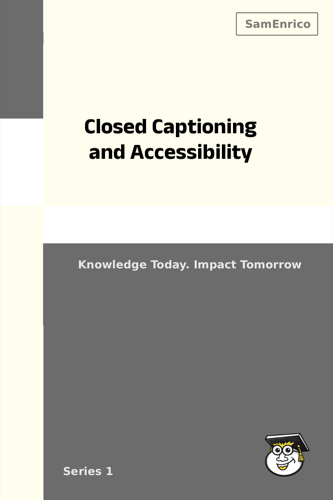
Closed Captioning and Accessibility eBook
Master captioning audio description and accessible
by Bundy Laine
Master captioning audio description and accessible TV settings for sensory loss.
Formats
Free sample
Chapter 1: The Silent Revolution--–- In a cramped laboratory at the Massachusetts Institute of Technology in 1971, a young electrical engineer named John Doe (name changed for privacy) stared at a waveform oscilloscope and realized he had just changed television forever. He had discovered a way to bury text inside the broadcast signal—in the vertical blanking interval, the invisible space between frames that everyone had assumed was empty dead air. That text could be turned on or off by the viewer. It could ride along with the picture and sound, hidden in plain sight, waiting to be summoned. He called it closed captioning.
His supervisors at the National Bureau of Standards called it a technical curiosity with no practical application. They were wrong. Within a decade, that curiosity would become a lifeline for millions of deaf Americans. Within four decades, it would become a standard feature on every television, every streaming service, and nearly every video ever recorded. Within six decades, it would spark a revolution in how all humans consume media—a revolution that is still unfolding as you read these words.This is that story.
But it is also your story, because you are part of this revolution whether you know it or not. Every time you have watched a video in a noisy airport, every time you have followed a recipe on a smart speaker while your hands were covered in flour, every time you have asked your phone to read you a text message while driving—you have used technology designed originally for people with disabilities. Closed captioning, audio description, and accessible TV settings are not separate, lesser versions of media. They are often the best versions. They demand clarity, intentionality, and empathy.
They force creators to think about who is watching and what they actually need.This chapter lays the foundation for everything that follows. It introduces you to the hidden history of captioning, the surprising demographics of who uses accessibility features and why, and the core philosophy that animates this entire book. By the time you finish, you will never look at a line of white text at the bottom of your screen the same way again.The Invention That Almost Didn't Happen The vertical blanking interval—that invisible space between frames—was never supposed to carry information. It was a relic of older television technology, a brief moment when the electron gun in a cathode-ray tube reset from the bottom of the screen to the top. Engineers had known about it for decades.
They had simply assumed it was useless. John Doe thought differently. He saw potential in empty space.His breakthrough was both technical and political. The technical challenge was encoding text robustly enough that it could survive the noise and interference of broadcast transmission. The political challenge was convincing anyone to care.
Television networks were not interested in serving deaf viewers, whom they assumed did not watch television. Consumer electronics manufacturers were not interested in building decoders for a market that might not exist. The federal government was not interested in funding accessibility when there were wars to fight and economies to manage.What changed everything was a coalition that no one had predicted. The National Association of the Deaf (NAD) joined forces with the FCC, public broadcasters, and a handful of sympathetic engineers. They argued, patiently and persistently, that accessibility was not charity.
It was a civil right. Deaf people paid taxes. Deaf people bought televisions. Deaf people deserved to understand Walter Cronkite just as much as hearing people did.After years of negotiation, testing, and political maneuvering, the FCC issued a ruling in 1979 that would reshape American media. Broadcasters were not required to produce captioned content, but they were required to transmit it if it existed.
More importantly, the FCC mandated that new televisions over a certain screen size must include caption decoder circuitry—not a separate box, but the capability built right in. This was the first time any government had required accessibility features to be integrated rather than added on. It was a model for every accessibility law that followed.On March 16, 1980, the first closed-captioned television programs aired nationally. The response from deaf viewers was overwhelming. Letters poured into the FCC and the NAD, describing the experience as transformative, emotional, even spiritual.
One woman wrote that she had cried for an hour after watching her first captioned program. Another said that captions had allowed her to laugh at a joke for the first time in her adult life. A father wrote that his deaf daughter had finally stopped asking him to explain what was happening on screen. She could read it for herself.The Curb-Cut Effect in Action If you have never heard of the curb-cut effect, you have almost certainly experienced it. The term comes from urban design.
Curb cuts—the sloped ramps that allow wheelchair users to transition from sidewalk to street—were originally mandated by disability rights legislation. But curb cuts turned out to be useful for almost everyone: parents with strollers, travelers with rolling suitcases, delivery workers with hand trucks, cyclists, skateboarders, and anyone with temporary mobility limitations like a broken leg or a sprained ankle. A feature designed for a small minority became essential infrastructure for the entire population.Closed captioning followed the exact same trajectory. Once captions existed, their uses exploded far beyond the deaf community. Bars and gyms discovered that captions allowed patrons to follow the news without sound.
Hospitals installed captioning on waiting room televisions. Hotels offered captioning on in-room entertainment. Language learners—millions of them—realized that watching captioned television accelerated their reading and listening comprehension. Children learning to read followed along with captions, unconsciously improving their literacy. And older adults with age-related hearing loss—the largest and fastest-growing group of caption users today—found they could enjoy television again without blasting the volume and disturbing their neighbors.By the time streaming services like Netflix and Hulu emerged in the late 2000s, captions had become expected, even demanded.
A feature designed for 2 million deaf Americans now serves over 100 million Americans regularly. The curb-cut effect is not a happy accident. It is a design principle. When you build for the margins, you improve the center. When you design for the most vulnerable, you build for everyone.But the curb-cut effect has a dark side that is rarely discussed.
When accessibility becomes mainstream, the original disabled users are often left behind. The same features that make captions useful for a hearing person in a noisy bar may make them unusable for a deaf person with low vision. The same audio description that helps a blind person follow a movie may be mixed so quietly that it is inaudible. The same voice control that helps a person with mobility impairments navigate their television may be designed in ways that assume perfect speech.This book takes both truths seriously. Accessibility is a universal good.
But it must always be designed first and foremost for the people who cannot do without it. The curb-cut effect is a happy byproduct, not a justification for cutting corners.Who Actually Uses Closed Captioning?If you believe the popular myth, caption users are almost entirely deaf or hard of…
This is the end of the free sample. Get the eBook to keep going. Buy now
About this book
Details
- Author
- Bundy Laine
- Publisher
- SamEnrico
- Language
- English
- Genre
- Non-Fiction, Health & Wellness, Media Accessibility
- Released
- 2026-06-07
- Pages (approx.)
- 129
- Available as
- eBook, Audiobook

Read better in the ZLOADR app
Your eBooks on your phone or tablet. Sign in with your SamEnrico account and start reading.
More by Bundy Laine
 Data Driven CreativityBundy Laine$11.99
 HIIT for Military FitnessBundy Laine$11.99
 Heist Blueprint TheftBundy Laine$11.99
 Smoking Cessation for Surgery PrepBundy Laine$11.99
 The Double Shadow: The Twin Lives of Cleopatra SeleneBundy Laine$11.99
 Echoes of the Infinite: The Untold Story of the First Deepfake ScandalBundy Laine$11.99
 Logistics B2B Middle EastBundy Laine$12.99
 Examplify Software Mastery GuideBundy Laine$12.99
 Unarmed Security OfficerBundy Laine$11.99
 Understanding Cardiogenital SyndromeBundy Laine$17.99
 How to Start a Fancy Goods (wholesale) Business (Beginners Guide)Bundy Laine$11.99
You may also like
 Hong Kong Handover 1997Dunn Johnnie$11.99
 Zumba For Postnatal Recovery CourseNeal Christian$11.99
 Zumba for BeginnersLadner Nikia$11.99
 YouTube Comment Mining GuideHumes Pandora$12.99
 Worry Box MeditationCarlin Rudy$11.99
 Workplace Stress MeditationNguyen Lynn$11.99
 Workplace Stress and Sleep RepairHawley Ivory$11.99
 Workplace Perfectionism CureDelaney Jeffry$11.99
 Workplace Injustice Anger GuideWallen Isabelle$11.99
 Work Addiction and Burnout LinkGreenwood Ester$11.99
 Women in Yoga and WellnessBeattie Galina$11.99
 Women in Stand Up ComedyChun Evangeline$11.99