
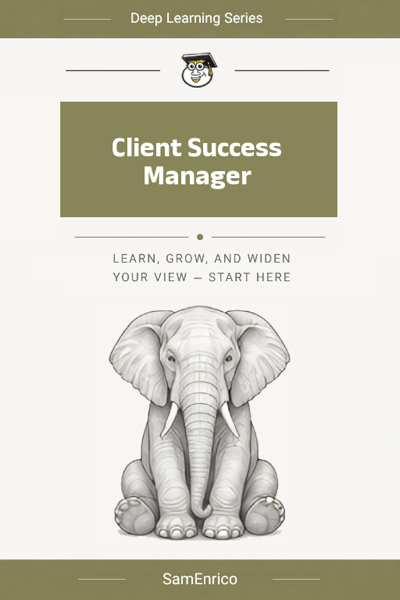
Non-FictionInformativeEducational
Client Success Manager eBook
A Coursebook on Client Success Manager
A Coursebook on Client Success Manager
Formats
Free sample
Chapter 1: The Churn Crisis...--Most Client Success Managers are hired to fail. That is not an opinion. It is a mathematical certainty baked into the way nearly every software company structures its retention function. You were probably hired with a title that includes the word “success,” a quota that includes the word “retention,” and a set of daily responsibilities that look suspiciously like customer support with a smile. If that description stings, good.
It should. Because the first step toward becoming a truly indispensable Client Success Manager is recognizing that everything you thought you knew about the job is probably wrong.Let us start with a simple question that most CSMs cannot answer: What is your actual job? If you said “keep customers happy,” you have already lost. Happiness is a feeling. Feelings change with the weather, with the CEO’s mood, with a single buggy software release.
You cannot build a multi-million dollar retention strategy on something as ephemeral as happiness. If you said “reduce churn,” you are closer but still missing the point. Churn is an outcome, not a job description. Reducing churn is like saying a surgeon’s job is to “reduce mortality.” Technically true. Completely useless as a daily guide for action.The correct answer is this: Your job is to close the gap between what your client bought and what your client actually uses.
That gap has a name. It is called the Consumption Gap, and it is the single greatest threat to recurring revenue in the history of modern business.The Birth of a Discipline: Why CSM Exists at All To understand what you should be doing, you first need to understand why your role exists. Client Success Management as a formal discipline emerged in the early 2010s, pioneered by companies like Salesforce, Hub Spot, and Gainsight. But the forces that created it were set in motion decades earlier with the rise of software as a service.Before Saa S, software was sold as a product. A company bought Oracle, Microsoft Office, or SAP, installed it on their own servers, and that was it.
The software vendor got paid once. If the customer never used the software, that was the customer’s problem. The vendor had already collected the check. This one-time transaction model created a perverse incentive: software companies were financially rewarded for selling software, not for making sure it worked.The subscription model changed everything. When customers pay monthly or annually, they can stop paying at any time.
The vendor only gets paid as long as the customer continues to derive value. This sounds fair, even virtuous, until you do the math on what happens when customers leave.The Churn Crisis: Math That Will Keep You Awake Let us run the numbers on a typical Saa S company. Imagine a business with 100 customers, each paying 10,000peryear.Thatis10,000 per year. That is 10,000peryear.Thatis1 million in annual recurring revenue, or ARR. Now imagine that this company loses 5 percent of its customers every month.
Not a catastrophic failure rate. Just five out of one hundred customers decide not to renew each month.At a 5 percent monthly churn rate, how many customers remain after one year? The answer is roughly 54. That is nearly half the customer base gone. What happens to revenue?
It falls from 1millionto1 million to 1millionto540,000. But the company still has the same fixed costs: salaries, servers, rent, marketing. To return to $1 million in revenue, the company must acquire 46 new customers just to get back to where they started. And acquiring new customers is expensive. Far more expensive than keeping existing ones.This is the Churn Crisis.
It is the economic reality that created your job. And it gets worse.Research from the Harvard Business Review and multiple venture capital firms has consistently shown that increasing customer retention by just 5 percent increases profits by 25 to 95 percent. The exact number depends on your industry, but the direction is always the same: retention is the highest-leverage lever in the entire business. A company with 120 percent net revenue retention (NRR) is growing even if it never signs a single new logo. A company with 80 percent NRR is dying slowly, bleeding revenue faster than it can be replaced.Here is the part that most CSMs never hear from their managers: your company hired you because the math of the Churn Crisis is terrifying.
They may not say it. They may frame your job in terms of “customer delight” or “brand advocacy.” But beneath all the corporate language, there is cold, hard arithmetic. Every customer who leaves costs the company not just that month’s revenue, but the entire lifetime value of that customer. And the company cannot afford to lose you.The Consumption Gap: Your True Enemy Now we arrive at the central concept of this entire book. The Consumption Gap is the distance between what a customer purchased and what they actually use.
It is the shadow that falls between the sales contract and the login log. And it is the primary driver of churn.Consider a typical software purchase. A mid-sized company buys 100 seats of your platform for $50,000 per year. The sales team celebrated. The contract was signed.
The champagne was opened. But then something happened. Or rather, nothing happened. The IT department set up the accounts. The marketing team attended a training webinar.
And then… silence. Three months later, only 30 of the 100 seats have logged in more than once. Only 10 seats are active weekly. The other 90 seats are ghosts—users who exist on paper but have never experienced the value your product promises.What happens at the renewal date? The customer looks at their usage report.
They see that 70 percent of their purchase is sitting idle. They ask themselves a simple question: Why am I paying for something my team does not use? The answer is obvious. They should not. They will not renew at the same price.
They will downgrade from 100 seats to 30. Or they will leave entirely, convinced that your product does not deliver value.This is the Consumption Gap in action. The customer bought a solution to a problem. But because they did not use the solution, the problem remained unsolved. And they blame you.The Consumption Gap has three root causes.
First, the product may be too complex. If users cannot figure out how to get value without spending hours in training, they will give up. Second, the organization may lack internal discipline. A champion bought the software, but that champion did not have the authority or willpower to force their team to adopt it. Third, the CSM may have disappeared.
Many companies assign a CSM only after the contract is signed, and by then, the Consumption Gap has already started growing.Your job, as a Client Success Manager, is to close this gap. Not to make customers happy. Not to send birthday cards. Not to conduct satisfaction surveys. To close the Consumption Gap.
That is the economic engine of your role. Everything else is decoration.The Great Confusion: Support vs. Success vs. Sales vs. Account Management Before we go any further, we need to draw some hard lines.
Most organizations blur the boundaries between four roles, and that blurring is the reason most CSMs burn out or underperform.Customer…
This is the end of the free sample. Get the eBook to keep going. Buy now
About this book
Details
- Author
- Simms Karlene
- Publisher
- SamEnrico
- Language
- English
- Genre
- Non-Fiction, Informative, Educational
- Released
- 2026-05-11
- Pages (approx.)
- 156
- Available as
- eBook, Audiobook

Read better in the ZLOADR app
Your eBooks on your phone or tablet. Sign in with your SamEnrico account and start reading.
More by Simms Karlene
 Work Addiction Prevention For StudentsSimms Karlene$11.99
 The Direct Mail FunnelSimms Karlene$11.99
 Burnout Organizational ChangeSimms Karlene$11.99
 Walter Hagen Showman Life GuideSimms Karlene$11.99
 Future Catastrophizing Anger LinkSimms Karlene$11.99
 The Last Whisper of the Atlantic: The Unsinkable Truth of the SS AmericaSimms Karlene$11.99
 Frozen Fury: Antarctica's Hidden Volcanoes and the Scientists Who DareSimms Karlene$11.99
 Understanding Chronic Lymphocytic LeukemiaSimms Karlene$17.99
 Wiki JS Confluence AlternativeSimms Karlene$12.99
 PLR Product Adaptation GuideSimms Karlene$12.99
 How to Start a Construction of Workshops Business (Beginners Guide)Simms Karlene$11.99
You may also like
 Hong Kong Handover 1997Dunn Johnnie$11.99
 Zumba For Postnatal Recovery CourseNeal Christian$11.99
 Zumba for BeginnersLadner Nikia$11.99
 YouTube Comment Mining GuideHumes Pandora$12.99
 Worry Box MeditationCarlin Rudy$11.99
 Workplace Stress MeditationNguyen Lynn$11.99
 Workplace Stress and Sleep RepairHawley Ivory$11.99
 Workplace Perfectionism CureDelaney Jeffry$11.99
 Workplace Injustice Anger GuideWallen Isabelle$11.99
 Work Addiction and Burnout LinkGreenwood Ester$11.99
 Women in Yoga and WellnessBeattie Galina$11.99
 Women in Stand Up ComedyChun Evangeline$11.99