
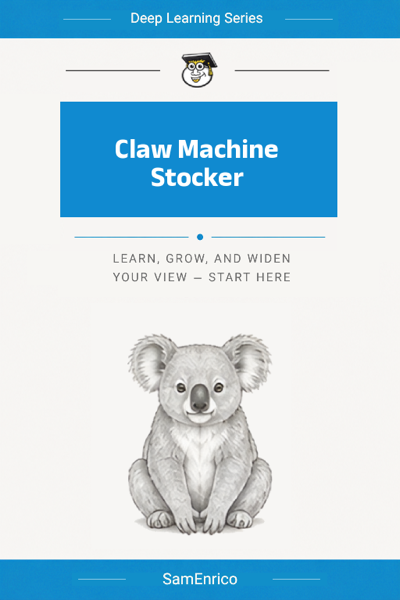
Non-FictionInformativeEducational
Claw Machine Stocker eBook
A Coursebook on Claw Machine Stocker
A Coursebook on Claw Machine Stocker
Formats
Free sample
Chapter 1: The Quarter That Changed Everything--–- I was nineteen years old, sitting on a cracked plastic chair in a laundromat in Tulsa, Oklahoma, watching a furious mother shove her eighth quarter into a claw machine. Her toddler was screaming. Her laundry was wrinkling. And she had just spent two dollars trying to win a seventy-five-cent plush octopus that she could have bought at the dollar store next door. The claw grabbed.
The octopus lifted. Then it slipped. She cursed, kicked the machine, and walked away empty-handed. The octopus sat there, mocking her.I had exactly one quarter left in my pocket. My minimum wage job paid $7.25 an hour.
I was ninety pounds overweight, living in my parents' basement, and pretty sure I was failing at life. But in that moment, I realized something that changed everything.While that mother lost her two dollars, the claw machine earned two dollars. In the thirty minutes I had been sitting there, that one machine had taken in 11.50.Thatwas11.50. That was 11.50.Thatwas23.00 an hour. I was making $7.25.
The machine was making three times my hourly wage, and it didn't complain, didn't take breaks, didn't ask for a raise.I walked over to the machine. It had maybe thirty plush toys inside — octopuses, bears, a sad-looking Sponge Bob. Some were faded from sun exposure. The glass was smudged. The claw looked flimsy.
It was, by any objective measure, a piece of junk. And it was printing money.I deposited my last quarter. I lost, of course. But I left that laundromat with something more valuable than a stuffed octopus. I left with a question: Could I own one of these machines?
Could I buy a claw machine, find a place to put it, fill it with better prizes, and let it make money while I slept?That question launched a five-year journey that took me from a broke college student to the owner of forty-five claw machines across twelve locations, generating a six-figure annual profit. I am not a genius. I am not a technician. I never inherited money or knew anyone in the arcade business. I just learned the rules of the game — the psychology, the math, the sourcing, the legal traps, and the scaling strategies — and I played it better than almost everyone else.This book is not a theoretical textbook.
It is the playbook I wish I had when I started. Whether you have 500or500 or 500or50,000, whether you want one machine as a side hustle or a fleet as your primary income, the principles are the same. And they work.The Dirty Secret of the Arcade Floor Most people walk past claw machines without a second glance. They see a game for children, a coin eater, a rigged contraption designed to steal quarters. They are wrong about the rigged part — mostly wrong, anyway — but they are right about one thing: claw machines are coin eaters.
They devour quarters, dollar coins, tokens, and bills with an appetite that would impress a Las Vegas slot machine.Here is the dirty secret that arcade owners don't want you to know. Claw machines are the most profitable asset on any arcade floor. Not the flashy racing games with hydraulic seats. Not the ticket redemption games that spit out rolls of paper tickets. Not the air hockey tables that require maintenance every other week.
The humble, overlooked, dimly lit claw machine.Let me give you the numbers. A typical arcade video game costs 5,000to5,000 to 5,000to15,000. It generates maybe 100to100 to 100to300 per week, with a gross profit margin of 20 to 40 percent after revenue sharing with the venue. A ticket redemption game costs 8,000to8,000 to 8,000to20,000. It generates 200to200 to 200to500 per week, with a margin of 50 to 60 percent.
A claw machine costs 1,500to1,500 to 1,500to4,000 new, or as little as 300usedon Facebook Marketplace.Itgenerates300 used on Facebook Marketplace. It generates 300usedon Facebook Marketplace.Itgenerates150 to $600 per week, with a gross profit margin of 80 to 90 percent.Yes, you read that correctly. Eighty to ninety percent. For every dollar that goes into a claw machine, eighty to ninety cents comes out as profit before expenses like rent, electricity, and labor. The only cost of goods sold is the prizes.
And prizes can be sourced for pennies on the dollar.Let me walk you through a real example from my first machine. I paid 400forausedstandardsingleclawmachinefromaclosed−downpizzeria.Iputitinalaundromat—myfirstlocation,thesameone Ihadbeensittingin.Theplaypricewasfiftycents.Theprizesweremedium−sizedplushtoysthat Iboughtfor400 for a used standard single claw machine from a closed-down pizzeria. I put it in a laundromat — my first location, the same one I had been sitting in. The play price was fifty cents. The prizes were medium-sized plush toys that I bought for 400forausedstandardsingleclawmachinefromaclosed−downpizzeria.Iputitinalaundromat—myfirstlocation,thesameone Ihadbeensittingin.Theplaypricewasfiftycents.Theprizesweremedium−sizedplushtoysthat Iboughtfor1.50 each from a domestic distributor.
My win rate was set to one win every twelve plays, which was the industry standard for plush at that price point.Do the math. Twelve plays at fifty cents each is six dollars in revenue. One prize costs me 1.50.Mygrossprofitis1.50. My gross profit is 1.50.Mygrossprofitis4.50 per twelve plays. That is a 75 percent gross margin.
And that was my novice operation. As I got better at sourcing — switching to overseas factories, buying in bulk, negotiating better shipping rates — my prize cost dropped to eighty cents per plush. Suddenly, twelve plays generated 6.00inrevenue,minus6.00 in revenue, minus 6.00inrevenue,minus0.80 in prize cost, for a gross profit of $5.20. That is an 87 percent gross margin.That first machine, in that dingy laundromat, earned an average of 220perweek.Mygrossprofitwas220 per week. My gross profit was 220perweek.Mygrossprofitwas190 per week.
Expenses were minimal: electricity maybe 5perweek,renttothelaundromatownerwas20percentofrevenue,or5 per week, rent to the laundromat owner was 20 percent of revenue, or 5perweek,renttothelaundromatownerwas20percentofrevenue,or44 per week. Net profit: roughly $140 per week. From one machine. In a laundromat. With no employees, no marketing, no website.That machine paid for itself in three weeks.Redemption Games vs.
Amusement Games To understand why claw machines are so profitable, you need to understand the two main categories of arcade games: redemption games and amusement games.Amusement games are pure play-for-fun. You put in your quarter or token, you play for a minute or two, and when you lose — as you almost always do — you walk away with nothing but the experience. Pac-Man. Street Fighter. The racing game with the moving seat.
These games have no payout, no prize, no tangible reward. Their profit margin is high because there is no cost of goods sold, but their revenue per play is limited by the fact that players quickly realize they are getting nothing for their money. The average player will spend 2to2 to 2to5 on an amusement game before walking away. The session length is short.Redemption games are different. You play, you accumulate tickets or points, and you redeem those tickets for prizes at a counter.
Ski-ball. Whack-a-mole. The coin pusher with the spinning wheel. Redemption games have a cost of goods sold — the prizes at the counter — but that cost is typically low, around 10 to 20 percent of revenue. The problem with traditional redemption games is that the connection between play and reward is delayed.
You play for ten minutes, you get thirty tickets, and then you have to wait in line at the redemption…
This is the end of the free sample. Get the eBook to keep going. Buy now
About this book
Details
- Author
- Coppola Mickie
- Publisher
- SamEnrico
- Language
- English
- Genre
- Non-Fiction, Informative, Educational
- Released
- 2026-05-11
- Pages (approx.)
- 128
- Available as
- eBook, Audiobook

Read better in the ZLOADR app
Your eBooks on your phone or tablet. Sign in with your SamEnrico account and start reading.
More by Coppola Mickie
 EQ Grief Support GuideCoppola Mickie$11.99
 Workaholism In Solo EntrepreneursCoppola Mickie$11.99
 The 5 Whys Anger MethodCoppola Mickie$11.99
 SAS Counter Terror OperatorCoppola Mickie$11.99
 Introvert Friendly Team CreativityCoppola Mickie$11.99
 The Silk Road's Forgotten Cartographer: Xuanzang's Epic Journey to the Heart of AsiaCoppola Mickie$11.99
 Anansi and the Weaver’s Vow: A Spider’s Web of Love and DeceitCoppola Mickie$11.99
 Monthly Runway Tracker WorkbookCoppola Mickie$12.99
 Business English to ChineseCoppola Mickie$12.99
 Understanding Furlong–kurczynski–hennessy SyndromeCoppola Mickie$17.99
 How to Start a Software Publishing BusinessCoppola Mickie$11.99
You may also like
 Hong Kong Handover 1997Dunn Johnnie$11.99
 Zumba For Postnatal Recovery CourseNeal Christian$11.99
 Zumba for BeginnersLadner Nikia$11.99
 YouTube Comment Mining GuideHumes Pandora$12.99
 Worry Box MeditationCarlin Rudy$11.99
 Workplace Stress MeditationNguyen Lynn$11.99
 Workplace Stress and Sleep RepairHawley Ivory$11.99
 Workplace Perfectionism CureDelaney Jeffry$11.99
 Workplace Injustice Anger GuideWallen Isabelle$11.99
 Work Addiction and Burnout LinkGreenwood Ester$11.99
 Women in Yoga and WellnessBeattie Galina$11.99
 Women in Stand Up ComedyChun Evangeline$11.99