
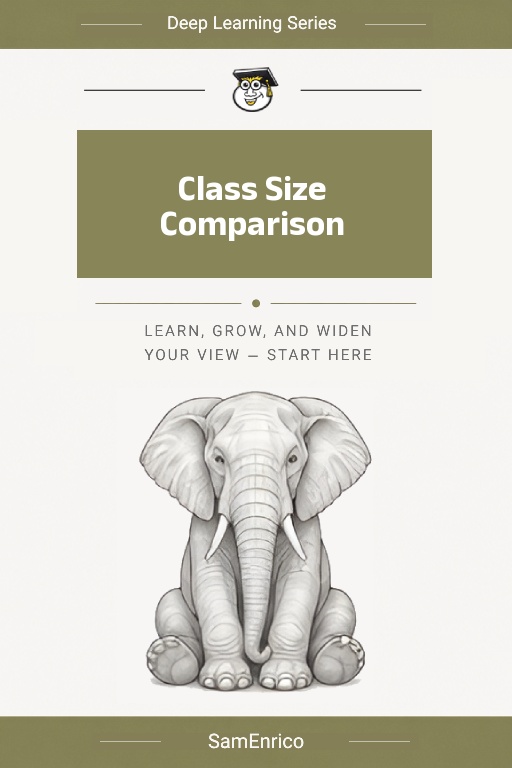
Non-FictionStudent's ShortcutLearning Environment
Class Size Comparison eBook
Compare lecture sizes, seminar participation, and
by Paine Bethel
Compare lecture sizes, seminar participation, and tutorial groups across UK, US, and Australia.
Formats
Free sample
Chapter 1: The Empty Chair--The lecture hall holds three hundred and forty-seven seats. On the first day of the semester, every one of them is full. By the fourth week, one chair sits empty. Then another. Then forty.
By midterms, the empty chairs outnumber the occupied ones. The professor stands at the podium, delivering the same lecture to a scattering of students who have learned that attendance is not graded, that the slides will be posted online, and that the examination will test only what is in the textbook. The empty chairs tell a story not about laziness but about design. The room was built for transmission, not engagement. The pedagogy assumed that bodies in seats equal learning.
And the students, silently and rationally, decided otherwise.This is not a failure of students. It is a failure of scale.Class size is not merely a number on a registration form. It is a hidden curriculum—a set of unspoken rules about what matters, who speaks, how you are judged, and whether you belong. Walk into a lecture hall of three hundred students, and you learn quickly that your voice does not matter. Walk into a seminar of fifteen, and you learn that silence is a failing grade.
Walk into a British tutorial with one other student, and you learn that your every argument will be tested to destruction. These are not different settings for the same activity. They are different activities entirely.This chapter begins where the book begins: with the largest and most common format across the United States, the United Kingdom, and Australia. The lecture hall is the great equalizer. It is also the great eraser.
Understanding how to survive—and occasionally thrive—in a room of three hundred strangers is the first step to understanding how class size shapes everything that follows.Three Hundred Strangers Let us start with the numbers, because the numbers are the first lie. A university will tell you that your class has one hundred and fifty students. That is the official enrollment cap. But on the first day, two hundred students appear—waitlisted students hoping to squeeze in, auditors, students from other sections whose preferred time was full. By the second week, the number stabilizes near the cap.
But the cap itself tells you nothing about the experience. A lecture of one hundred fifty students in a tiered auditorium designed for two hundred feels spacious. The same number in a flat classroom designed for eighty feels like a fire hazard.The United States specializes in the mega-lecture. Introductory courses in psychology, biology, economics, and political science regularly exceed three hundred students at large public universities. At the University of Texas at Austin, introductory psychology enrolls over fifteen hundred students in a single course, split across multiple lecture sections but coordinated by a single professor.
At Arizona State University, the largest introductory biology course enrolls over one thousand students per semester, with lectures held in a converted movie theater. These numbers are not anomalies. They are the business model. A single professor teaching a three-hundred-student lecture generates roughly one million dollars in tuition revenue for a semester-long course. Pay that professor one hundred fifty thousand dollars, hire two graduate teaching assistants at twenty thousand dollars each, and the university keeps over eight hundred thousand dollars from a single room.
The empty chairs are profitable.The United Kingdom operates on a different logic. Lectures there rarely exceed one hundred fifty students, and the typical number is closer to fifty to one hundred. This is not generosity. It is efficiency of a different kind. The UK system separates the lecture from the tutorial.
The lecture delivers content efficiently to a moderately sized group. The tutorial—typically one to three students—does the work of deep learning. Because the tutorial is so labor-intensive, the lecture can afford to be smaller. There is no need for a three-hundred-person lecture when the real teaching happens elsewhere. The lecture is the appetizer, not the meal.Australia occupies a middle position that confuses everyone.
Australian lectures typically range from one hundred to two hundred students. But unlike the US model, where the lecture stands alone, the Australian lecture is almost always paired with a tutorial—called a "tute"—that meets weekly with ten to thirty students. Unlike the UK model, where the tutorial is the site of original argumentation, the Australian tute is the site of application. The lecture introduces concepts. The tute solves problems.
This division of labor allows Australian lectures to be larger than UK lectures but smaller than US mega-lectures. It also creates a peculiar rhythm: students watch the lecture, then apply it, then return to the next lecture having already tested the previous week's ideas. In theory, this is elegant. In practice, it depends entirely on whether students actually watch the lecture before the tute.The common thread across all three countries is this: the lecture hall is where class size becomes visible. In a seminar of fifteen, class size is a felt experience—you know exactly who is in the room.
In a lecture of three hundred, class size is an abstract number. You cannot see three hundred people. You see a blur of faces, a murmur of voices, a field of laptop screens glowing like a constellation. The anonymity is not a bug. For the university, it is a feature.The Pedagogy of Passive Listening Walk into any large lecture hall five minutes before the start of class.
Watch what students do. They arrive in clusters, conversation humming. They find seats—the back rows fill first, then the middle, then the front only when the back is full. They pull out laptops, phones, coffee cups. Some open notebooks.
Most open something else: social media, email, the news. The professor enters. The conversations do not stop immediately. They fade, like a radio losing signal. The professor says something—"Good morning," or "Let's begin," or simply starts speaking.
The room settles into a familiar posture: eyes forward, hands still, minds elsewhere.This is the pedagogy of passive listening. It is not a plan. It is a default.Passive listening is what happens when the ratio of students to instructors exceeds the threshold for meaningful interaction. Research on human attention shows that most people can maintain focused listening for approximately ten to fifteen minutes before their minds begin to wander. After twenty minutes of uninterrupted lecture, retention drops by nearly half.
After forty-five minutes, the typical student retains less than twenty percent of the material presented in the first ten minutes. The lecture hall does not cause this problem. It exacerbates it. In a small classroom, the professor can see wandering eyes and call on the wanderer. In a large lecture hall, the professor sees a field of faces, not individuals.
The wandering student is invisible.The most successful large-lecture instructors have learned to fight this invisibility with structure. They break the lecture into chunks. Every ten to fifteen minutes, they insert an "active learning chunk"—a brief activity that forces students to engage. The minute paper: stop, write for one minute on the single most important thing you have heard so far. Think-pair-share: turn to the person next to…
This is the end of the free sample. Get the eBook to keep going. Buy now
About this book
Details
- Author
- Paine Bethel
- Publisher
- SamEnrico
- Language
- English
- Genre
- Non-Fiction, Student's Shortcut, Learning Environment
- Released
- 2026-06-01
- Pages (approx.)
- 128
- Available as
- eBook, Audiobook

Read better in the ZLOADR app
Your eBooks on your phone or tablet. Sign in with your SamEnrico account and start reading.
More by Paine Bethel
 Russian Aluminum WarsPaine Bethel$11.99
 Shopping Addiction And Hoarding WorkbookPaine Bethel$11.99
 Dreams for Decision MakingPaine Bethel$11.99
 Food Addiction Genetic FactorsPaine Bethel$11.99
 The Lake VisualizationPaine Bethel$11.99
 The Silent Guardians: How India's Mars Orbiter Mission Pioneered Deep-Space ExplorationPaine Bethel$11.99
 Echoes of the Ark: The Last Human BroadcastPaine Bethel$11.99
 Understanding Congenital Adrenal Hyperplasia Due to 3 Beta-hydroxysteroid Dehydrogenase DeficiencyPaine Bethel$17.99
 Javascript DeveloperPaine Bethel$11.99
 Value Proposition For BoPPaine Bethel$12.99
 How to Become a Ceramics Test EngineerPaine Bethel$11.99
You may also like
 Hong Kong Handover 1997Dunn Johnnie$11.99
 Zumba For Postnatal Recovery CourseNeal Christian$11.99
 Zumba for BeginnersLadner Nikia$11.99
 YouTube Comment Mining GuideHumes Pandora$12.99
 Worry Box MeditationCarlin Rudy$11.99
 Workplace Stress MeditationNguyen Lynn$11.99
 Workplace Stress and Sleep RepairHawley Ivory$11.99
 Workplace Perfectionism CureDelaney Jeffry$11.99
 Workplace Injustice Anger GuideWallen Isabelle$11.99
 Work Addiction and Burnout LinkGreenwood Ester$11.99
 Women in Yoga and WellnessBeattie Galina$11.99
 Women in Stand Up ComedyChun Evangeline$11.99