
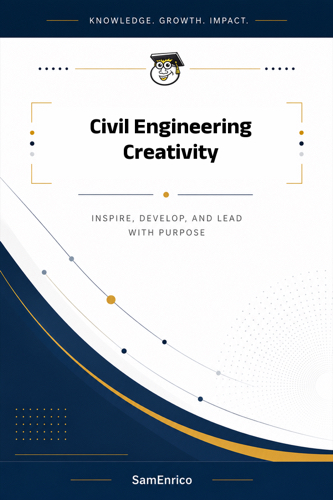
Non-FictionSelf-HelpCivil Engineering
Civil Engineering Creativity eBook
Apply innovative approaches to infrastructure, tra
Apply innovative approaches to infrastructure, transportation, and structural design.
Formats
Free sample
Chapter 1: The Gray Blur...–- Every morning, millions of people drive over the same concrete bridge, walk beneath the same steel overpass, and wait at the same traffic signal—all without once looking up. The infrastructure that surrounds them has become invisible, not because it is hidden, but because it is monotonous. From Boston to Bangkok, the highways look identical. The water towers are indistinguishable. The culverts, the retaining walls, the bus shelters—they all share a kind of weary uniformity, as if someone photocopied a single design and stamped it across continents.
This is not an accident. It is the result of a deeply ingrained professional culture that has learned to confuse repetition with reliability, and standardization with safety.The opening observation of this book is simple, and for some engineers, uncomfortable: most civil infrastructure is aesthetically and functionally boring not because it must be, but because the profession has systematically trained creativity out of its practitioners. The consequences are more severe than bad architecture. When infrastructure becomes a gray blur, the public stops caring about it. When the public stops caring, funding dries up.
When funding dries up, maintenance is deferred. And when maintenance is deferred, bridges fall, levees breach, and water mains burst. The path from creative stagnation to physical failure is longer than a single news cycle, but it is real.This chapter argues for a fundamental redefinition of what it means to be a civil engineer. It proposes that creativity is not an optional aesthetic layer applied after the real work is done, but rather a core professional competency—as essential as structural analysis or hydrology. The creative engineer is not a rebel who disregards codes, but a problem-seeker who asks better questions before solving the obvious ones.
This chapter traces the historical marriage of engineering and art, diagnoses the forces that drove them apart, and lays the philosophical foundation for every technique and case study that follows in the remaining eleven chapters.The Myth of the Two Cultures For most of human history, there was no distinction between the builder and the designer. The person who calculated the thrust of an arch was the same person who carved the keystone. The medieval cathedral builders did not have separate teams for "structural engineering" and "architecture." They had master masons who understood force, geometry, and beauty as a single, unified discipline. The flying buttresses of Notre-Dame are not ornament applied to structure; they are the structure, and they are breathtaking.Something shifted during the Industrial Revolution. As materials became standardized (cast iron, then steel, then reinforced concrete) and as calculation methods became codified, a division emerged.
The architect claimed the realm of appearance; the engineer claimed the realm of performance. By the mid-twentieth century, this split had become a chasm. Architectural schools taught form and space; engineering schools taught differential equations and material properties. Neither spoke the other's language fluently, and each began to view the other with a mixture of suspicion and condescension. Architects accused engineers of soulless pragmatism.
Engineers accused architects of dangerous flights of fancy.The result, visible in every suburban office park and highway interchange, is a kind of negotiated mediocrity. The architect designs a building envelope, and the engineer fits a structure inside it. The engineer designs a bridge girder, and the architect wraps it in a decorative shroud. Each discipline treats the other as a constraint to be worked around rather than a collaborator to be engaged with. This is the myth of the two cultures: the belief that art and calculation are separate domains, and that any bridge between them is merely a nice-to-have.The Creative Engineer Defined The central argument of this book rests on a single definition.
A creative civil engineer is not someone who ignores codes or pursues novelty for its own sake. Rather, a creative engineer is a problem-seeker rather than merely a problem-solver.Consider the difference. A problem-solver receives a well-defined assignment: design a retaining wall for this slope, with these soil properties, this surcharge, and this safety factor. The problem-solver opens the code, selects the appropriate equation, and produces a design that satisfies the specified constraints. This is necessary work, and it fills thousands of project binders every day.
But it is not creative. It is computational, even when done by hand.A problem-seeker, by contrast, receives the same site visit and asks: What else is happening here? Is the slope eroding in ways the soil report didn't capture? Could the retaining wall also function as a noise barrier for the adjacent school? Does the drainage pattern suggest an opportunity for stormwater harvesting?
What would happen to this slope in a hundred-year storm that exceeds code assumptions? These questions do not invalidate the original assignment; they expand it. The problem-seeker recognizes that the code-prescribed assignment is a floor, not a ceiling. It is the minimum acceptable response to a simplified version of reality. Creativity begins where the code ends.This distinction has profound implications for how engineers are trained and evaluated.
Most engineering curricula teach students to solve problems that are already fully specified. The professor hands out a problem set: given these loads, this span, these material properties, find the required beam depth. The student who returns the correct number receives an A. But real-world projects never arrive so neatly packaged. The loads are uncertain, the material properties vary, and the stakeholders disagree about what the problem even is.
The creative engineer is the one who can navigate this ambiguity, who can reframe a question before answering it, who can see the retaining wall not as a concrete obstacle but as an opportunity.The Historical Precedent: Brunelleschi and the Duomo To understand what creative engineering looks like in practice, it is worth examining a case where the constraints were so severe that only radical creativity could succeed. Filippo Brunelleschi's dome for the Florence Cathedral, completed in 1436, remains one of the most astonishing structural achievements in history. The problem seemed impossible. The cathedral had a massive octagonal opening—42 meters wide—that needed to be covered. Traditional dome construction required wooden centering: a temporary scaffold that would support the masonry until the keystone was placed.
But no trees in Tuscany were tall enough or strong enough to span 42 meters. And even if they were, the cost and labor would have been ruinous.A problem-solver would have concluded that the dome could not be built. A problem-solver might have proposed a flat roof, or a series of smaller domes, or abandoning the cathedral altogether. Brunelleschi, a problem-seeker, asked a different question: What if the dome could support itself during construction? He developed a double-shell design—an inner dome thin and light, an outer dome thicker and protective—with a herringbone brick pattern that transferred loads downward without centering.
He invented hoisting machines that could lift massive stones precisely into place. He concealed his most innovative techniques from rival builders, not because he was secretive, but because the risk of imitation without understanding was too great.The Duomo stands today not because Brunelleschi ignored constraints, but because he refused to accept them as final. He treated every limitation—the absence of timber, the octagonal plan, the political pressure…
This is the end of the free sample. Get the eBook to keep going. Buy now
About this book
Details
- Author
- Prado Hermine
- Publisher
- SamEnrico
- Language
- English
- Genre
- Non-Fiction, Self-Help, Civil Engineering
- Released
- 2026-06-08
- Pages (approx.)
- 141
- Available as
- eBook, Audiobook

Read better in the ZLOADR app
Your eBooks on your phone or tablet. Sign in with your SamEnrico account and start reading.
More by Prado Hermine
 Repairing Self-Worth in RecoveryPrado Hermine$11.99
 The UAE Interview Questions GuidePrado Hermine$11.99
 The Talent Myth DebunkedPrado Hermine$11.99
 Legitimization Of Paltry FavorsPrado Hermine$11.99
 The Fire Arrow Forges an Empire: The Inventor Who Changed Chinese WarfarePrado Hermine$11.99
 Commercial LenderPrado Hermine$11.99
 YC Energy Tech Africa GuidePrado Hermine$12.99
 UAE VAT Executive PrimerPrado Hermine$12.99
 Understanding Trisomy 2 MosaicismPrado Hermine$17.99
 How to Become a Piston MakerPrado Hermine$11.99
You may also like
 Hong Kong Handover 1997Dunn Johnnie$11.99
 Zumba For Postnatal Recovery CourseNeal Christian$11.99
 Zumba for BeginnersLadner Nikia$11.99
 YouTube Comment Mining GuideHumes Pandora$12.99
 Worry Box MeditationCarlin Rudy$11.99
 Workplace Stress MeditationNguyen Lynn$11.99
 Workplace Stress and Sleep RepairHawley Ivory$11.99
 Workplace Perfectionism CureDelaney Jeffry$11.99
 Workplace Injustice Anger GuideWallen Isabelle$11.99
 Work Addiction and Burnout LinkGreenwood Ester$11.99
 Women in Yoga and WellnessBeattie Galina$11.99
 Women in Stand Up ComedyChun Evangeline$11.99