
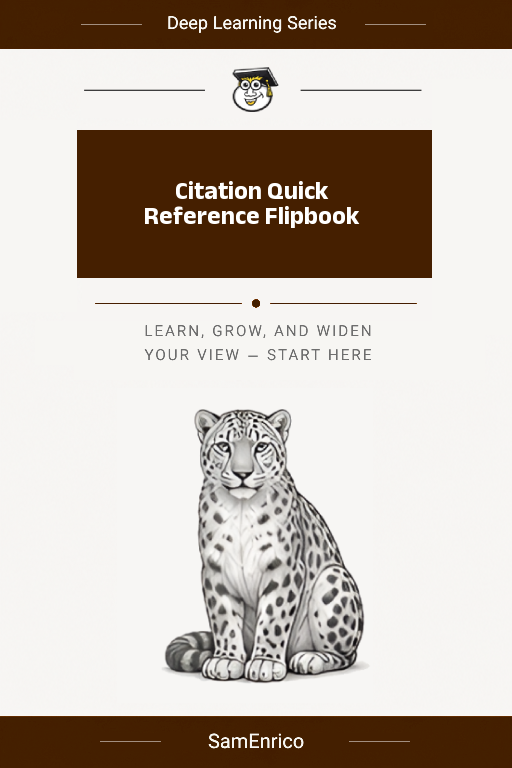
Non-FictionStudent's ShortcutQuick Reference
Citation Quick Reference Flipbook eBook
See examples for books, articles, websites, and mo
by Dial Katlyn
See examples for books, articles, websites, and more at a glance.
Formats
Free sample
Chapter 1: The Conversation Myth--–- Every student has heard it at least once: “Academic writing is a conversation.” Your professor says it. The writing center tutor says it. The online guide you glanced at before starting your paper says it. You nod, write it down, and then immediately forget it because you have three other assignments due and a citation that just won’t format correctly. But here’s the problem with hearing the same advice over and over: you stop listening.
The “conversation” metaphor becomes background noise, white noise, another piece of academic fluff that doesn’t help you finish your paper at 1:47 AM.This chapter is going to change that. Not by repeating the metaphor, but by showing you why it actually matters to your grade, your sanity, and your future as a writer.Let me ask you something direct. When you finish a research paper, who do you imagine reading it? If you’re like most students, your answer is probably “my professor” or “my TA.” And that’s honest. But it’s also incomplete.
The real answer is more interesting, and it’s the key to understanding why citations are not the punishment they feel like.Imagine you walk into a party where fifty people are already talking. They’ve been talking for hours, days, even years. Some of them are shouting. Some are whispering. Some have been arguing the same point since before you arrived.
Now, you want to say something. You have an idea. But if you just start talking without acknowledging anyone who spoke before you, what happens? Two things. First, people ignore you because they don’t know how your comment connects to anything.
Second, someone eventually says, “Actually, that point was already made twenty minutes ago by the person standing next to you.”That awkward party scenario is academic writing. The “people” are other researchers, scholars, journalists, and experts. The “party” is the body of published work on your topic. And citations are how you say, “I heard what you said, and I’m building on it” or “I heard what you said, and I disagree for these reasons.”This is Chapter 1 of the Citation Quick Reference Flipbook, and before we show you a single example citation, before we teach you a single formatting rule, we need to reset your relationship with citations entirely. Because if you still think citations are just a punishment for using other people’s words, you will keep making the same mistakes, keep losing points, and keep feeling frustrated.
If you understand citations as your entry ticket into an ongoing intellectual conversation, you will write better papers, argue more effectively, and probably enjoy the process more. That is not a small claim, and I intend to prove it to you in the next few pages.Let us begin with the mistake almost everyone makes.The Punishment Trap Why do citations feel like punishment? Because that is how they are often taught. Think back to the first time you learned about plagiarism. There was probably a lecture, a syllabus policy with threatening language about academic integrity violations, and possibly a story about a student who got expelled or failed a course.
The message was clear: if you do not cite correctly, you will be punished. The message that was missing: if you cite correctly, you will be rewarded.This is not your fault. It is a failure of pedagogy. Most academic integrity instruction focuses on what not to do rather than what to do. The result is that students learn to fear citations rather than understand them.
And fear leads to strange behaviors. Students over-cite common knowledge because they are afraid of missing something. Students under-cite because they are afraid of looking like they have no original ideas. Students copy citations from other papers without verifying them because they are in a hurry and terrified.Here is what the research says about this problem. In a 2019 study of undergraduate writing across fifteen universities, researchers found that nearly seventy percent of citation errors were not attempts to cheat.
They were attempts to follow confusing rules under time pressure. Students mixed up APA and MLA because they had written three papers in three different styles in the same semester. Students misplaced periods and parentheses because the rules are genuinely finicky. Students forgot to include DOIs because no one had ever explained what a DOI was.These are not moral failings. They are skill gaps.
And skill gaps can be filled with the right tools and the right mindset.The Citation Quick Reference Flipbook is built on a simple bet: if you understand why citations exist, the how becomes much easier to remember. You will not need to memorize every rule if you understand the logic behind them. And that understanding starts with reframing citation as an act of intellectual generosity, not self-protection.Intellectual Honesty Versus Plagiarism Let us get precise about the difference between intellectual honesty and plagiarism, because the spectrum between them is wider than most people realize.Plagiarism, in its clearest form, is taking someone else’s work or ideas and presenting them as your own. This includes buying a paper from an online source, copying a friend’s homework, or pasting a paragraph from Wikipedia without quotation marks. That is deliberate plagiarism, and it is both academically dishonest and surprisingly rare.
Most studies suggest that fewer than five percent of students deliberately plagiarize in a significant way.But there is a much larger category that causes more confusion and more academic integrity violations: accidental plagiarism. The most common form is called patchwriting.Patchwriting happens when you take a sentence from a source and change a few words without changing the sentence structure. For example:Original text: “The American Revolution fundamentally altered the relationship between colonial subjects and the British crown by introducing the possibility of legitimate resistance to imperial authority.”Patchwritten version: “The American Revolution fundamentally changed the relationship between colonial citizens and the British monarchy by introducing the possibility of legitimate resistance to royal authority.”This student changed a few words: “altered” became “changed,” “subjects” became “citizens,” “crown” became “monarchy,” “imperial” became “royal.” But the sentence structure is identical. The student has not actually paraphrased. They have simply thesaurus-swapped.
This is still plagiarism, even if it was accidental, even if the student included a citation at the end of the paragraph.Why does this matter? Because patchwriting suggests that you have not fully understood the original argument. You have just rearranged its furniture. Proper paraphrasing requires you to digest the source, understand it, and then express it in your own sentence structure entirely.So where is the line? Intellectual honesty means you do three things every time you use a source:First, you clearly indicate where someone else’s idea begins and where your own idea takes over.
This can happen through a citation, through a signal phrase (“According to Smith...”), or through the structure of your paragraph.Second, you use quotation marks for any exact words that are not your own. This includes phrases longer than three words that are distinctive to the source.Third, you paraphrase in your own sentence structure, not just your own…
This is the end of the free sample. Get the eBook to keep going. Buy now
About this book
Details
- Author
- Dial Katlyn
- Publisher
- SamEnrico
- Language
- English
- Genre
- Non-Fiction, Student's Shortcut, Quick Reference
- Released
- 2026-05-29
- Pages (approx.)
- 148
- Available as
- eBook, Audiobook

Read better in the ZLOADR app
Your eBooks on your phone or tablet. Sign in with your SamEnrico account and start reading.
More by Dial Katlyn
 Homeland Vacation Reverse ShockDial Katlyn$11.99
 Mind Mapping Group GuideDial Katlyn$11.99
 Mexico Punctuality FlexibilityDial Katlyn$11.99
 Slack Notification ManagementDial Katlyn$11.99
 Design Thinking for Product ManagersDial Katlyn$11.99
 Anger at Childs Property DestructionDial Katlyn$11.99
 Small Talk for Hair SalonsDial Katlyn$11.99
 Dream Book JournalDial Katlyn$11.99
 Shadows Over the Wilderness: Wolfe and Montcalm's Fateful DuelDial Katlyn$11.99
 Constantinople's Last Light: The Byzantine Legacy of KnowledgeDial Katlyn$11.99
 How to Produce Semi-transparent Oil PaintDial Katlyn$11.99
 Voice ActingDial Katlyn$11.99
You may also like
 Hong Kong Handover 1997Dunn Johnnie$11.99
 Zumba For Postnatal Recovery CourseNeal Christian$11.99
 Zumba for BeginnersLadner Nikia$11.99
 YouTube Comment Mining GuideHumes Pandora$12.99
 Worry Box MeditationCarlin Rudy$11.99
 Workplace Stress MeditationNguyen Lynn$11.99
 Workplace Stress and Sleep RepairHawley Ivory$11.99
 Workplace Perfectionism CureDelaney Jeffry$11.99
 Workplace Injustice Anger GuideWallen Isabelle$11.99
 Work Addiction and Burnout LinkGreenwood Ester$11.99
 Women in Yoga and WellnessBeattie Galina$11.99
 Women in Stand Up ComedyChun Evangeline$11.99