
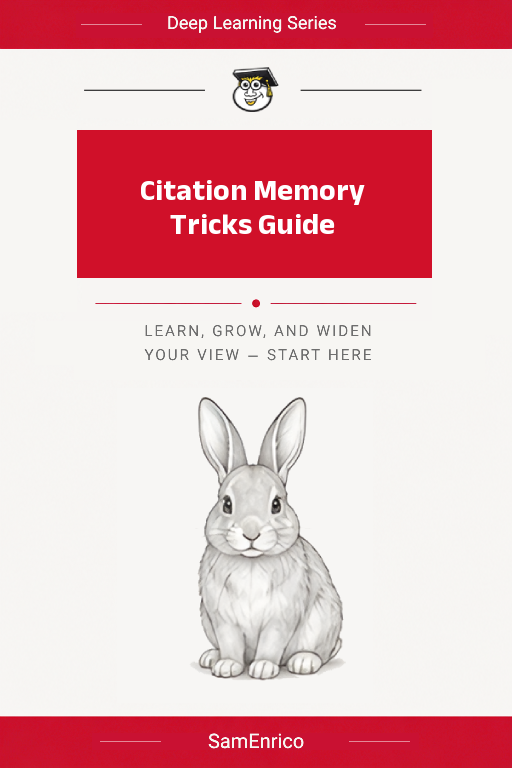
Citation Memory Tricks Guide eBook
Use mnemonics to remember the difference between A
by Schell Karyn
Use mnemonics to remember the difference between APA MLA and Chicago.
Formats
Free sample
Chapter 1: The Three Suspects...--–- The fluorescent lights hummed overhead as Sarah stared at the red scrawl across the top of her returned research paper. "Inconsistent citation style," the professor had written. "See me." Three little words that felt like a life sentence. Sarah had spent twelve hours on that paper—twelve hours of cross-referencing the Purdue OWL, flipping through dog-eared manuals, and second-guessing every period and parenthesis. And still, she had gotten it wrong.
She wasn't stupid. She was a junior with a 3.6 GPA. But somewhere between the psychology textbook (APA) and the English elective (MLA) and the history seminar (Chicago), her brain had simply given up. The rules blurred together. Dates floated free of their parentheses.
Page numbers appeared and disappeared like ghosts. She felt, in that moment, less like a scholar and more like a fraud.This book is for Sarah. And for you. Because the problem is not that citation rules are too hard. The problem is that no one ever taught you how to remember them.The Secret No Professor Tells You Every semester, millions of students perform the same desperate ritual.
They open three browser tabs: one for APA, one for MLA, one for Chicago. They copy-paste citations from citation generators. They pray. And then they close the tabs and forget everything within forty-eight hours, only to repeat the cycle on the next paper. This is not a failure of intelligence.
It is a failure of encoding—the cognitive process by which information is stored in long-term memory.The human brain evolved to remember stories, people, and places, not arbitrary rules about parentheses and italics. When you try to memorize a list of formatting rules, your prefrontal cortex (the brain's "working memory" center) quickly maxes out. Cognitive psychologists call this "cognitive load." Citation manuals are the equivalent of handing someone a telephone book and asking them to memorize page 47 in thirty seconds. It is possible, barely, with massive effort. But it is not sustainable.What if, instead of memorizing rules, you memorized people?The Party Trick That Changes Everything Imagine you are walking into a crowded party.
You don't know anyone. Someone hands you a list of fifty names and job titles and expects you to remember them all. Impossible. But if instead, you met three people—just three—and spent ten minutes talking to each, learning their personality, their quirks, their obsessions, you would remember them for years. You would remember the woman who would not stop checking her watch.
You would remember the man who carried a worn paperback and kept asking, "What page is that from?" You would remember the older woman in the corner scribbling footnotes in a leather notebook.This is not a metaphor. This is the loci method, also known as the memory palace technique, used by Greek and Roman orators to memorize hours-long speeches. The technique works because the brain is exceptionally good at spatial and visual memory. When you attach abstract information (citation rules) to concrete images (people, rooms, objects), you are essentially piggybacking on a cognitive system that evolution optimized over millions of years.In this book, you will build a memory palace with exactly three rooms. But before you enter those rooms, you need to meet the three people who live there.
These three people are not real—but your brain will treat them as if they are. And that is exactly the point.Meet the Scientist (APA)The first person at the party is standing near the refreshment table, but she is not eating. She is holding a clipboard and checking her wristwatch every few seconds. Her lab coat is pristine, almost aggressively white. Safety goggles are pushed up on her forehead.
She does not smile. She is not here to be friendly. She is here to collect data.This is The Scientist. Her name is APA, though she would never introduce herself that way. (She prefers "Doctor.") Every question you ask her, she answers with a date.
"When did you arrive?" "Twenty-two hundred hours." "How long have you been here?" "Forty-seven minutes." "What do you think of the music?" "The study was conducted in 2019 and replicated in 2022." Dates, dates, dates. The Scientist is obsessed with when things happened. To her, a fact without a date is like a specimen without a label—useless.Why this matters for citations: APA style (American Psychological Association) is the standard for social sciences: psychology, sociology, education, nursing, business, and many others. In these fields, the currency of knowledge is recency. A study from 1995 might be obsolete; a study from 2023 is cutting-edge.
When you write an APA paper, you are telling the reader, "Here is who discovered this and when they discovered it. The date matters as much as the author."The Scientist's signature tics:She constantly writes things like (Smith, 2020)—the comma is her pause to emphasize the year She labels every experiment with the year first She uses the word "data" as a plural (because she is precise)She does not use first-person pronouns in her writing ("The researcher observed" not "I observed")The hook you will never forget: Scientists live by dates. The year a study was published is everything. When you picture The Scientist checking her watch, you will remember: APA cares about the date.Meet the English Professor (MLA)Across the room, a man is gesturing emphatically with a worn copy of The Great Gatsby. His reading glasses hang from a chain around his neck.
His tweed jacket has leather patches on the elbows—not ironically, but because he has actually worn through the fabric from leaning on library tables. He is arguing about a single word choice in a poem you have never heard of. He does not care that you have never heard of it. He cares that you understand why that word matters.This is The English Professor. His name is MLA (Modern Language Association), though he prefers "Professor." He is obsessed with text—specifically, the exact location of text within a book.
Ask him for a quote, and he will not just tell you the quote; he will tell you the page number, the edition, the line breaks, and the footnote at the bottom of the page. "Page 47," he will say, tapping his finger. "Second paragraph. Fourth line. You see how Fitzgerald uses the word 'green' there?
That is not accidental."Why this matters for citations: MLA style is the standard for humanities: literature, languages, cultural studies, film, and philosophy. In these fields, the currency of knowledge is precision. You are not just citing a source; you are inviting the reader to verify the exact passage you are analyzing. A page number is not a formality—it is a treasure map to a specific sentence.The Professor's signature tics:He writes (Smith 23)—no comma, just a space, as if to say "go directly to this page"He calls the final page "Works Cited" because he only lists what he actually quoted (not everything he read)He puts article titles in quotation marks because he is "speaking" the words He uses full first names in his bibliography (John Smith) because he respects the author as a person The hook you will never forget: English…
This is the end of the free sample. Get the eBook to keep going. Buy now
About this book
Details
- Author
- Schell Karyn
- Publisher
- SamEnrico
- Language
- English
- Genre
- Non-Fiction, Student's Shortcut
- Released
- 2026-06-01
- Pages (approx.)
- 137
- Available as
- eBook, Audiobook

Read better in the ZLOADR app
Your eBooks on your phone or tablet. Sign in with your SamEnrico account and start reading.
More by Schell Karyn
 Social Media Detox WorkbookSchell Karyn$11.99
 Imposter Syndrome In AcademiaSchell Karyn$11.99
 Branch Davidian EscapeeSchell Karyn$11.99
 Pregnancy Immunization GuideSchell Karyn$11.99
 Discord Server Status RankingSchell Karyn$11.99
 Healing From Enmeshed FamiliesSchell Karyn$11.99
 Thunberg Vegan AdvocacySchell Karyn$11.99
 CBD and Nightmare ReductionSchell Karyn$11.99
 Resilience Building GuideSchell Karyn$11.99
 The Sky’s the Limit: How the Wright Brothers’ First Flight Redefined HumanitySchell Karyn$11.99
 The Shattered Tides of Manilla Bay: Commodore Dewey's Lightning StrikeSchell Karyn$11.99
 The Philosopher’s Stone: Macleay and the Birth of Australian ScienceSchell Karyn$11.99
You may also like
 Hong Kong Handover 1997Dunn Johnnie$11.99
 Zumba For Postnatal Recovery CourseNeal Christian$11.99
 Zumba for BeginnersLadner Nikia$11.99
 YouTube Comment Mining GuideHumes Pandora$12.99
 Worry Box MeditationCarlin Rudy$11.99
 Workplace Stress MeditationNguyen Lynn$11.99
 Workplace Stress and Sleep RepairHawley Ivory$11.99
 Workplace Perfectionism CureDelaney Jeffry$11.99
 Workplace Injustice Anger GuideWallen Isabelle$11.99
 Work Addiction and Burnout LinkGreenwood Ester$11.99
 Women in Yoga and WellnessBeattie Galina$11.99
 Women in Stand Up ComedyChun Evangeline$11.99