
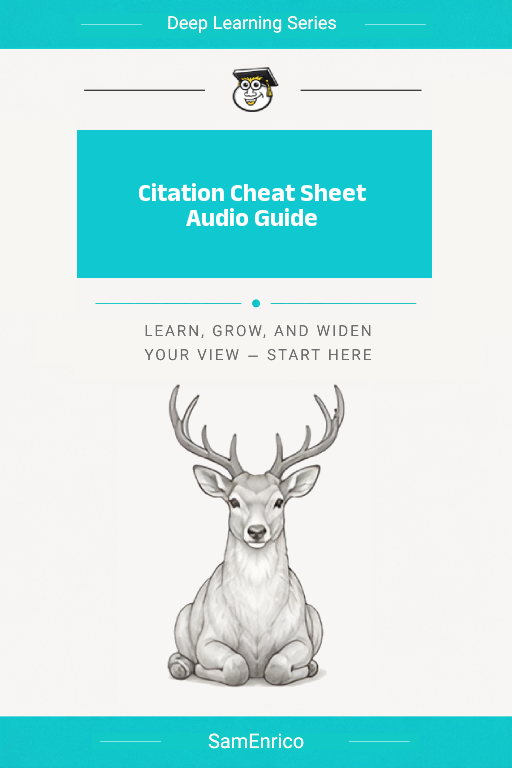
Non-FictionStudent's ShortcutMnemonic Study AidReference Handbook
Citation Cheat Sheet Audio Guide eBook
Memorize in-text citations and bibliography format
by Scully Hyman
Memorize in-text citations and bibliography formats without note cards. Each rule is repeated twice with a short quiz to lock in correct punctuation.
Formats
Free sample
Chapter 1: The Skeleton Key--–- Close your eyes for a moment. Imagine you’re sitting in front of a laptop at 11:47 PM. The cursor blinks on the last page of a fifteen-page research paper due at midnight. You’ve finished the argument. You’ve proofread the thesis statement seven times.
But now you’re staring at a single parentheses, trying to remember whether the comma goes inside or outside the quotation mark, whether the year needs a “p.” before the page number, and whether you should italicize the period after the URL. Your heart rate climbs. You open a browser tab to Purdue OWL for the fourteenth time this semester. You find the rule. You copy it exactly.
You paste it into your bibliography. And three days later, when the graded paper comes back, you see the same red circle around the same missing comma. The note says, “See style guide.” You want to scream, “I DID see the style guide!”If that scene feels familiar, you are not alone. And more importantly, you are not broken. You do not have a “bad memory” for rules.
You have been using the wrong learning method for the task at hand. Note cards, style guides, and citation generators all share the same fatal flaw: they give you the answer in the moment but never train your brain to retrieve the answer under pressure. That is like practicing basketball by reading the rulebook while sitting on the bench and then wondering why you miss every free throw during the game.This chapter is called The Skeleton Key because it unlocks something most citation guides never mention: beneath the surface chaos of MLA, APA, and Chicago, every citation shares the same hidden structure. Once you see that structure—once you can hear it in your mind—the specific punctuation rules of each style become simple variations on a single theme. You will stop drowning in exceptions and start recognizing patterns.
By the end of this chapter, you will be able to look at any citation from any style and identify its skeleton within three seconds. More importantly, you will never again feel that midnight panic of not knowing where to start.The Universal Skeleton: Five Bones, One Body Every citation in every academic style contains exactly five pieces of information. Not six. Not four. Five.
Think of them as bones in a skeleton. The names of the bones change depending on whether you are looking at an in-text citation or a bibliography entry, but the bones themselves are always there.Bone 1: Author. Who wrote it? This could be a single person, multiple people, an organization, or even a pseudonym. In in-text citations, the author is almost always the first thing your reader sees.
In bibliographies, the author determines where the entry sits alphabetically. Without an author, you cannot anchor a citation. That is why anonymous works cause so much confusion—they force you to use the title as the anchor instead, which feels unnatural because your brain is trained to look for a name first.Bone 2: Date. When was it published? In APA, the date appears early and often.
In MLA, the date hides near the end of the bibliography entry and never appears in the in-text citation unless the source has no page numbers. But make no mistake: the date is always there somewhere. The difference is one of emphasis, not presence. Social sciences care deeply about currency, so APA puts the date front and center. Humanities care deeply about textual precision, so MLA moves the date to the background.
But neither style deletes it.Bone 3: Title. What is the work called? Titles come in two flavors: large and small. Large titles (books, journals, films, albums) get italics. Small titles (articles, chapters, poems, songs) get quotation marks.
Every citation guide agrees on this distinction. The only variation is whether the title appears before or after the date. That is it.Bone 4: Source Container. Where does the work live? For a book, the container is the publisher.
For a journal article, the container is the journal itself. For a chapter in an edited book, the container is the larger book. For a website, the container is the site name. This is the bone that confuses students the most because the same work can be a container and also live inside another container. A journal article is a small work (title in quotes) that lives inside a journal (title in italics).
The journal is the container. But that same journal lives inside a database like JSTOR. The database is a second container. MLA and APA handle this nesting differently, but the core concept—that works exist inside larger works—is identical across all styles.Bone 5: Locator. Where in the work can the reader find your specific evidence?
This is almost always a page number, but it can also be a paragraph number (for web sources without pagination), a timestamp (for video), a chapter number, or a DOI/URL. In-text citations exist primarily to point to a locator. Bibliographies include locators for journal articles (the page range of the entire article) but not for books (because a book’s locator changes depending on which page you cite). Understanding what counts as a locator and when to include it solves seventy percent of citation errors.That is the skeleton. Five bones.
Every citation. Every style. If you can name these five bones in any citation you encounter, you will never again feel lost. The rest is just punctuation—and punctuation is just rhythm.The Anchor Principle: Why Your Eye Knows Where to Look Here is a sentence: “The quick brown fox jumps over the lazy dog.” Without looking back, where does the word “quick” appear? You know immediately: it is the second word.
You did not have to sound out each letter or count positions. Your brain has learned the pattern of English sentences so thoroughly that word order feels automatic.Citations work exactly the same way. Every citation style has an anchor point—the first piece of information your eye seeks when scanning a citation for meaning. In almost every case, the anchor is the author’s last name. That is why the repeated rule of this chapter is so important: “Every citation has an anchor point—usually the author’s last name.”When you see (Smith 23), your brain instantly knows that Smith is the author.
When you see (Smith, 2020, p. 23), your brain again anchors on Smith. When you see a footnote that begins “1. Smith, John,” your brain again finds Smith. The anchor does not change.
What changes is everything around it.This is the secret that separates confident writers from anxious ones. Confident writers know that the anchor is stable. Anxious writers stare at the whole citation and see a wall of punctuation. They cannot find the anchor because they are looking for the wrong thing—they are looking for the rule instead of the pattern.Think of it this way: When you learn to drive, you do not memorize the exact position of every pedal and lever before you turn the key. You learn that the steering wheel is the anchor.
It is always in front of you. The pedals are always under your feet. The turn signal is always to…
This is the end of the free sample. Get the eBook to keep going. Buy now
About this book
Details
- Author
- Scully Hyman
- Publisher
- SamEnrico
- Language
- English
- Genre
- Non-Fiction, Student's Shortcut, Mnemonic Study Aid, Reference Handbook
- Released
- 2026-05-29
- Pages (approx.)
- 152
- Available as
- eBook, Audiobook

Read better in the ZLOADR app
Your eBooks on your phone or tablet. Sign in with your SamEnrico account and start reading.
More by Scully Hyman
 Oil Strikes Against ShahScully Hyman$11.99
 ABCDE for Creative ProfessionalsScully Hyman$11.99
 The Self Hypnosis Scripts LibraryScully Hyman$11.99
 GAD Social Anxiety OverlapScully Hyman$11.99
 Competitive Response MappingScully Hyman$11.99
 The Spice Route Rebels: Dutch Traders and the Secrets of the East (1950s)Scully Hyman$11.99
 Merlin's Shadow: The Untold Lessons of the Forgotten SageScully Hyman$11.99
 Traveler's Check VerificationScully Hyman$11.99
 Understanding Hageman Factor DeficiencyScully Hyman$17.99
 How to Become a Civil Preparedness Training OfficerScully Hyman$11.99
You may also like
 Hong Kong Handover 1997Dunn Johnnie$11.99
 Zumba For Postnatal Recovery CourseNeal Christian$11.99
 Zumba for BeginnersLadner Nikia$11.99
 YouTube Comment Mining GuideHumes Pandora$12.99
 Worry Box MeditationCarlin Rudy$11.99
 Workplace Stress MeditationNguyen Lynn$11.99
 Workplace Stress and Sleep RepairHawley Ivory$11.99
 Workplace Perfectionism CureDelaney Jeffry$11.99
 Workplace Injustice Anger GuideWallen Isabelle$11.99
 Work Addiction and Burnout LinkGreenwood Ester$11.99
 Women in Yoga and WellnessBeattie Galina$11.99
 Women in Stand Up ComedyChun Evangeline$11.99