
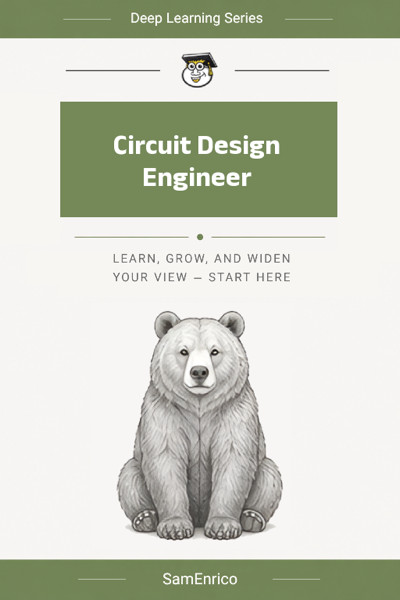
Non-FictionInformativeEducational
Circuit Design Engineer Audiobook
A Coursebook on Circuit Design Engineer
A Coursebook on Circuit Design Engineer
Formats
Free sample
Chapter 1: The Five Killers--–- Every engineering textbook lies to you. Not maliciously, but systematically. They present clean equations, perfect sine waves, and circuits that behave exactly as calculated. Then you build your first real board, plug in power, and something catches fire. Or it doesn’t work at all.
Or it works on your bench but fails the moment a customer touches it. This chapter is about why that happens and how to think differently. We call the gap between theory and reality the “design gap,” and bridging it is the entire job of a circuit design engineer.Before we write a single line of code or solder a single component, we need to rewire your brain. Academic training teaches you to solve for voltage at node X given ideal resistors and perfect sources. Professional circuit design teaches you to ask: “What happens when that resistor is 5% off?
When the transistor heats up by 40 degrees? When the power supply sags? When the PCB trace next to my signal carries a switching current?” The difference between a hobbyist and a professional is not knowing more formulas. It is knowing which formulas to trust, which to ignore, and which to treat as loose guidelines.This chapter introduces the five fundamental constraints that drive every design decision you will ever make. I call them the Five Killers because ignoring any one of them will kill your project – maybe not immediately, but certainly before it reaches production.
They are: Power, Speed, Noise, Cost, and Reliability. Every chapter in this book will return to these five constraints. Every design choice is a trade-off between them. Master the trade-offs, and you master circuit design.The Great Lie of Textbook Circuits Textbooks teach you Kirchhoff’s laws, Ohm’s law, and the magic of ideal components. An ideal resistor has exactly its marked resistance at all temperatures and frequencies.
An ideal capacitor stores charge without leakage or parasitic inductance. An ideal op-amp has infinite gain, infinite bandwidth, and zero noise. These assumptions are necessary for learning the math. They are deadly for building real circuits.Let me give you an example. A textbook shows a voltage divider: two 10k resistors across a 5V supply.
The math says node voltage equals 2.5V. You build it. You measure 2.5V. Good. Then you add a load – say, a 10k resistor from that node to ground.
The math now says 5V * (5k / (10k + 5k)) = 1.67V. You measure 1.67V. Still good. But then…
This is the end of the free sample. Get the Audiobook to keep going. Buy now
About this book
Details
- Author
- Petrie Kurtis
- Publisher
- SamEnrico
- Language
- English
- Genre
- Non-Fiction, Informative, Educational
- Released
- 2026-05-04
- Pages (approx.)
- 130
- Available as
- eBook, Audiobook

Listen in the VoxFlicks app
Audiobooks and audio dramas wherever you go. Sign in with your SamEnrico account and press play.
More by Petrie Kurtis
 Zumba for Postnatal Recovery GuidePetrie Kurtis$11.99
 Loneliness And Pet CompanionshipPetrie Kurtis$11.99
 Stalking Social Media Influencer CasesPetrie Kurtis$11.99
 Teen Emotional Intelligence GuidePetrie Kurtis$11.99
 LinkedIn Success Theater ExposedPetrie Kurtis$11.99
 The Amazon Skyway: When South America Conquered the AtlanticPetrie Kurtis$11.99
 Lost Letters of the Last Tsar: Nicholas & AlinePetrie Kurtis$11.99
 Understanding Duplication of Leg Mirror FootPetrie Kurtis$17.99
 AI Workflow Automation GuidePetrie Kurtis$12.99
 Union Employer NeutralityPetrie Kurtis$12.99
 How to Become a Automobile-seat-cover InstallerPetrie Kurtis$11.99
You may also like
 Hong Kong Handover 1997Dunn Johnnie$11.99
 Zumba For Postnatal Recovery CourseNeal Christian$11.99
 Zumba for BeginnersLadner Nikia$11.99
 YouTube Comment Mining GuideHumes Pandora$12.99
 Worry Box MeditationCarlin Rudy$11.99
 Workplace Stress MeditationNguyen Lynn$11.99
 Workplace Stress and Sleep RepairHawley Ivory$11.99
 Workplace Perfectionism CureDelaney Jeffry$11.99
 Workplace Injustice Anger GuideWallen Isabelle$11.99
 Work Addiction and Burnout LinkGreenwood Ester$11.99
 Women in Yoga and WellnessBeattie Galina$11.99
 Women in Stand Up ComedyChun Evangeline$11.99