
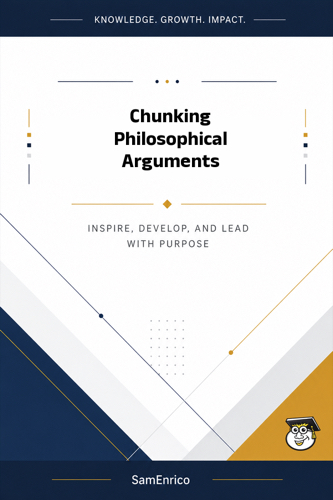
Non-FictionSelf-HelpPhilosophyLogic
Chunking Philosophical Arguments
Break premises, evidence, conclusions into logical
by Condon Pia
Break premises, evidence, conclusions into logical memory groups.
Formats
About this book
Free sample
Chapter 1: The Skeleton Key--–- Every philosophy student knows the feeling. You sit down with a cup of coffee, open Plato’s Republic or Kant’s Critique of Pure Reason, read the first page with careful attention, and understand every sentence. By the bottom of the second page, you are no longer sure how the first paragraph connects to the third. By the end of the chapter, the argument has dissolved into a fog of competing claims, qualifications, and counterexamples. You close the book feeling defeated—not because you lack intelligence, but because you have been asked to hold fifteen marbles in a hand built for four.This is not a personal failing.
It is a cognitive bottleneck baked into the architecture of the human brain. The psychologist George Miller published a landmark paper in 1956 titled “The Magical Number Seven, Plus or Minus Two,” in which he demonstrated that human working memory can hold approximately seven discrete items at once. Subsequent research has refined this number downward. Most cognitive scientists now agree that under typical conditions—especially with complex, abstract material like philosophical propositions—the functional limit is closer to four items. Four.
That is it. And a single paragraph of serious philosophy often contains more than a dozen premises, evidence claims, qualifications, and counterarguments.The problem is not philosophy. The problem is that no one ever taught you how to read it.This book exists to teach you exactly that skill. It is called chunking—the cognitive process of grouping smaller, discrete pieces of information into larger, meaningful clusters. Chunking is not a study hack or a memory trick.
It is how the brain naturally organizes information. When you learn to chunk deliberately and systematically, you transform an overwhelming cascade of individual claims into a manageable structure of logical groups. You move from being a passive reader who drowns in details to an active analyst who sees the skeleton beneath the skin.The Anatomy of an Argument: Three Core Components Before you can chunk anything, you must know what you are looking for. Every philosophical argument, regardless of its complexity…
This is the end of the free sample. Get the eBook to keep going. Buy now
Contents
- Chapter 1
- Chapter 2
- Chapter 3
- Chapter 4
- Chapter 5
- Chapter 6
- Chapter 7
- Chapter 8
- Chapter 9
- Chapter 10
- Chapter 11
- Chapter 12
Details
- Author
- Condon Pia
- Publisher
- SamEnrico
- Language
- English
- Genre
- Non-Fiction, Self-Help, Philosophy, Logic
- Released
- 2026-06-08
- Pages (approx.)
- 149
- Available as
- eBook, Audiobook

Read better in the ZLOADR app
Your eBooks on your phone or tablet. Sign in with your SamEnrico account and start reading.
More by Condon Pia
 Burnout Prevention Work PacingCondon Pia$11.99
 The Arthritis Pregnancy GuideCondon Pia$11.99
 Remote Company Retreats Conflict ResolutionCondon Pia$11.99
 The Memory Nutrition HandbookCondon Pia$11.99
 The Rio Grande Gold Heist: The Untold Story of Latin America's Greatest Casino RobberyCondon Pia$11.99
 Understanding Sheehan SyndromeCondon Pia$17.99
 How to Become a Polysomnographic TechnicianCondon Pia$11.99
 Korean Scholarship Eligibility GuideCondon Pia$12.99
 Shea Value Addition GuideCondon Pia$12.99
 ScreenwritingCondon Pia$11.99
You may also like
 Hong Kong Handover 1997Dunn Johnnie$11.99
 Zumba For Postnatal Recovery CourseNeal Christian$11.99
 Zumba for BeginnersLadner Nikia$11.99
 YouTube Comment Mining GuideHumes Pandora$12.99
 Worry Box MeditationCarlin Rudy$11.99
 Workplace Stress MeditationNguyen Lynn$11.99
 Workplace Stress and Sleep RepairHawley Ivory$11.99
 Workplace Perfectionism CureDelaney Jeffry$11.99
 Workplace Injustice Anger GuideWallen Isabelle$11.99
 Work Addiction and Burnout LinkGreenwood Ester$11.99
 Women in Yoga and WellnessBeattie Galina$11.99
 Women in Stand Up ComedyChun Evangeline$11.99