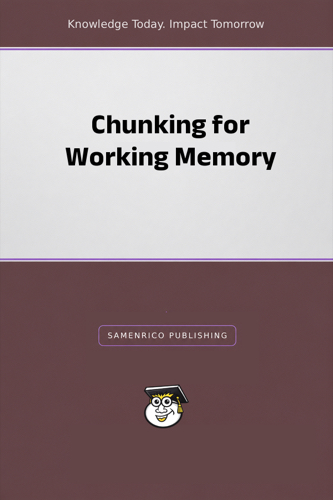
Chunking for Working Memory Audiobook
Group information into meaningful units to increas
Group information into meaningful units to increase effective capacity.
Formats
Free sample
Chapter 1: The Forgetting Tax--It happens to everyone. You walk into a room and stand there, frozen, surrounded by the vague feeling that something is missing. You know you came here for a reason. You can almost feel the shape of that reason – a pressure, an intention, a ghost of purpose. But the specific content has evaporated.
A few seconds ago, in the other room, that thought was solid. Now it is smoke. You retreat to the original room, and the moment you cross the threshold, the memory snaps back into place. “Keys,” you mutter. “I came to get my keys.”This experience is so universal that we have domesticated it with humor.
We call it a “senior moment” even when we are twenty-five. We shrug and say, “If it was important, I would have remembered it.” But something strange happens when we examine this moment closely. You did not forget your keys because your memory is old or damaged. You forgot them because, in the few seconds it took to cross from one room to another, your brain performed a complete reset of its temporary workspace. And that reset happens thousands of times a day, to every human being, regardless of intelligence, education, or effort.The name for this temporary workspace is working memory, and it is the single most underappreciated bottleneck in human cognition.
Most people have never heard of it. Those who have often confuse it with long-term memory – the vast archive where your brain stores your mother’s face, the capital of France, and how to ride a bicycle. But working memory is not an archive. It is a workbench. It is the small, exposed surface where you hold the tools you need to build the thought you are building right now.
And that surface is shockingly small.The Workbench That Cannot Be Expanded Let us make this concrete. Look at the following string of numbers for five seconds, then look away and try to repeat them in order:7 2 9 4 1 8 3 6 5How many did you get? Most people get five to seven digits correct. A few get eight or nine. Almost no one gets all nine on the first try.
Now try this different version:123-456-789You probably got all nine instantly, without effort. Here is the crucial insight that changes everything: the second string contains exactly the same number of digits as the first. The raw information load is identical.…
This is the end of the free sample. Get the Audiobook to keep going. Buy now
About this book
Details
- Author
- Esparza Zonia
- Publisher
- SamEnrico
- Language
- English
- Genre
- Non-Fiction, Self-Help, Memory Strategies
- Released
- 2026-06-08
- Pages (approx.)
- 136
- Available as
- eBook, Audiobook

Listen in the VoxFlicks app
Audiobooks and audio dramas wherever you go. Sign in with your SamEnrico account and press play.
More by Esparza Zonia
 Buck Owens Act NaturallyEsparza Zonia$11.99
 Ethiopia Therapy Access GuideEsparza Zonia$11.99
 Name Memory for Flight AttendantsEsparza Zonia$11.99
 Cat Litter Auto-ship ChurnEsparza Zonia$11.99
 The De-Stress Date NightEsparza Zonia$11.99
 Pat Nixon First LadyEsparza Zonia$11.99
 Detox Agitation ControlEsparza Zonia$11.99
 The Sky Whisperers: How the Maya Predicted the End of the World (And Why They Were Wrong)Esparza Zonia$11.99
 Simon Stevin: The Mathematician Who Armed the Dutch RevoltEsparza Zonia$11.99
 How to Produce a Shrink TunnelEsparza Zonia$11.99
 A Collector's Handbook to the Bsa Scout Series 6Esparza Zonia$11.99
 Evidence Integration AI PromptsEsparza Zonia$12.99