
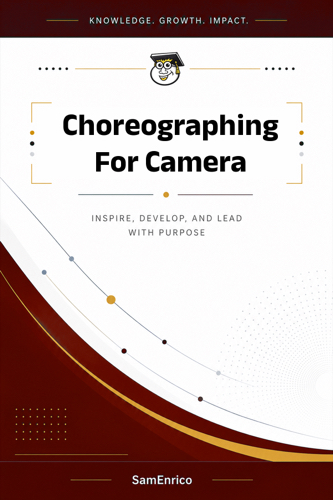
Non-FictionBiographyFilm Directing
Choreographing For Camera Audiobook
Teaches adapting stage movement for film, includin
Teaches adapting stage movement for film, including framing, editing rhythm, and close-up emotion.
Formats
Free sample
Chapter 1: The Broken Wall--–- The first time a stage choreographer watches their work through a camera lens, something breaks. It is not the choreography itself, which remains physically intact. It is not the dancers, who perform with the same precision they would deliver to a sold-out house. What breaks is an assumption so deeply embedded that most choreographers do not even know they carry it: the belief that movement is movement, and that a body in space communicates the same way regardless of who is watching.This chapter dismantles that assumption. It does so not gently but deliberately, because gentle does not work.
Stage choreographers who have spent twenty years learning to fill a proscenium must unlearn half of what they know before they can begin to learn what the camera requires. The good news is that every principle of timing, dynamics, and spatial relationship still applies. The bad news is that the translation from stage to screen is not a matter of adjusting a few variables. It is a matter of rebuilding the entire perceptual framework from the foundation up.The title of this chapter is "The Broken Wall." The wall in question is the invisible fourth wall of the theater, that imaginary boundary between performers and audience that stage choreographers learn to respect and manipulate. For the camera, there is no fourth wall.
There is only the frame, and the frame changes everything.The Myth of the Neutral Lens Before we can understand what changes, we must first confront a persistent and damaging myth: that the camera is a neutral observer. This myth appears in many forms. Sometimes it surfaces as the belief that filming a dance is simply a matter of putting a camera in the best seat in the house and pressing record. Sometimes it appears as the assumption that a wide shot preserves the "truth" of the choreography while close-ups and editing distort it. Both are wrong, and both will sabotage your work before you begin.A camera is never neutral.
Every choice a filmmaker makes—where to place the camera, what lens to use, when to cut, how to light—is an interpretation. The same dancer performing the same phrase can appear heroic, pathetic, terrifying, or erotic depending entirely on camera choices that have nothing to do with the movement itself. This is not a limitation of the medium. It is the medium's greatest power.Stage…
This is the end of the free sample. Get the Audiobook to keep going. Buy now
About this book
Details
- Author
- Lorenz Gaylene
- Publisher
- SamEnrico
- Language
- English
- Genre
- Non-Fiction, Biography, Film Directing
- Released
- 2026-06-05
- Pages (approx.)
- 143
- Available as
- eBook, Audiobook

Listen in the VoxFlicks app
Audiobooks and audio dramas wherever you go. Sign in with your SamEnrico account and press play.
More by Lorenz Gaylene
 Conversation Starters for RetireesLorenz Gaylene$11.99
 Bullying Trauma DreamsLorenz Gaylene$11.99
 Stress and Turning TowardsLorenz Gaylene$11.99
 The Iron Architects of Meroë: Engineering the Nile’s Golden AgeLorenz Gaylene$11.99
 How to Start a Boiler for Marine Applications Business (Beginners Guide)Lorenz Gaylene$11.99
 How to Produce Beach MatsLorenz Gaylene$11.99
 Bank Account for Latin AmericansLorenz Gaylene$12.99
 Inyoite MiningLorenz Gaylene$11.99
You may also like
 Hong Kong Handover 1997Dunn Johnnie$11.99
 Zumba For Postnatal Recovery CourseNeal Christian$11.99
 Zumba for BeginnersLadner Nikia$11.99
 YouTube Comment Mining GuideHumes Pandora$12.99
 Worry Box MeditationCarlin Rudy$11.99
 Workplace Stress MeditationNguyen Lynn$11.99
 Workplace Stress and Sleep RepairHawley Ivory$11.99
 Workplace Perfectionism CureDelaney Jeffry$11.99
 Workplace Injustice Anger GuideWallen Isabelle$11.99
 Work Addiction and Burnout LinkGreenwood Ester$11.99
 Women in Yoga and WellnessBeattie Galina$11.99
 Women in Stand Up ComedyChun Evangeline$11.99