
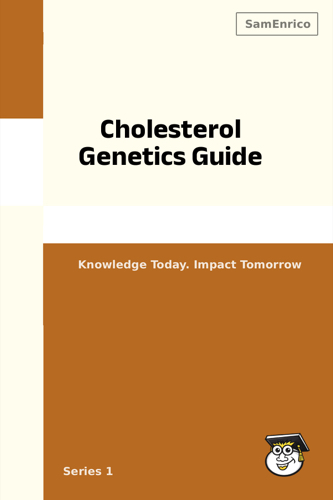
Non-FictionHealth & Wellness / Genetics
Cholesterol Genetics Guide eBook
undefined
undefined
Formats
Free sample
Chapter 1: The $31 Billion Blindfold--–- On a cold February morning in 2019, a 52-year-old marathon runner named Sarah collapsed in her kitchen while making oatmeal. She had done everything right. Her total cholesterol was 178 – well within the "normal" range. Her doctor had praised her lipid panel just six months earlier. She ate a low-fat, high-fiber diet.
She ran four times a week. She had never smoked. And yet, when the paramedics arrived, they found a massive blockage in her left anterior descending artery – the "widowmaker." Sarah survived, but only barely. When her cardiologist reviewed her records, he shrugged and said, "Sometimes these things just happen."But they don't "just happen." Sarah's story is not a medical mystery. It is a medical failure – a failure of a paradigm that has dominated heart disease treatment for over five decades.
And as you will discover in this chapter, the key to understanding why Sarah almost died – and why millions of people like her are being failed every single day – lies not in her cholesterol number, but in something far more fundamental: her genes.The Number That Killed Certainty For the better part of sixty years, the medical establishment has operated under a simple, seductive, and ultimately incomplete theory: the diet-heart hypothesis. Proposed by physiologist Ancel Keys in the 1950s, the hypothesis states that dietary saturated fat raises blood cholesterol, which then deposits in arteries, causing heart disease. It is a clean, linear, and intuitively appealing model. Eat butter. Get high cholesterol.
Have a heart attack. The solution, therefore, was equally clean: lower saturated fat intake, lower cholesterol, and heart disease would vanish.This theory became the bedrock of modern cardiology. It spawned the low-fat revolution of the 1980s and 1990s. It filled grocery store shelves with fat-free cookies, Snack Wells, and margarine. It led to the creation of the National Cholesterol Education Program.
And it paved the way for the most commercially successful class of drugs in human history: statins.In 2023, the global statin market was valued at approximately $31 billion. That is billion with a B. To put that number in perspective, the entire GDP of Iceland is around $27 billion. The world spends more money on statins than the entire economic output of a developed nation. Lipitor alone, the best-selling statin in history, generated over $130 billion in revenue for Pfizer before its patent expired.
That is enough money to send the James Webb Space Telescope into orbit thirty times over.None of this would be problematic if statins were a perfect solution. But they are not. And here is where the story becomes deeply uncomfortable. Despite the widespread use of statins – over 40 million Americans take them daily – heart disease remains the leading cause of death in the United States, claiming nearly 700,000 lives each year. That is one death every 45 seconds.
It is more deaths than from all cancers combined.If the diet-heart hypothesis were correct, and if statins were the answer, these numbers would be declining dramatically. They are not. Something is profoundly wrong.The Two Paradoxes That Should Have Changed Everything The first crack in the diet-heart hypothesis appeared decades ago, but almost no one in the mainstream medical community wanted to look at it. It is called the French Paradox.Here is the paradox: France has one of the highest rates of saturated fat consumption in the Western world. The French diet is rich in butter, cheese, cream, pâté, and red meat.
A typical French meal might include a cheese course followed by a buttery dessert, all washed down with wine. By every measure of the diet-heart hypothesis, France should have astronomical rates of heart disease.It does not. France has roughly one-third the rate of coronary heart disease mortality as the United States, despite consuming significantly more saturated fat. The French live longer, eat more fat, and have fewer heart attacks. How is this possible?
The diet-heart hypothesis has no answer. Proponents have tried to explain it away by pointing to red wine (the "alcohol protects the heart" theory), but subsequent research has shown that even without wine, the paradox remains.Then there is the Moscow Paradox, which is even more inconvenient for the mainstream view. In the 1990s, following the collapse of the Soviet Union, Russia experienced a dramatic economic crisis. Average caloric intake dropped. Saturated fat consumption plummeted.
People could not afford butter, meat, or cheese. By the logic of the diet-heart hypothesis, heart disease should have fallen.It did the opposite. Heart disease mortality in Russia spiked by nearly 40 percent during the early 1990s. Cholesterol levels fell. Heart attacks rose.
The Moscow Paradox stands as one of the most powerful refutations of the simple diet-heart model: you can lower a population's cholesterol and watch heart disease increase.Neither of these paradoxes is new. The French Paradox has been discussed in medical literature since the 1980s. The Moscow Paradox was documented extensively in the 1990s. And yet, the medical establishment has largely ignored them. Why?
Because admitting that the diet-heart hypothesis is incomplete would require dismantling a $31 billion industry, rewriting dietary guidelines, and telling forty million Americans that their daily statin might not be addressing the real problem.The Firefighter, Not the Arsonist To understand what is actually happening, we need to radically reframe how we think about cholesterol. The mainstream view treats cholesterol as a villain – a waxy, sticky substance that clogs arteries like grease clogging a pipe. This metaphor is visually intuitive but scientifically backwards.Cholesterol is not the arsonist. Cholesterol is the firefighter.Consider what happens inside your arteries on a microscopic level. Your arterial walls are delicate structures lined with a single layer of cells called the endothelium.
When these cells become damaged – by high blood pressure, by smoking, by chronic stress, by environmental toxins, or most commonly, by high blood sugar – they send out distress signals. The body's immune system responds by sending inflammatory cells to the site of damage.This is where cholesterol enters the story. Cholesterol, carried by LDL particles, travels through the bloodstream and arrives at the damaged site. The LDL particles are drawn into the arterial wall, where they attempt to deliver cholesterol to help repair the cellular damage. Cholesterol is essential for cell membrane repair.
Without it, your cells cannot heal.The problem is not the cholesterol. The problem is what happens next. If the inflammatory environment is severe enough, the LDL particles become oxidized. Oxidized LDL is a different beast entirely. Your immune system does not recognize it as the helpful repair substance it once was.
Instead, the immune system attacks oxidized LDL as if it were an invading pathogen. Macrophages – the Pac-Men of your immune system – engulf the oxidized LDL particles and become engorged, turning into what pathologists call "foam cells." These foam cells accumulate, creating plaque. The plaque grows. The artery narrows. Eventually, the plaque can rupture, causing a heart attack or stroke.Do you see what happened there?
Cholesterol was the first responder. It showed up to put out a fire. But the fire was so intense that the firefighters themselves became part of the problem. The solution to heart disease, therefore, is not to eliminate the firefighters. It is to eliminate the fire.That…
This is the end of the free sample. Get the eBook to keep going. Buy now
About this book
Details
- Author
- Ammons Marivel
- Publisher
- SamEnrico
- Language
- English
- Genre
- Non-Fiction, Health & Wellness / Genetics
- Released
- 2026-06-08
- Pages (approx.)
- 148
- Available as
- eBook, Audiobook

Read better in the ZLOADR app
Your eBooks on your phone or tablet. Sign in with your SamEnrico account and start reading.
More by Ammons Marivel
 Sugar Cravings and Menstrual CycleAmmons Marivel$11.99
 Question Asking TechniqueAmmons Marivel$11.99
 DBT for Compulsive SpendingAmmons Marivel$11.99
 After Parent Dies Caregiver MemoirAmmons Marivel$11.99
 Sandstorm Survival ActionAmmons Marivel$11.99
 Bipolar Spectrum ExplainedAmmons Marivel$11.99
 Love in the Sands of War: The Iran-Iraq War's Forbidden RomanceAmmons Marivel$11.99
 The Burning of Washington: America's Humiliation and ResurgenceAmmons Marivel$11.99
 How to Produce Tennis NetsAmmons Marivel$11.99
 How to Produce Home Theater SystemsAmmons Marivel$11.99
 International Franchise Online Ordering SystemsAmmons Marivel$12.99
 Chinese Police Clearance CertificateAmmons Marivel$12.99
You may also like
 Hong Kong Handover 1997Dunn Johnnie$11.99
 Zumba For Postnatal Recovery CourseNeal Christian$11.99
 Zumba for BeginnersLadner Nikia$11.99
 YouTube Comment Mining GuideHumes Pandora$12.99
 Worry Box MeditationCarlin Rudy$11.99
 Workplace Stress MeditationNguyen Lynn$11.99
 Workplace Stress and Sleep RepairHawley Ivory$11.99
 Workplace Perfectionism CureDelaney Jeffry$11.99
 Workplace Injustice Anger GuideWallen Isabelle$11.99
 Work Addiction and Burnout LinkGreenwood Ester$11.99
 Women in Yoga and WellnessBeattie Galina$11.99
 Women in Stand Up ComedyChun Evangeline$11.99