
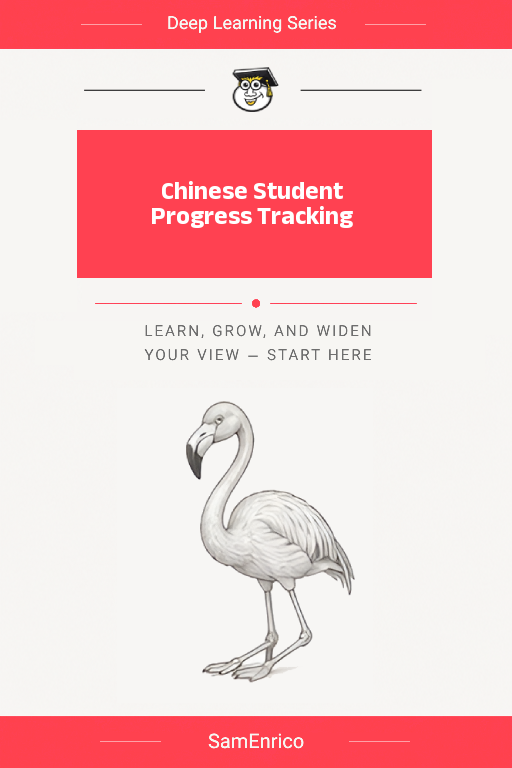
Non-FictionSide Hustle ArchitectAssessment
Chinese Student Progress Tracking eBook
Show measurable English improvement to Chinese par
Show measurable English improvement to Chinese parents with data sheets. Track vocabulary growth, fluency metrics, and test score changes over time.
Formats
Free sample
Chapter 1: The Ganjao Illusion--–- It begins, as it always does, with a parent staring at a test score and feeling something that is not quite relief and not quite panic. The score is 78 out of 100. Last month it was 74. The month before that, 81. The line goes up, then down, then sideways.
The parent frowns, sighs, and makes a mental note to speak with the tutor. Another month passes. Another score arrives. The feeling persists: a low-grade anxiety that money is being spent on something invisible, like watering a garden in the dark.This is the Ganjao Trap.Ganjao (感觉) is the Chinese word for "feeling" or "sensation." In the context of a child's education, it is the primary decision-making tool for millions of parents. "I feel like his English is improving." "I feel like the tutor is not very good." "I feel like she studies hard but nothing changes." These feelings are not wrong.
They are simply not data. And when feelings replace measurement, parents make expensive mistakes: switching tutors every three months, buying the next flashy app, doubling homework hours, or worse – concluding that their child is simply "not good at English" and giving up.This chapter exists to break that cycle.The argument is simple and, once understood, irreversible. What you feel about your child's progress is feedback. It tells you that something is happening. But it does not tell you what, or how much, or in which direction.
Only data can do that. And the single most important shift you will make as a parent – more important than any tutor, any curriculum, any amount of paid instruction – is the shift from feeling-based parenting to evidence-based learning.This is not about becoming cold or mechanical. It is about becoming effective. The parents who succeed in accelerating their child's English progress are not the ones who love the most or push the hardest. They are the ones who track.
They keep dashboards. They measure vocabulary retention, not just vocabulary exposure. They time speech samples. They plot error decay curves. And because they can see progress, they do not panic.
Because they do not panic, they do not make desperate, expensive changes. And because they do not make desperate changes, their children actually improve faster.This chapter will teach you three things: why feelings fail, what evidence-based learning actually looks like in a Chinese household, and how to build the simplest possible data tool – the Single Page Dashboard – that will replace anxiety with clarity, starting tonight.The Neuroscience of Parental Anxiety Before we talk about data, we must talk about why feelings are so seductive. The human brain is not designed for probability and long-term trends. It is designed for stories. When your child brings home a low test score, your brain does not calmly think, "Let me check this against the baseline and see if this is an outlier." Instead, it tells a story: "The tutor is failing.
My child is lazy. We are falling behind the cousin. I am a bad parent." This story produces cortisol, the stress hormone. Cortisol makes you want to act immediately – to change something, anything – because action reduces anxiety in the short term, even if it is the wrong action.This is the Ganjao Trap operating at the biological level. Your feelings are real.
They are also terrible guides to educational decisions.Research from behavioral economics, particularly the work of Daniel Kahneman, shows that humans are consistently overconfident in their intuitions about complex systems. A child's English development is an extraordinarily complex system. It involves memory consolidation (which happens during sleep), motivation (which fluctuates with mood), teacher quality (which varies session by session), test conditions (which change daily), and dozens of other variables. No parent – no matter how attentive – can intuitively track all of these. Yet parents routinely make decisions as if they can.Consider a typical scenario.
A parent observes that their child seems more willing to speak English after switching to a new tutor. The parent concludes: the new tutor is better. But what else changed? The child slept an extra hour that week. There was a school holiday.
The topic was about video games, which the child loves. The improvement might have nothing to do with the tutor. Without data, the parent cannot know. And so they continue paying a premium for a tutor who may or may not be effective, while the real lever – sleep, interest, or topic alignment – remains untouched.The alternative is not to ignore feelings. The alternative is to treat feelings as hypotheses, not conclusions.
"I feel like she is improving" becomes a hypothesis to be tested against measurement. "I feel like the tutor is not working" becomes a trigger to examine the data, not a reason to cancel tomorrow. This simple reframing – from feeling to hypothesis – is the foundation of evidence-based learning.Performance vs. Proficiency: The Critical Distinction Most parents confuse two concepts that look similar but behave very differently: performance and proficiency.Performance is a single measurement on a single day. It is your child's score on last Tuesday's vocabulary quiz, when they had a headache and forgot to eat breakfast.
Performance is volatile. It jumps up and down based on sleep, mood, luck, and test difficulty. A child with mediocre English can have a great performance day. A child with excellent English can have a terrible performance day. Performance is like a photograph – a frozen moment that may or may not represent reality.Proficiency is the underlying ability that produces performance over time.
It is your child's true vocabulary size, their automaticity in grammar, their comfort with spoken English. Proficiency changes slowly. It does not jump around. A child with high proficiency will occasionally have low performance days, but over time, their scores will cluster in a high range. Proficiency is like a video – a pattern that emerges only when you watch many frames in sequence.Here is the mistake that almost all parents make: they react to performance as if it were proficiency.
A single low test score triggers panic. A single high test score triggers relief. But both reactions are wrong because they treat a single data point as meaningful. In reality, a single test score tells you almost nothing. It tells you that on that day, under those conditions, your child produced that number.
It does not tell you whether your child is improving, stagnating, or declining. For that, you need a trend line.This is why the Single Page Dashboard (introduced below) tracks only three metrics over time. You do not need more. You need a small number of metrics, measured consistently, to reveal the trend. The trend is the truth.
The individual scores are noise.Let us make this concrete. Imagine two children. Child A scores 80, 82, 79, 81, 80 on five monthly tests. The trend is flat. Their English is not improving, despite what the 82 might suggest.
Child B scores 70, 72, 75, 74, 78 on five monthly tests. The trend is upward. Their English is improving, despite the fact that their highest score (78) is lower than Child A's lowest score (79). If you only looked at the most recent score, you would think Child A is ahead. But Child…
This is the end of the free sample. Get the eBook to keep going. Buy now
About this book
Details
- Author
- Timm Rasheeda
- Publisher
- SamEnrico
- Language
- English
- Genre
- Non-Fiction, Side Hustle Architect, Assessment
- Released
- 2026-06-01
- Pages (approx.)
- 141
- Available as
- eBook, Audiobook

Read better in the ZLOADR app
Your eBooks on your phone or tablet. Sign in with your SamEnrico account and start reading.
More by Timm Rasheeda
 NuvaRing Removal EffectsTimm Rasheeda$11.99
 Networking for the Temporarily UnemployedTimm Rasheeda$11.99
 Gut Brain Axis and ObesityTimm Rasheeda$11.99
 Forgiveness of Others GuideTimm Rasheeda$11.99
 The Leshy's Labyrinth: Guardian of the Forbidden ForestTimm Rasheeda$11.99
 How to Produce BasketsTimm Rasheeda$11.99
 Dining Services Partner ServerTimm Rasheeda$11.99
 How to Start a Bolognas Business (Beginners Guide)Timm Rasheeda$11.99
You may also like
 Hong Kong Handover 1997Dunn Johnnie$11.99
 Zumba For Postnatal Recovery CourseNeal Christian$11.99
 Zumba for BeginnersLadner Nikia$11.99
 YouTube Comment Mining GuideHumes Pandora$12.99
 Worry Box MeditationCarlin Rudy$11.99
 Workplace Stress MeditationNguyen Lynn$11.99
 Workplace Stress and Sleep RepairHawley Ivory$11.99
 Workplace Perfectionism CureDelaney Jeffry$11.99
 Workplace Injustice Anger GuideWallen Isabelle$11.99
 Work Addiction and Burnout LinkGreenwood Ester$11.99
 Women in Yoga and WellnessBeattie Galina$11.99
 Women in Stand Up ComedyChun Evangeline$11.99