
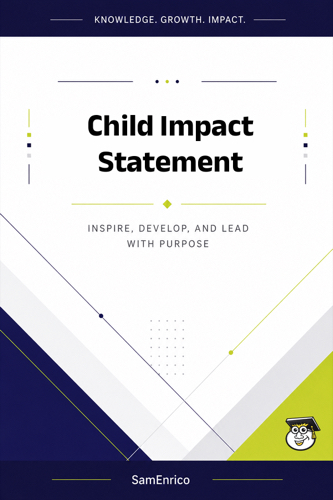
Non-FictionTrue CrimeChild Witness
Child Impact Statement eBook
A child describes losing a parent to murder in the
A child describes losing a parent to murder in their own words.
Formats
Free sample
Chapter 1: The Last Ordinary Tuesday...--The morning started with burnt toast.I remember the smell before I remember anything else—that sharp, acrid edge of carbon cutting through the kitchen's usual warmth. My father was at the stove, scraping a blackened slice of bread with a butter knife over the sink, muttering something under his breath that I wasn't supposed to hear. My mother sat at the kitchen table with her coffee, the steam curling up past her face, and she was laughing—that low, quiet laugh she had, the one that came from somewhere deep in her chest. She was reading the back of a cereal box, which I thought was strange because we weren't a cereal family. We were a toast-and-eggs family, or a leftover-pancakes-from-Sunday family, but never a cereal family.
That morning, though, there was a box of something called "Frosted Flakes" on the table, bright yellow and grinning, and my mother was reading the nutrition facts like they were a novel."You know," she said, not looking up, "this has eleven grams of sugar per serving."My father dropped the burnt toast into the trash can with a clatter. "Everything has sugar in it. That's what makes it food.""That's not how nutrition works.""That's how my happiness works."They were like that—a back-and-forth that looked like bickering to strangers but was really just the sound of two people who had been married long enough to finish each other's jokes. I was seven years old, and I didn't know that other families talked differently. I thought everyone's parents sounded like a comedy show that never ended, a radio playing in the background of every meal.I was sitting at the table in my blue shirt with the stain on the sleeve—the one my mother kept telling me to throw away, the one I refused to part with because it was the color of the sky on a clear day and because it was soft from too many washes.
My feet didn't touch the floor. They swung, two small pendulums counting down the minutes until school. My backpack was on the chair next to me, unzipped, a half-eaten apple rolling around at the bottom from yesterday. I had forgotten to eat it. I forgot a lot of things back then.The light through the kitchen window was that particular shade of morning gold that only happens in late spring, when the sun is still low enough to stretch across the whole room, turning everything pale and warm.
I can still see that light. I can still feel it on my arms, on the back of my neck, on the surface of my half-full glass of orange juice. There are moments in a life that get burned into you not because they're dramatic but because they're ordinary, and the ordinariness becomes the thing you mourn later. You don't miss the big moments. You miss the mornings with burnt toast and cereal-box nutrition facts and feet that don't touch the floor.My father rinsed his hands in the sink and turned around, drying them on a dish towel that had a faded picture of a lobster on it.
I don't know where the lobster towel came from. We had never been to Maine. We didn't eat lobster. But that towel had been hanging on the oven handle for as long as I could remember, and my father used it for everything—drying his hands, wiping counters, once even chasing a moth that had gotten into the house. He was a tall man, or he seemed tall to me then.
I have since learned that he was of average height, but when you are seven, every adult is a mountain. His hair was the color of wet sand, and he had a habit of pushing it off his forehead with the back of his wrist, leaving a streak of whatever he had just been touching. That morning, the streak was butter."Hey, kiddo," he said, and he reached over to ruffle my hair. His hand was warm. "You ready for the spelling test?"I had forgotten about the spelling test.
The word "forgot" appears a lot in this chapter, and that's because forgetting was my baseline state. I forgot homework. I forgot to bring my library books back. I forgot to put my shoes in the right place, which meant every morning was a frantic search under the couch, behind the television, once inside the refrigerator. (I still don't understand how that happened.) The spelling test was for words ending in "ight"—light, night, right, bright, fight.
I had studied, sort of, but "sort of" wasn't going to cut it."Maybe," I said.My mother looked up from the cereal box. "Maybe you're ready, or maybe you forgot?""Maybe I forgot," I admitted.She laughed again, that low laugh, and reached across the table to steal a piece of my toast—the one my father had made for me, the one that wasn't burnt. She tore off a corner and popped it into her mouth, and I remember thinking that she looked like a bird, quick and precise, her dark hair pulled back in a clip that was always threatening to fall out. My mother was not a tall woman, but she had a way of filling a room that made her seem larger than she was. She was the kind of person who remembered everyone's birthday, who sent thank-you cards for thank-you cards, who knew the names of the grocery store cashiers.
She was, in other words, the person who remembered things so that the rest of us didn't have to.I am seven years old in this chapter, and I don't know that I will spend the rest of my life trying to remember things about her. I don't know that the ordinary moments—the burnt toast, the lobster towel, the way she said "kiddo" like it was a secret between us—will become a kind of currency, something I hoard and count and guard. I am seven, and I think I have forever.The Geography of a Family Our house was small, the kind of small that meant you couldn't hide from anyone even if you wanted to. The kitchen opened into the living room, which opened into a hallway that led to three bedrooms and one bathroom. The walls were painted a color my mother called "eggshell" and my father called "white but boring," and they had argued about repainting for three years without ever actually doing it.
There were photographs on the walls—me as a baby, me at my first birthday, me on a beach somewhere, my parents on their wedding day, my parents at a concert I was too young to remember. The photographs were in mismatched frames, some wood, some metal, one plastic one shaped like a star that I had made in kindergarten and that my mother had hung up despite its obvious ugliness.The couch was green and had a stain on one cushion that no one could identify. My father called it "the mystery spot." My mother called it "the reason we can't have nice things." I called it…
This is the end of the free sample. Get the eBook to keep going. Buy now
About this book
Details
- Author
- Schmidt Derek
- Publisher
- SamEnrico
- Language
- English
- Genre
- Non-Fiction, True Crime, Child Witness
- Released
- 2026-06-06
- Pages (approx.)
- 127
- Available as
- eBook, Audiobook

Read better in the ZLOADR app
Your eBooks on your phone or tablet. Sign in with your SamEnrico account and start reading.
More by Schmidt Derek
 Assertiveness At Home GuideSchmidt Derek$11.99
 Name Memory for ExtrovertsSchmidt Derek$11.99
 Dale Earnhardt IntimidationSchmidt Derek$11.99
 Tobacco Free Generation GuideSchmidt Derek$11.99
 Methamphetamine Sobriety PlanSchmidt Derek$11.99
 Gaming Subscription Adoption TrendsSchmidt Derek$11.99
 Pauling Nature Chemical BondSchmidt Derek$11.99
 Whispers of the Wind and Water: The Forbidden Love of Star Boy and Water LilySchmidt Derek$11.99
 The Maestro of the Pitch: How a 19th-Century Coach Transformed Latin American FootballSchmidt Derek$11.99
 How to Produce Shoe CoversSchmidt Derek$11.99
 A Collector's Handbook to the BMW M1Schmidt Derek$11.99
 Historical Events Faceless Channel PlanSchmidt Derek$12.99
You may also like
 Hong Kong Handover 1997Dunn Johnnie$11.99
 Zumba For Postnatal Recovery CourseNeal Christian$11.99
 Zumba for BeginnersLadner Nikia$11.99
 YouTube Comment Mining GuideHumes Pandora$12.99
 Worry Box MeditationCarlin Rudy$11.99
 Workplace Stress MeditationNguyen Lynn$11.99
 Workplace Stress and Sleep RepairHawley Ivory$11.99
 Workplace Perfectionism CureDelaney Jeffry$11.99
 Workplace Injustice Anger GuideWallen Isabelle$11.99
 Work Addiction and Burnout LinkGreenwood Ester$11.99
 Women in Yoga and WellnessBeattie Galina$11.99
 Women in Stand Up ComedyChun Evangeline$11.99