
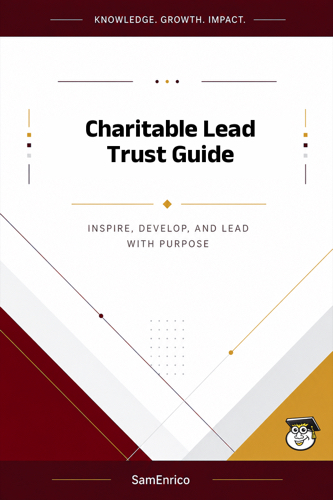
Non-FictionBusiness BriefCharitable Giving
Charitable Lead Trust Guide
Pay charity first then pass remaining assets to he
Pay charity first then pass remaining assets to heirs using this CLT handbook.
Formats
About this book
Free sample
Chapter 1: The Inversion Principle--–- Most wealthy individuals spend their entire lives asking the wrong question about their estates. They ask, “How do I give as little as possible to the IRS and as much as possible to my children?” That question, while understandable, has produced generations of estate plans built on delay, avoidance, and the hope that death will somehow erase the tax collector’s claim. This book proposes a fundamentally different question: “What if I could give my way out of estate taxes entirely by putting charity first?”The answer to that question lies in a remarkably elegant but underutilized vehicle called the Charitable Lead Trust. For reasons that range from simple lack of awareness to active resistance from advisors who prefer more conventional tools, the CLT remains one of the best-kept secrets in high-net-worth estate planning. This chapter introduces the inversion principle that drives the entire CLT strategy and explains why “paying charity first” is not an act of altruistic sacrifice but a financial masterstroke.The Traditional Model: Heirs First, Charity Last, IRS Always Before we can appreciate the power of inversion, we must understand the default estate planning model that governs most wealthy families.
Let us call this the “Heirs First” model. Under this approach, the donor structures their estate to pass maximum wealth to children and grandchildren while minimizing taxes. Charity, if it appears at all, is typically an afterthought—a bequest in the will, a donation of leftover assets, or perhaps a small annual gift to a favorite cause.The Heirs First model has a fundamental flaw: it treats taxes as a fixed cost to be reduced rather than as a variable that can be restructured. Consider a simple example. A donor has $10 million in highly appreciated stock.
Under the Heirs First model, the donor might hold the stock until death, allowing heirs to receive a “step-up” in basis under current tax law, eliminating capital gains. The estate pays 40 percent federal estate tax on anything above the exemption amount. The heirs receive approximately $6 million after taxes. The IRS receives $4 million. Charity…
This is the end of the free sample. Get the eBook to keep going. Buy now
Contents
- Chapter 1
- Chapter 2
- Chapter 3
- Chapter 4
- Chapter 5
- Chapter 6
- Chapter 7
- Chapter 8
- Chapter 9
- Chapter 10
- Chapter 11
- Chapter 12
Details
- Author
- Houston Bradford
- Publisher
- SamEnrico
- Language
- English
- Genre
- Non-Fiction, Business Brief, Charitable Giving
- Released
- 2026-06-06
- Pages (approx.)
- 145
- Available as
- eBook, Audiobook

Read better in the ZLOADR app
Your eBooks on your phone or tablet. Sign in with your SamEnrico account and start reading.
More by Houston Bradford
 Stress And Autoimmune FlaresHouston Bradford$11.99
 The Persuasion Resistance InoculationHouston Bradford$11.99
 Memory Palace Construction CourseHouston Bradford$11.99
 Nordic Consumer TrendsHouston Bradford$11.99
 The Lioness of Kush: Amanirenas and the Battle of AswanHouston Bradford$11.99
 Understanding Ovarian Dwarfism As PArt of Turner SyndromeHouston Bradford$17.99
 Tim Cook Leadership Priorities GuideHouston Bradford$12.99
 Facebook Pixel Setup Action GuideHouston Bradford$12.99
 How to Start a Packing and Crating BusinessHouston Bradford$11.99
 Aliettite MiningHouston Bradford$11.99
You may also like
 Hong Kong Handover 1997Dunn Johnnie$11.99
 Zumba For Postnatal Recovery CourseNeal Christian$11.99
 Zumba for BeginnersLadner Nikia$11.99
 YouTube Comment Mining GuideHumes Pandora$12.99
 Worry Box MeditationCarlin Rudy$11.99
 Workplace Stress MeditationNguyen Lynn$11.99
 Workplace Stress and Sleep RepairHawley Ivory$11.99
 Workplace Perfectionism CureDelaney Jeffry$11.99
 Workplace Injustice Anger GuideWallen Isabelle$11.99
 Work Addiction and Burnout LinkGreenwood Ester$11.99
 Women in Yoga and WellnessBeattie Galina$11.99
 Women in Stand Up ComedyChun Evangeline$11.99