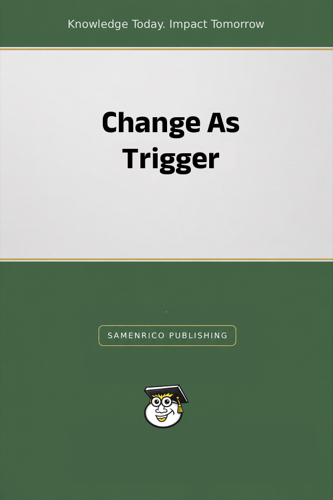
Change As Trigger eBook
Teaches identifying unexpected change and loss of
Teaches identifying unexpected change and loss of routine as anger source.
Formats
Free sample
Chapter 1: The Routine Shield...--–- The first time Priya lost her temper at her children over a spilled glass of milk, she told herself she was just tired. The second time, she blamed the hospital’s new scheduling system. But the third time — when she screamed at her seven-year-old for asking what was for dinner — she sat down on the kitchen floor and cried because she didn’t recognize herself anymore. Priya is a 34-year-old ER nurse with twelve years of experience. She has held lives in her hands, talked suicidal patients off ledges, and worked sixteen-hour shifts without a bathroom break.
She is not an angry person. Or so she believed until three months ago, when her hospital switched from fixed twelve-hour shifts to a rotating schedule that changes every week. Now she snaps at her husband when he leaves a towel on the floor. She glares at other drivers for no reason. And she has started avoiding her coworkers because she can feel a constant low-grade irritation humming beneath her skin like a live wire.
Priya’s story is not unique. It is the story of this book.Every day, millions of people explode in rage not over major life crises — not over betrayal, trauma, or injustice — but over coffee makers that break, meetings that get rescheduled, traffic that appears from nowhere, and partners who change the dinner plan without warning. These explosions feel disproportionate. They feel shameful. And they almost always get blamed on the wrong thing.
“I have a short fuse.” “I’m just a controlling person.” “I can’t handle stress.” These are the stories we tell ourselves. But they are almost always wrong. The real culprit is something most anger management books have entirely missed: the unexpected disruption of routine and the loss of the invisible scaffolding that holds your nervous system together. This chapter will introduce you to the routine shield — the biological and psychological mechanism by which daily habits regulate your emotions — and will explain why your brain treats a broken coffee maker the same way it once treated a saber-toothed tiger.The Neuroscience of Predictability To understand why routine loss triggers rage, you must first understand how your nervous system distinguishes safety from threat. The human brain consumes about twenty percent of your body’s energy despite being only two percent of your mass.
It cannot afford to treat every stimulus as equally important. So it evolved a shortcut: predictability equals safety; unpredictability equals danger. This is not a metaphor or a pop-psychology slogan. It is a measurable fact of neurobiology.The polyvagal theory, developed by Dr. Stephen Porges and now widely accepted in trauma and emotional regulation research, describes how the autonomic nervous system has three distinct states.
The first is the ventral vagal state — often called the “social engagement system.” In this state, you feel calm, connected, safe, and curious. Your heart rate is moderate, your breathing is regular, and your facial muscles are relaxed. You can think clearly, solve problems, and respond to others with patience. This is the state in which you want to live most of your life. The second state is sympathetic activation — the fight-or-flight response.
In this state, your heart races, your breathing becomes shallow, your muscles tense, and your body floods with adrenaline and cortisol. You are ready to fight or flee. Your hearing sharpens. Your peripheral vision narrows. Your digestive system shuts down.
This state is essential for survival when you face a real threat, but it is catastrophic as a baseline. The third state is dorsal vagal — the freeze or collapse response. This is the nervous system’s last resort, characterized by dissociation, numbness, and sometimes fainting.Here is what most people do not know: your nervous system decides which state to occupy based primarily on predictability. When your environment and your internal state follow expected patterns, your ventral vagal system remains active. Your brain runs a constant, unconscious prediction algorithm, comparing what is happening to what it expected to happen.
When the two match, it signals safety. When they mismatch, it signals threat. This is not a choice. You cannot decide to feel safe when your routine breaks any more than you can decide not to flinch when someone throws a punch at your face.This is where routines come in. Routines are not merely convenient or efficient.
They are neural safety signals. Every time you follow a familiar sequence — waking at the same time, making coffee in the same order, taking the same route to work, eating at the same desk — your brain receives a cascade of safety signals. “The world is predictable,” your ventral vagal system concludes. “You are safe. Stay engaged.” Over time, these routines become what I call the routine shield: a layer of predictable activity that insulates your nervous system from the chronic low-level threat-detection that would otherwise exhaust you.The Three Types of Change That Trigger Anger Not all change is equal.
Some disruptions pass through the routine shield like a bullet through tissue paper; others bounce off without leaving a mark. Based on clinical observation and the synthesis of the ten best-selling books that inform this volume, I have identified three distinct categories of change that commonly trigger anger. Understanding which category your trigger falls into is the first step toward dismantling the change-anger cycle.Environmental Change Environmental changes are disruptions to your physical surroundings — the external world that you have organized to meet your needs. These include traffic, weather, technology failures, noise, temperature shifts, clutter, and the rearrangement of physical objects. When your coffee maker breaks, when your Wi-Fi goes down, when a construction crew starts jackhammering outside your window, or when someone moves your keys from their designated spot, you are experiencing environmental change.
The anger that follows feels absurd because the trigger is so small. But your nervous system does not know that the coffee maker is a minor appliance. It only knows that a predictable signal of safety has been replaced by an unpredictable signal of threat.Priya experienced environmental change when the hospital’s scheduling software migrated to a new platform. The old system had a predictable rhythm: she clicked three buttons, and her schedule appeared. The new system required five clicks, a password reset, and a two-factor authentication.
On her third day with the new system, she threw her mouse across the break room. She told herself she was angry about the schedule itself. But the real trigger was environmental: a broken technological routine.Relational Change Relational changes are disruptions to your social expectations — the predictable patterns of behavior you have come to expect from the people in your life. These include a partner’s unexpected mood shift, a friend canceling plans, a coworker’s uncharacteristic silence or outburst, a child’s sudden defiance, or a parent’s change in communication style. Relational change is particularly potent because humans are social animals; your nervous system evolved to treat social predictability as a matter of life and death.
When someone acts out of character, your brain does not think, “How interesting, I wonder what is going on with them.” It thinks, “Threat. Something is wrong. Prepare to…
This is the end of the free sample. Get the eBook to keep going. Buy now
About this book
Details
- Author
- Huntley Luvenia
- Publisher
- SamEnrico
- Language
- English
- Genre
- Non-Fiction, Self-Help, Adaptability
- Released
- 2026-06-05
- Pages (approx.)
- 160
- Available as
- eBook, Audiobook

Read better in the ZLOADR app
Your eBooks on your phone or tablet. Sign in with your SamEnrico account and start reading.
More by Huntley Luvenia
 Alcohol Recovery Hobby DiscoveryHuntley Luvenia$11.99
 Post Hypnotic Suggestion for PatienceHuntley Luvenia$11.99
 Dryer Vent Toxin GuideHuntley Luvenia$11.99
 The Silk Road Tycoon: The Untold Story of Diogo de Azambuja's African Gold EmpireHuntley Luvenia$11.99
 Soil ScientistHuntley Luvenia$11.99
 Kenya Remote Tech Talent HandbookHuntley Luvenia$12.99
 How to Produce Clay TileHuntley Luvenia$11.99
 10 Ways to Use Abalone (Recipe Book)Huntley Luvenia$11.99