
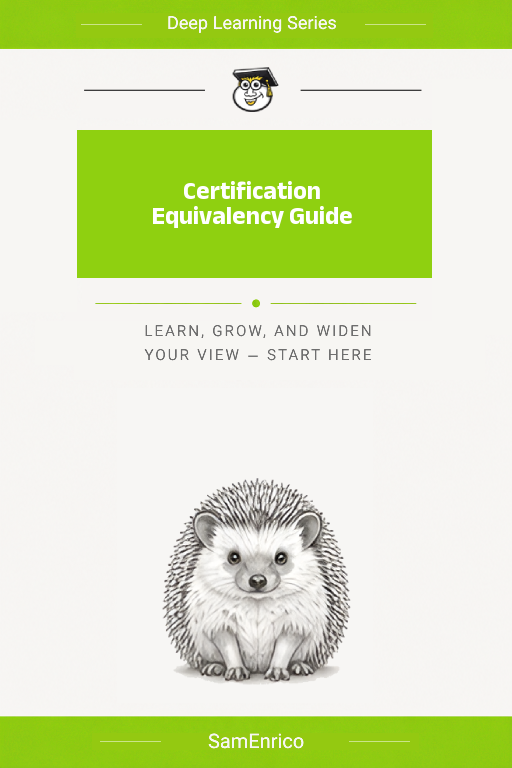
Certification Equivalency Guide eBook
Navigate equivalency between sustainability certif
by Major Aurore
Navigate equivalency between sustainability certifications for export to avoid duplicate audits and recognition gaps.
Formats
Free sample
Chapter 1: The Proliferation Trap--Mai Tran stared at the spreadsheet on her screen, the numbers blurring after fourteen straight hours of audit preparation. The coffee cooperative she had built over fifteen years in the highlands of Lam Dong, Vietnam, was profitable. The beans were excellent – single-origin arabica, cupping scores consistently above 86 points. Her farmers were paid fairly. The forest canopy remained intact.
By any reasonable measure, Mai Tran ran a sustainable operation.But reason, she had learned, had nothing to do with certification.The spreadsheet told a different story. Row after row listed certifications, each with its own annual fee, its own audit schedule, its own documentation requirements, and its own definition of what "sustainable" meant. Rainforest Alliance: 47,000peryear,auditeverytwelvemonths,requiresthreeseparatesiteinspections,usesawatertestingprotocolthatdemandssamplesbeshippedto Germanywithinseventy−twohours.Fairtrade:47,000 per year, audit every twelve months, requires three separate site inspections, uses a water testing protocol that demands samples be shipped to Germany within seventy-two hours. Fairtrade: 47,000peryear,auditeverytwelvemonths,requiresthreeseparatesiteinspections,usesawatertestingprotocolthatdemandssamplesbeshippedto Germanywithinseventy−twohours.Fairtrade:38,000 per year, audit every fifteen months, requires separate smallholder organization records, uses a different water testing protocol that demands on-site analysis by an approved local laboratory. Organic US/EU: 52,000peryear,auditannually,requiresthreeyearsofconversiondocumentation,prohibitscertaininputsthat Rainforest Allianceallows.4CAssociation:52,000 per year, audit annually, requires three years of conversion documentation, prohibits certain inputs that Rainforest Alliance allows.
4C Association: 52,000peryear,auditannually,requiresthreeyearsofconversiondocumentation,prohibitscertaininputsthat Rainforest Allianceallows.4CAssociation:23,000 per year, audit every eighteen months, less stringent on biodiversity but requires extensive child labor monitoring that partially overlaps with Fairtrade's requirements but not completely.Total: $160,000 in direct certification fees. Plus the internal cost of Carlos, her quality manager, spending nearly half his time on nothing but audit preparation. Plus the opportunity cost of lost sales when buyers demanded certifications the cooperative didn't have. Plus the sheer, grinding exhaustion of explaining to her farmers why the same coffee, grown on the same land, processed in the same facility, required four different logos to reach four different markets.And now, as if the universe had a dark sense of humor, her largest European buyer had just sent an email that would change everything."We regret to inform you," the email read, "that effective January 1, our sourcing policy will require all coffee suppliers to provide geo-location polygon data for every production plot, verified by third-party deforestation assessment, in accordance with the EU Deforestation Regulation. Your current Rainforest Alliance certification, while valued, does not automatically satisfy this requirement.
Please contact us to discuss a supplementary audit."Mai closed her laptop and walked outside. The sun was setting over the coffee trees, the red volcanic soil glowing in the last light. Her grandfather had planted the first trees on this land in 1975, when the war ended and the government distributed land to returning families. He had taught her that a good harvest was about patience, about understanding the rhythm of the land, about knowing when to prune and when to let the trees rest.He had not taught her how to navigate the proliferation trap.The Proliferation Trap Defined The proliferation trap is the central paradox of modern sustainability certification: more certifications often mean less market access, not more. It is the condition in which the very tools designed to verify responsible production multiply to the point that they defeat their own purpose, creating a labyrinth of overlapping, conflicting, and competing requirements that exporters must navigate at immense cost.Here is how the trap works.
In the 1980s, sustainability certification was a novelty. The Forest Stewardship Council launched in 1993 as a response to tropical deforestation. The organic certification movement gained traction in Europe. There were perhaps a dozen meaningful eco-labels worldwide. A producer who obtained one could credibly claim to be a leader, and buyers who demanded certification were rare enough that compliance was a competitive advantage rather than a cost of entry.By 2025, that world is unrecognizable.
The International Trade Centre's Standards Map – a digital registry of sustainability initiatives – tracks more than 230 distinct certification schemes operating in global trade. These range from the well-known (FSC for forestry, Fairtrade for smallholder agriculture, GLOBALG.A.P. for food safety) to the obscure (the Roundtable on Sustainable Palm Oil, the Aquaculture Stewardship Council, the Responsible Jewellery Council, the Better Cotton Initiative, the Leather Working Group, the Forest Trust, the Rainforest Alliance's new 2020 version, the old Rainforest Alliance version that some buyers still accept, and so on, and so on).Each of these schemes is, in isolation, defensible. Each has legitimate governance structures, credible audit protocols, and genuine environmental or social objectives. Each has been adopted by some set of buyers who find it useful.But taken together, they create a system that no single producer can reasonably navigate.
The trap has three interlocking mechanisms.First, overlap without alignment. Multiple certifications cover the same issues – water quality, worker safety, carbon accounting – but use different definitions, thresholds, evidence formats, and audit cycles. A water test that satisfies Rainforest Alliance may not satisfy Fairtrade, not because the water is any different, but because the protocols diverge in ways that have no material significance. The result is redundant work.Second, exclusive buyer requirements. Large retailers and food companies have begun demanding their own proprietary certification standards or endorsing specific schemes over others.
A European supermarket chain might accept only GLOBALG.A.P. for fresh produce. A Japanese trading house might require Fairtrade for coffee but Rainforest Alliance for cocoa. A Chinese customs official might recognize ISCC for biofuels but not a scheme from a different jurisdiction. The exporter cannot choose one certification; they must maintain a portfolio, because different buyers demand different badges.Third, regulatory creep.
What began as voluntary, buyer-driven certification is rapidly becoming mandatory through regulation. The EU Deforestation Regulation, which entered into force in June 2025, prohibits the import of commodities linked to deforestation regardless of private certification. The Corporate Sustainability Due Diligence Directive will require companies to audit their entire supply chains for human rights and environmental risks. These regulations do not replace private certifications; they add new layers on top of them. An exporter who already holds Rainforest Alliance or Fairtrade must now also comply with EUDR, which requires different documentation, different data formats, and different verification protocols.The trap, in short, is that the proliferation of sustainability standards has transformed what was once a marketing choice into a compliance nightmare.
And the victims are not the large multinational corporations that can afford dedicated sustainability departments. The victims are the Mai Trans of the world – the medium-sized exporters, the farmer cooperatives, the family-owned processors – who lack the scale to absorb the costs but cannot opt out because certification has become a condition of market access.The Banana Exporter's Nightmare To understand how the proliferation trap operates in practice, consider the case of a banana exporter in Ecuador. This exporter supplies fresh bananas to three European supermarket chains, each with slightly different sourcing policies. To access all three markets, the exporter must maintain three certifications simultaneously: GLOBALG.A.P., Rainforest Alliance, and Fairtrade.The table below, drawn from real industry data, illustrates the duplication.Requirement Category – GLOBALG.A.P. – Rainforest Alliance – Fairtrade – Overlap (Unique to One Standard)Water testing frequency – Quarterly – Monthly – Quarterly – Rainforest Alliance more frequent but same lab Worker safety training – Annual…
This is the end of the free sample. Get the eBook to keep going. Buy now
About this book
Details
- Author
- Major Aurore
- Publisher
- SamEnrico
- Language
- English
- Genre
- Non-Fiction, Business Brief
- Released
- 2026-05-30
- Pages (approx.)
- 143
- Available as
- eBook, Audiobook

Read better in the ZLOADR app
Your eBooks on your phone or tablet. Sign in with your SamEnrico account and start reading.
More by Major Aurore
 Affirmation Breathwork IntegrationMajor Aurore$11.99
 Workplace Self TalkMajor Aurore$11.99
 The CrossFit Beginners GuideMajor Aurore$11.99
 The UK Influencer Disclosure GuideMajor Aurore$11.99
 Australian Business GuideMajor Aurore$11.99
 The Brush and the Beacon: How a Liberian Artist Lit the Fires of African ModernismMajor Aurore$11.99
 Understanding UrticariaMajor Aurore$17.99
 How to Start a Domestic Hollow Ware Made of Metal Business (Beginners Guide)Major Aurore$11.99
 Low Income Payment MethodsMajor Aurore$12.99
 Head of Financial Planning and AnalysisMajor Aurore$11.99
You may also like
 Hong Kong Handover 1997Dunn Johnnie$11.99
 Zumba For Postnatal Recovery CourseNeal Christian$11.99
 Zumba for BeginnersLadner Nikia$11.99
 YouTube Comment Mining GuideHumes Pandora$12.99
 Worry Box MeditationCarlin Rudy$11.99
 Workplace Stress MeditationNguyen Lynn$11.99
 Workplace Stress and Sleep RepairHawley Ivory$11.99
 Workplace Perfectionism CureDelaney Jeffry$11.99
 Workplace Injustice Anger GuideWallen Isabelle$11.99
 Work Addiction and Burnout LinkGreenwood Ester$11.99
 Women in Yoga and WellnessBeattie Galina$11.99
 Women in Stand Up ComedyChun Evangeline$11.99