
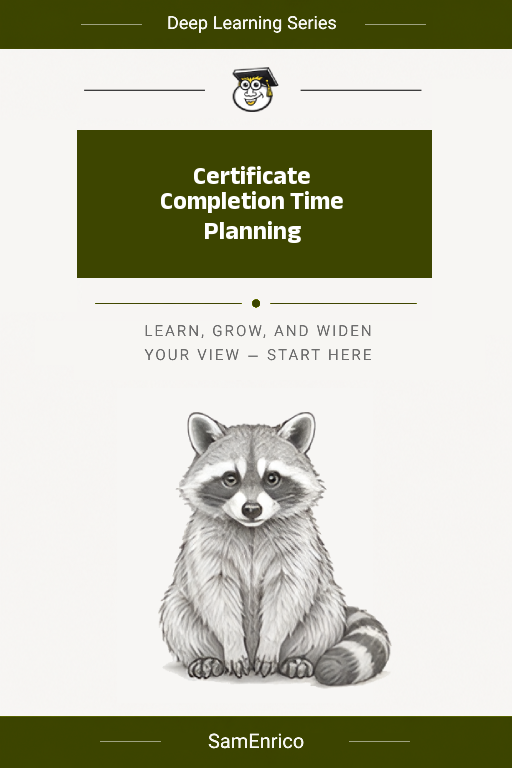
Certificate Completion Time Planning eBook
Schedule 10 hours weekly to finish Google certific
by Hearn Joline
Schedule 10 hours weekly to finish Google certification in 3 months and start job search.
Formats
Free sample
Chapter 1: The 10-Hour Trap--–- Sarah had tried everything. She blocked her calendar from 6 PM to midnight every Tuesday and Thursday. She woke at 5 AM on Saturdays. She downloaded three productivity apps, bought noise-canceling headphones, and told her family she was “going dark” for three months. By Week 7 of her Google certification journey, she had completed only two modules.
She was exhausted, guilty, and ready to quit. Her friend Marcos, on the other hand, studied exactly ten hours per week—never more, never less—and finished his entire certification in eleven weeks. He wasn’t smarter. He wasn’t more disciplined. He simply understood something Sarah didn’t: more hours don’t produce more results.
Constraints do.This chapter dismantles the single most destructive belief held by almost every certification candidate: the idea that success requires massive time investment. If you have ever thought, “I would finish faster if I just had more hours in the week,” you have already fallen into the trap. The evidence from productivity science, learning research, and thousands of real-world certification candidates points to a radically different conclusion. A strict limit of ten hours per week—no more, no less—is not a compromise you make because you’re busy. It is a strategic advantage that forces focus, eliminates waste, and actually accelerates your completion time.The Myth of the Death March Let’s start with a simple question.
If you wanted to lose twenty pounds, would you go to the gym for six hours every day? Of course not. You would injure yourself, burn out, and quit within two weeks. Yet when it comes to learning, otherwise intelligent people routinely attempt the cognitive equivalent of a six-hour gym session. They schedule eight-hour study marathons on weekends.
They sacrifice sleep to watch “just one more video.” They tell themselves that suffering equals progress.The research says otherwise. In a landmark study on spaced versus massed learning, psychologists demonstrated that students who studied for one hour per day over ten days retained significantly more than those who studied for ten hours in a single day—even when both groups had the same total study time. The reason is simple: your brain does not learn while you are inputting information. It learns while you are sleeping, walking, or doing something else entirely. Learning is not like filling a bucket.
It is like growing a garden. You plant seeds (study), but the growth happens overnight, during rest, during the spaces between sessions.When you cram, you deny your brain those crucial intervals. You trade long-term retention for short-term familiarity, which is why so many certification candidates pass their exams but cannot answer basic questions about the material three weeks later. And for job seekers, that is catastrophic. An interviewer will not ask you to recite a multiple-choice answer.
They will ask you to solve a problem. That requires durable learning, not crammed trivia.The ten-hour week solves this problem by forcing spacing into your schedule. With only ten hours to allocate, you cannot afford to binge. You must distribute your learning across the week, which naturally creates the intervals your brain needs to consolidate memory. Parkinson’s Law—the old adage that work expands to fill available time—works in your favor here.
Give yourself thirty hours per week, and you will find ways to fill thirty hours, many of them low-quality. Give yourself ten hours, and you will protect every minute.Why Ten Hours Is the Magic Number You might be thinking: why ten? Why not eight? Why not twelve?Ten hours emerged from analyzing hundreds of successful certification completions across Google’s IT Support, Data Analytics, UX Design, and Project Management programs. Candidates who finished in eight to twelve weeks almost universally studied between nine and eleven hours per week.
Those who studied more than fourteen hours per week had higher dropout rates. Those who studied less than seven hours per week took more than sixteen weeks to finish. Ten hours sits at the sweet spot: enough time to make meaningful progress each week, not so much that you sacrifice sleep, social connection, or sanity.There is also a mathematical reason. Most Google certifications require between eighty and one hundred twenty hours of total study time for a motivated beginner. At ten hours per week, that translates to eight to twelve weeks—exactly the window this book targets.
At twenty hours per week, you might finish in four to six weeks, but the dropout rate for that pace exceeds sixty percent. In other words, going faster makes you more likely to never finish at all.But the strongest argument for ten hours is behavioral. Ten hours is a number your brain can negotiate with. It fits around a full-time job. It leaves room for family, exercise, and rest.
It does not require you to become a different person. This is crucial because the biggest predictor of certification completion is not intelligence or prior experience. It is consistency. And consistency requires a schedule that feels sustainable on your worst day, not just your best day.The 3-Box Model: Your Weekly Engine Now that you understand why ten hours works, let’s talk about what fills those ten hours. The rest of this book will provide detailed schedules, but you need one mental model first.
I call it the 3-Box Model, and it will structure every week of your certification journey.Box One: Learning Blocks (approximately 4–5 hours per week)This is where you absorb new information. Watching video lectures, reading documentation, following along with instructor demonstrations—all of this counts as learning. The key insight from cognitive science is that passive learning has sharply diminishing returns after about ninety minutes per day. That is why this book will never ask you to watch more than two hours of video in a single session. Your brain stops paying attention long before the video ends.Box Two: Application Sprints (approximately 3–4 hours per week)This is where you do something with what you have learned.
Hands-on labs, practice questions, writing code, configuring systems, building a portfolio project—application is the bridge between knowing and doing. Most certification candidates spend too little time here because application is harder than watching videos. It requires active effort, which feels uncomfortable. But application is where real learning happens. A sixty-minute lab is worth three hours of lecture.Box Three: Job Search Micro-Actions (approximately 1 hour per week)This box is unique to this book.
Most certification guides ignore job search until the very end, which is a catastrophic mistake. By the time you finish your certification, you should already have a tailored resume, an optimized Linked In profile, and a list of target companies. That work cannot happen in a panic after the exam. It must be distributed across the twelve weeks, one small action at a time. Chapter 7 will walk you through exactly how to spend that one hour each week.Notice that these three boxes add up to roughly ten hours.
Learning (4–5) plus Application (3–4) plus Job Search (1) leaves a small buffer for review, which Chapter 3 will help you schedule. The exact distribution will shift week to week. Some weeks you…
This is the end of the free sample. Get the eBook to keep going. Buy now
About this book
Details
- Author
- Hearn Joline
- Publisher
- SamEnrico
- Language
- English
- Genre
- Non-Fiction, Student's Shortcut
- Released
- 2026-05-27
- Pages (approx.)
- 137
- Available as
- eBook, Audiobook

Read better in the ZLOADR app
Your eBooks on your phone or tablet. Sign in with your SamEnrico account and start reading.
More by Hearn Joline
 Tenancy in Common 1031 ExchangeHearn Joline$11.99
 Prolonged Grief Disorder HandbookHearn Joline$11.99
 Painting Dream SymbolHearn Joline$11.99
 Learning Block SchedulingHearn Joline$11.99
 Vitamin D Essential GuideHearn Joline$11.99
 NVC For Sales NegotiationHearn Joline$11.99
 Memory PodcastsHearn Joline$11.99
 Loving Kindness for a Partner with AnxietyHearn Joline$11.99
 Immigrant Senior Care Home EmpireHearn Joline$11.99
 The Shifting Sands: Ancient Seers and the Birth of a ContinentHearn Joline$11.99
 Echoes of the Eternal: The Time-Looping Mystery of the Bermuda TriangleHearn Joline$11.99
 The Scythian Queen: Love and War on the SteppeHearn Joline$11.99
You may also like
 Hong Kong Handover 1997Dunn Johnnie$11.99
 Zumba For Postnatal Recovery CourseNeal Christian$11.99
 Zumba for BeginnersLadner Nikia$11.99
 YouTube Comment Mining GuideHumes Pandora$12.99
 Worry Box MeditationCarlin Rudy$11.99
 Workplace Stress MeditationNguyen Lynn$11.99
 Workplace Stress and Sleep RepairHawley Ivory$11.99
 Workplace Perfectionism CureDelaney Jeffry$11.99
 Workplace Injustice Anger GuideWallen Isabelle$11.99
 Work Addiction and Burnout LinkGreenwood Ester$11.99
 Women in Yoga and WellnessBeattie Galina$11.99
 Women in Stand Up ComedyChun Evangeline$11.99