
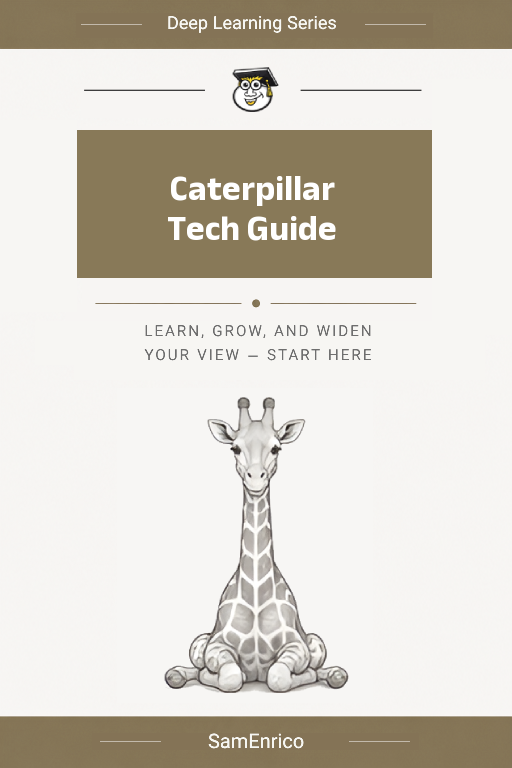
Non-FictionStrategic AtlasIndustrial Patents
Caterpillar Tech Guide eBook
Explore heavy equipment maker's autonomous mining,
Explore heavy equipment maker's autonomous mining, electric powertrain, and telematics patent innovations.
Formats
Free sample
Chapter 1: The Yellow Lie...–- In the boardrooms of Deerfield, Illinois, a quiet revolution has been underway for nearly two decades. The world still sees Caterpillar Inc. as the company that paints the earth yellow—a manufacturer of brute-force bulldozers, excavators that bite into hillsides, and haul trucks that move mountains one scoop at a time. That image is not wrong, but it is dangerously incomplete. It is the “Yellow Lie”—the comfortable fiction that heavy industry moves at the same slow, mechanical pace it always has.
The truth, buried in thousands of patent filings and whispered in engineering conferences, is that Caterpillar has quietly transformed into a data and automation company that happens to manufacture heavy steel. This chapter dismantles the outdated image, introduces the “Patent Thesis” as a roadmap for seeing the future before it arrives, and establishes the three foundational pillars—Autonomy, Electrification, and Connectivity (AEC)—that will define the next generation of mining. More importantly, it sets the consistent argument that runs through this entire book: technology does not eliminate miners; it elevates them.The Boardroom That Changed Everything In 2007, Caterpillar’s leadership gathered for a strategy review that would determine the company’s trajectory for the next thirty years. The mining boom was in full swing. China’s appetite for coal, copper, and iron ore seemed insatiable.
Competitors like Komatsu and Liebherr were racing to build larger, more powerful machines. The obvious answer was to double down on what Caterpillar had always done best: build bigger iron. But the engineers in the room presented an alternative. They showed slides of Moore’s Law—the observation that computing power doubles roughly every two years—and plotted it against the much slower curve of diesel engine efficiency. The two lines crossed somewhere around 2015.
Beyond that point, the engineers argued, the most important improvements would come not from larger cylinders or stronger steel, but from software. The room fell silent. Then the president asked a question that would become legend: “So you’re telling me we should become a technology company that happens to build tractors?” The chief engineer replied, “No. I’m telling you we already are one. We just haven’t admitted it yet.”That moment marked the beginning of what this book calls the “Yellow Lie”—not a malicious deception, but a strategic necessity.
Caterpillar could not announce to the world that it was pivoting to data and autonomy while its core customers were still buying diesel-powered machines by the thousands. So the company maintained the public image of a traditional manufacturer while quietly building one of the most sophisticated technology portfolios in heavy industry. Today, Caterpillar holds over 15,000 active patents. More than 40 percent of them relate to software, sensors, autonomy, or electrification—not mechanical systems. The Yellow Lie allowed Caterpillar to keep selling its existing products while secretly inventing the products that would eventually replace them.The Patent Thesis: Reading the Future in Legal Filings The central methodological claim of this book is what I call the “Patent Thesis.” Simply stated: a company’s patent filings reveal its strategic direction years—sometimes a decade—before its products reach the market.
Patents are not accidental. Each filing costs tens of thousands of dollars in legal fees and represents years of research and development. Companies do not patent technologies they do not intend to commercialize. Moreover, the patent system requires applicants to describe their inventions in sufficient detail that a “person skilled in the art” could replicate them. This means patents are not vague marketing documents; they are technical blueprints.
For those willing to read them, patents offer a window into the future.Consider patent US2025022683, filed in late 2022 and published in 2024. The title is mundane: “Automated Drill Rig Control System.” The abstract is dense with legal jargon. But beneath the legalese lies a radical claim: a drilling machine that can position itself, select a drill bit, thread it into the chuck, execute a precise blast-hole pattern, detect bit wear, and swap the bit for a new one—all without any human intervention. At the time of filing, Caterpillar had not announced any autonomous drilling product. Industry analysts were still focused on autonomous haul trucks, which had been in development for years.
But the patent told a different story. Caterpillar was already solving the harder problem: autonomous drilling, which requires not just navigation but physical manipulation of heavy components in a dusty, vibrating environment. Two years after the patent was published, Caterpillar quietly began field trials of its autonomous drill system. The patent had predicted the future with remarkable accuracy.This book will analyze dozens of patents across the three pillars of autonomy, electrification, and connectivity. Each chapter focuses on a specific patent or family of patents, explaining not just what the technology does but why it matters for the future of mining.
The Patent Thesis is not about legal trivia; it is about seeing around corners. For mine operators, equipment dealers, and technology investors, understanding Caterpillar’s patent portfolio is the closest thing to having a crystal ball.Three Pillars, One Future Before diving into specific patents, we must establish the framework that organizes this book. Caterpillar’s transformation rests on three interconnected pillars: Autonomy, Electrification, and Connectivity (AEC) . These are not separate initiatives but a single integrated strategy. Autonomy without connectivity is a machine that cannot communicate its intent.
Electrification without autonomy is a cleaner machine that still requires a human operator. Connectivity without electrification is a data stream that cannot act on its own insights. The magic—and the competitive advantage—lies in the fusion of all three.Autonomy means machines that can perceive their environment, make decisions, and execute tasks without real-time human control. This is the most visible pillar, the one that captures the public imagination. But autonomy in mining is fundamentally different from autonomy on public roads.
A self-driving car must navigate unpredictable human drivers, pedestrians, and traffic signals. A self-driving haul truck operates on private roads with known geometry, predictable traffic patterns, and no pedestrians. The problem is actually simpler—except for the extreme weights, the dust that blinds sensors, and the vibrations that shake electronics apart. Autonomous mining is not easier than autonomous driving; it is differently hard.Electrification means replacing diesel engines with battery-electric powertrains, hydrogen fuel cells, or trolley systems that draw power from overhead lines. The motivation is partly environmental—mining companies face mounting pressure to reduce carbon emissions—but the real driver is economic.
Electric motors produce full torque from zero RPM, which means they can accelerate loaded trucks faster than diesels. They have far fewer moving parts, which reduces maintenance costs. And they can capture energy through regenerative braking when trucks descend into pits. The challenge is energy density. Diesel fuel contains about fifty times more energy per kilogram than the best lithium-ion batteries.
Electrifying a mine site requires not just new trucks but new infrastructure: charging stations, battery swap depots, and possibly grid upgrades. The patents in this pillar reveal how Caterpillar is solving these problems, from high-voltage safety systems to thermal management in dusty environments.Connectivity means the network that ties machines together and links them to remote operators. This is the…
This is the end of the free sample. Get the eBook to keep going. Buy now
About this book
Details
- Author
- Hutson Maryanna
- Publisher
- SamEnrico
- Language
- English
- Genre
- Non-Fiction, Strategic Atlas, Industrial Patents
- Released
- 2026-05-26
- Pages (approx.)
- 158
- Available as
- eBook, Audiobook

Read better in the ZLOADR app
Your eBooks on your phone or tablet. Sign in with your SamEnrico account and start reading.
More by Hutson Maryanna
 Scott Peterson Laci Financial Problems MotiveHutson Maryanna$11.99
 HRT For Sleep Disturbance CourseHutson Maryanna$11.99
 The Empathy for Angry People GuideHutson Maryanna$11.99
 Social Ease TriggerHutson Maryanna$11.99
 PCOS Stress Cortisol ReductionHutson Maryanna$11.99
 The Codebreaker Who Outsmarted the Nazis: Alan Turing's Hidden WarHutson Maryanna$11.99
 Understanding Pemphigus Vulgaris, FamilialHutson Maryanna$17.99
 Domain Broker Service GuideHutson Maryanna$12.99
 Product Data AnalystHutson Maryanna$11.99
 How to Start a Hobby in TrackHutson Maryanna$11.99
You may also like
 Hong Kong Handover 1997Dunn Johnnie$11.99
 Zumba For Postnatal Recovery CourseNeal Christian$11.99
 Zumba for BeginnersLadner Nikia$11.99
 YouTube Comment Mining GuideHumes Pandora$12.99
 Worry Box MeditationCarlin Rudy$11.99
 Workplace Stress MeditationNguyen Lynn$11.99
 Workplace Stress and Sleep RepairHawley Ivory$11.99
 Workplace Perfectionism CureDelaney Jeffry$11.99
 Workplace Injustice Anger GuideWallen Isabelle$11.99
 Work Addiction and Burnout LinkGreenwood Ester$11.99
 Women in Yoga and WellnessBeattie Galina$11.99
 Women in Stand Up ComedyChun Evangeline$11.99