
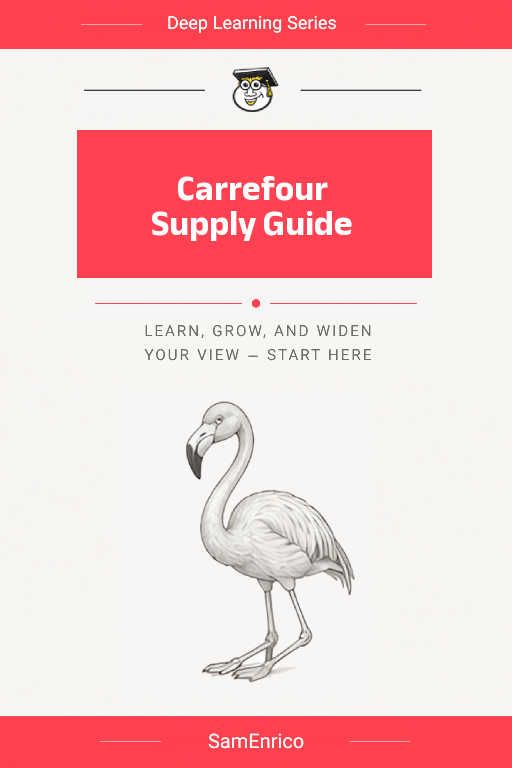
Non-FictionStrategic AtlasEuropean Retail
Carrefour Supply Guide
Trace hypermarket logistics, cross-docking, and pe
Trace hypermarket logistics, cross-docking, and perishable supply chains for European retail leader.
Formats
About this book
Free sample
Chapter 1: Inventory Is Liabilities--– In the summer of 2004, a senior logistics analyst at Carrefour’s headquarters in Boulogne-Billancourt ran a seemingly routine report comparing inventory turns across European retailers. The numbers that came back stopped the meeting cold. Carrefour was sitting on thirty-eight days of stock across its French hypermarkets. Tesco, its fiercest rival, was operating on twenty. The difference was not a footnote in an internal memo.
It was a crisis dressed in spreadsheets. At an estimated cost of one hundred fifty million euros per day in tied-up working capital, inventory was not a necessary evil. It was the single largest source of cash bleeding silently from the balance sheet. That moment forced a question that no one at Carrefour had asked with sufficient honesty: Why are we storing so much of what we do not need?The answer, it turned out, was habit. For decades, hypermarket logistics had been built on a warehouse-first model.
Suppliers shipped full truckloads to regional distribution centers. Those distribution centers stored pallets for days or weeks. Store orders triggered picking, repacking, and a second leg of transport. The system was designed for a world where demand was predictable, shelf space was static, and the cost of capital was low. By 2004, none of those conditions held.
Carrefour was carrying billions in inventory that was slowly expiring, being discounted, or simply sitting as a monument to outdated thinking. That discovery launched one of the most consequential supply chain transformations in European retail history—and it began with a single, uncomfortable realization: inventory is not an asset. Inventory is a liability dressed in a balance sheet costume.This chapter builds the philosophical and operational foundation for everything that follows. We will establish why traditional warehousing became the default model for hypermarkets, why that model began to fail in the face of margin compression and omni-channel pressure, and how Carrefour’s leadership came to embrace cross-docking as the primary mechanism for inventory reduction. We will then advance beyond simple inventory minimization to the “zero stock” ideal—not literal emptiness, but the elimination of non-value-added touches through perfect synchronization.…
This is the end of the free sample. Get the eBook to keep going. Buy now
Contents
- Chapter 1
- Chapter 2
- Chapter 3
- Chapter 4
- Chapter 5
- Chapter 6
- Chapter 7
- Chapter 8
- Chapter 9
- Chapter 10
- Chapter 11
- Chapter 12
Details
- Author
- Mixon Alexander
- Publisher
- SamEnrico
- Language
- English
- Genre
- Non-Fiction, Strategic Atlas, European Retail
- Released
- 2026-05-30
- Pages (approx.)
- 148
- Available as
- eBook, Audiobook

Read better in the ZLOADR app
Your eBooks on your phone or tablet. Sign in with your SamEnrico account and start reading.
More by Mixon Alexander
 Sunbeam Healing LightMixon Alexander$11.99
 TM Sleep Improvement CourseMixon Alexander$11.99
 Chickenpox Vaccine ScheduleMixon Alexander$11.99
 Public Speaking AffirmationsMixon Alexander$11.99
 Gacy's Las Vegas Time PeriodMixon Alexander$11.99
 The Lioness of Dahomey: Warriors of the AmazonMixon Alexander$11.99
 Smoker Operator (BBQ)Mixon Alexander$11.99
 How to Become a Clothespin-drier OperatorMixon Alexander$11.99
 AI Video For EcommerceMixon Alexander$12.99
 Understanding Multiple AMixon Alexander$17.99
You may also like
 Hong Kong Handover 1997Dunn Johnnie$11.99
 Zumba For Postnatal Recovery CourseNeal Christian$11.99
 Zumba for BeginnersLadner Nikia$11.99
 YouTube Comment Mining GuideHumes Pandora$12.99
 Worry Box MeditationCarlin Rudy$11.99
 Workplace Stress MeditationNguyen Lynn$11.99
 Workplace Stress and Sleep RepairHawley Ivory$11.99
 Workplace Perfectionism CureDelaney Jeffry$11.99
 Workplace Injustice Anger GuideWallen Isabelle$11.99
 Work Addiction and Burnout LinkGreenwood Ester$11.99
 Women in Yoga and WellnessBeattie Galina$11.99
 Women in Stand Up ComedyChun Evangeline$11.99