
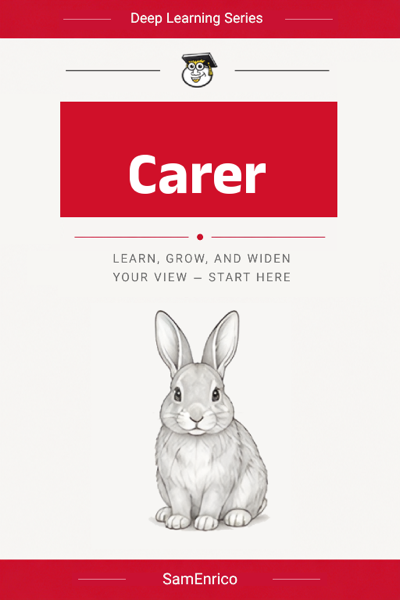
Non-FictionInformativeEducational
Carer eBook
A Coursebook on Carer
by Holmes Melba
A Coursebook on Carer
Formats
Free sample
Chapter 1: The Two Truths--– You are going to fail. Not because you are lazy, or unloving, or fundamentally broken as a human being. You are going to fail because you were told a lie. The lie is that if you try hard enough, love hard enough, sacrifice hard enough, the person you care for will eventually get “better.” They will remember your name again. They will stop hitting.
They will stop running away. They will stop screaming that they hate you. They will become the person they used to be, or the child you dreamed they could become. That lie is the most destructive force in caregiving, and it has already done damage to you whether you know it or not.This chapter exists to kill that lie. Not brutally, but with surgical precision.
Because once the lie is gone, something more useful can grow in its place. That something is the Two Truths. And the Two Truths will save your life, your sanity, and your capacity to actually help the person in your care.Let us begin with the first carer I ever met who told me the truth. Her name was Margaret, and she had cared for her husband with early-onset Alzheimer’s for seven years. Seven years of watching a man who had built houses with his hands forget how to hold a fork.
Seven years of answering the same question (“What time is dinner?”) forty times before noon. I asked her, in a moment of professional stupidity, “What keeps you going?” I expected something noble. Love. Faith. The memory of their wedding day.Margaret looked at me with eyes that had seen too much and said: “I stopped trying to fix him three years ago.
That’s what keeps me going.”She was not being cruel. She was being precise. For the first four years, she had fought. She corrected him when he called her by his mother’s name. She showed him photos to “jog his memory.” She argued with him about what year it was.
And every single time, he became more agitated, more confused, more lost. She was trying to fix him, and she was making him worse. Then a hospice nurse gave her permission to stop. To stop fixing. To stop correcting.
To stop measuring success by whether he remembered her name. Instead, she started measuring success by whether he felt safe in the ten seconds they were currently sharing. That shift—from Fixer to Carer—did not cure his Alzheimer’s. Nothing could. But it stopped the bleeding.
His agitation dropped by half. She stopped crying in the bathroom every night.Margaret had discovered the Two Truths without naming them. Here they are, named at last.The First Truth: You cannot fix the core condition.Whether you are caring for a child who has experienced complex trauma, a parent with dementia, a partner with a permanent disability, or a friend at the end of their life, the central reality is permanent. The trauma has already rewired the child’s brain. The plaques and tangles of Alzheimer’s will not dissolve.
The spinal cord injury will not regrow. The cancer will not be cured by your love. This is not pessimism. This is anatomy. This is neurology.
This is the difference between a broken arm (fixable) and a broken history (irreversible). The Fixer looks at a child who has been abused and thinks, “If I just love them enough, they will trust again.” That is a beautiful intention. It is also wrong. Trust, once shattered by a primary attachment figure, does not return because a new person is nice. Trust returns—if it returns at all—through thousands of micro-interactions over years, and even then, the child’s nervous system may always scan for danger first.
The Fixer looks at a dementia patient and thinks, “If I just explain it clearly enough, they will understand.” But the part of the brain that processes explanation is the same part that is dissolving. You cannot explain someone out of a brain state they did not reason themselves into.The First Truth is not an excuse to give up. It is an invitation to stop wasting energy on impossible goals. You cannot make a traumatized child feel safe by Christmas. You cannot make a dementia patient remember your birthday.
Let those goals go. They were never yours to achieve.The Second Truth: You can radically improve quality of life.If the First Truth is the cold water, the Second Truth is the warm towel. Because while you cannot fix the core condition, you can absolutely change how it feels to live inside that condition. You can reduce the frequency of meltdowns. You can increase moments of genuine connection.
You can create environments where agitation drops and peace rises. You can help a child who has never been held learn that touch does not have to hurt. You can help a dementia patient who sundowns every evening find twenty minutes of calm before sunset. These are not small victories. They are the entire point.The difference between the First Truth and the Second Truth is the difference between curing and caring.
Medicine cures. Care comforts, stabilizes, dignifies, and connects. Both are valuable. But you are not a doctor. You are a carer.
Your success is not measured by whether they walk again. It is measured by whether they smiled today. Whether they ate without fighting. Whether they went ten minutes without asking where their mother is, and in those ten minutes, they hummed along to a song from their youth. That is real.
That is enough.The Carer vs. The Fixer: A Side-by-Side Comparison Let us make this distinction painfully concrete. The Fixer and the Carer can stand in the same room, looking at the exact same behavior, and see completely different things.When a foster child throws a plate of food against the wall, the Fixer thinks: “They are being ungrateful. I made this meal with love. They need to learn that this is unacceptable behavior.
I will explain why we don’t throw food. I will impose a consequence. I will try harder to make food they like.” The Carer looks at the same plate on the floor and thinks: “What need is this child trying to meet? Are they terrified of being poisoned (common in trauma)? Are they asserting the only control they have because everything else in their life is chosen by social workers?
Are they dysregulated because a visit with their birth parent was canceled today?” The Carer does not ignore the behavior. The Carer investigates it.When a dementia patient hits their spouse during a bath, the Fixer thinks: “They have become violent. This is dangerous. We need to restrain them or sedate them. They used to be so gentle—what happened?” The Carer thinks: “The water temperature may be too hot or too cold.
They may not recognize the person touching them. They may be reacting to a memory of past assault, not to me. I will slow down, narrate every touch before it happens, and offer them a washcloth they can control.”The Fixer measures success by outcomes that…
This is the end of the free sample. Get the eBook to keep going. Buy now
About this book
Details
- Author
- Holmes Melba
- Publisher
- SamEnrico
- Language
- English
- Genre
- Non-Fiction, Informative, Educational
- Released
- 2026-05-08
- Pages (approx.)
- 142
- Available as
- eBook, Audiobook

Read better in the ZLOADR app
Your eBooks on your phone or tablet. Sign in with your SamEnrico account and start reading.
More by Holmes Melba
 Service Commitment in Twelve StepsHolmes Melba$11.99
 Stress and ADHD in RelationshipsHolmes Melba$11.99
 Lifelong Resilience Building GuideHolmes Melba$11.99
 Body Scan for Smoking CessationHolmes Melba$11.99
 The Shanghai Gambit: The Trial That Exposed the Underground Casino KingpinsHolmes Melba$11.99
 How to Produce Body Weight ScalesHolmes Melba$11.99
 Language Detection RoutingHolmes Melba$12.99
 Ultimate Handbook Guide to Hezhou : (China) Travel GuideHolmes Melba$11.99
You may also like
 Hong Kong Handover 1997Dunn Johnnie$11.99
 Zumba For Postnatal Recovery CourseNeal Christian$11.99
 Zumba for BeginnersLadner Nikia$11.99
 YouTube Comment Mining GuideHumes Pandora$12.99
 Worry Box MeditationCarlin Rudy$11.99
 Workplace Stress MeditationNguyen Lynn$11.99
 Workplace Stress and Sleep RepairHawley Ivory$11.99
 Workplace Perfectionism CureDelaney Jeffry$11.99
 Workplace Injustice Anger GuideWallen Isabelle$11.99
 Work Addiction and Burnout LinkGreenwood Ester$11.99
 Women in Yoga and WellnessBeattie Galina$11.99
 Women in Stand Up ComedyChun Evangeline$11.99