
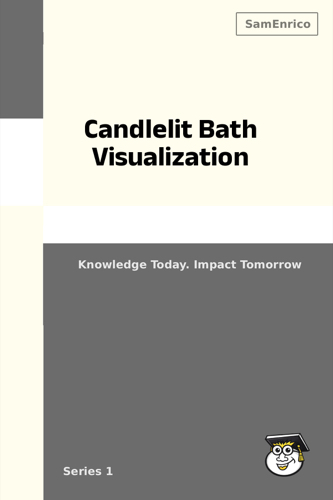
Candlelit Bath Visualization eBook
Soak in a warm bath surrounded by candles and let
Soak in a warm bath surrounded by candles and let every muscle let go.
Formats
Free sample
Chapter 1: The Sanctuary Blueprint--–- The bathroom is the most lied-about room in the house. We tell ourselves it is purely functional—a place to scrub, shave, rinse, and exit. But watch someone step into a hot bath after a sixteen-hour day. Watch their shoulders drop two inches before their knees even touch the water. That is not hygiene.
That is a surrender reflex so ancient it bypasses language. Your nervous system knows something your calendar refuses to admit: water is medicine, and candles are the oldest technology for telling a frightened brain that the wolves are not at the door tonight.This book is not about taking baths. You already know how to do that. This book is about building a sensory sanctuary—a repeatable, portable ritual that transforms your bathtub into a control room for your autonomic nervous system. Chapter 1 is the foundation.
Skip it, and the visualizations in later chapters will feel like trying to plant orchids in concrete. Read it slowly. Take notes. Light a single candle while you read. This is not decoration.
This is training.Why Most Baths Fail to Heal You have taken hundreds of baths. Perhaps you added bubbles. Perhaps you scrolled through your phone with one dry hand hovering over the water. Perhaps you emerged feeling temporarily warm but fundamentally unchanged. That is because a bath without intentional sensory design is just wet furniture.The difference between a bath that relaxes you and a bath that rewires you comes down to three variables that 99 percent of bathers ignore: light spectrum, water temperature precision, and sound boundaries.
Without these, your bath is a swimming pool for one. With them, it becomes what neuropsychologists call a "controlled sensory environment"—the same category as float tanks and sensory deprivation chambers, but warmer, cheaper, and infinitely more accessible.Let me be specific. The average person runs bathwater at 105 to 110 degrees Fahrenheit because it feels luxurious for the first thirty seconds. Then they spend the next fifteen minutes slowly cooking their autonomic nervous system into heat stress, which raises cortisol rather than lowering it. Simultaneously, they leave the overhead fluorescent light on—a light spectrum that signals the brain's suprachiasmatic nucleus to stay in daytime mode.
Then they add a podcast or a playlist at seventy decibels, which keeps the auditory cortex in active processing rather than rest.You have been doing relaxation wrong because no one gave you the manual. This chapter is that manual.The Three Pillars of a Sensory Sanctuary Every sanctuary-grade bath rests on three pillars. Think of them as legs of a stool. Remove one, and the entire practice collapses into mere comfort.Pillar One: Thermal Precision Your body has a built-in relaxation switch, but it only flips under specific temperature conditions. The ideal bath temperature for nervous system downregulation is 99 to 102 degrees Fahrenheit (37 to 39 degrees Celsius) .
This is not a suggestion. This is physiology.At 98.6 degrees (skin temperature), your blood vessels neither constrict nor dilate. At 99 to 102 degrees, peripheral vasodilation begins—your blood vessels widen, sending warmth to your hands and feet. This triggers a cascade: warm extremities signal the brain's insular cortex that you are safe (cold extremities signal potential threat), which in turn lowers sympathetic nervous system activity. Your heart rate drops.
Your breathing deepens. Your digestion shifts from "emergency" to "rest."Above 102 degrees, the opposite happens. Your body perceives heat as a stressor and activates cooling mechanisms that include increased heart rate and sweating. You feel relaxed at first, then vaguely anxious, then exhausted. Below 99 degrees, vasodilation does not occur, and you remain in a neutral or mildly alert state.Here is what this means practically: buy a bath thermometer.
Not a guess. Not a wrist test. A floating thermometer that costs eight dollars and lives in your bathroom drawer. Fill the tub with water that feels slightly cooler than you want. Wait.
Add hot water in small increments until the thermometer reads 100 degrees. That is your number. Remember it. Your nervous system will thank you.Pillar Two: Light Spectrum Management Light is not neutral. Every photon that hits your retina carries information about time of day, safety, and threat.
Overhead fluorescent lights operate at 4000 to 5000 Kelvin—the same color temperature as an overcast noon sky. They tell your brain it is daytime. Daytime means alertness. Alertness means cortisol.Candlelight, by contrast, operates at 1800 to 2000 Kelvin. This is the color temperature of a setting sun, a campfire, a hearth.
It does not directly stimulate melatonin production—that is a common myth this book corrects. What candlelight does is reduce hypervigilance. The warm, flickering spectrum signals safety to the amygdala, the brain's threat-detection center. A safe amygdala stops scanning for danger. A relaxed amygdala permits the parasympathetic nervous system to engage.But here is the counterintuitive part: candlelight works indirectly.
You do not need to stare at it to receive the benefit. Simply having candles in your peripheral vision changes your brain state. The flicker rate (approximately 7 to 10 hertz, depending on air currents) entrains your brain's alpha waves, the same frequency associated with meditation and creative flow.Practical application: Use three to seven candles. One candle is a point of focus. Three create a triangle of warmth.
Seven create a field. Place them at eye level or slightly below—never above, as upward light mimics daylight. Use unscented beeswax or soy wax for the cleanest burn. Avoid candles with synthetic fragrances, which introduce unpredictable olfactory stimuli.Pillar Three: Sound Boundaries Sound is the most underrated variable in relaxation. Your ears never close.
Even in sleep, your auditory system processes threat-relevant sounds at a subconscious level. A sudden noise—a car horn, a phone buzz, a family member calling your name—jolts your nervous system out of rest in under 200 milliseconds.This presents a choice. Do you fill the bath with sound, or do you chase silence? The answer depends on your nervous system's baseline.For readers with racing thoughts, anxiety, or a history of trauma, silence can feel louder than noise. An empty auditory field leaves room for intrusive thoughts.
For these readers, sound is a container. The best options are:Binaural beats at 4 to 8 hertz (theta range)Steady ambient music without lyrics or sudden volume changes Single-instrument recordings (cello, piano, singing bowls)For readers with sensory overstimulation, migraines, or difficulty filtering background noise, silence is medicine. True silence—not "quiet," but the absence of intentional sound—allows the auditory cortex to rest. This is not silence as in "no sounds at all" (your bathroom will always have the hum of pipes, the drip of a faucet). It is silence as in "no added sound."This book adopts a clear rule that will appear throughout: silence for emotional release (Chapters 4 and 5); external sound or humming for restless minds (Chapter 11) .
For Chapter 1, experiment with both. Run a five-minute trial of silence. Then run five minutes of binaural beats. Notice which one makes your exhale longer. That is your answer.The Candle Selection Deep Dive Not all candles are equal.
The following breakdown will save you money and prevent the frustration of candles that tunnel, smoke, or extinguish themselves.Wax types ranked by benefit:Beeswax – Emits negative ions when burned, which…
This is the end of the free sample. Get the eBook to keep going. Buy now
About this book
Details
- Author
- Schrader Moshe
- Publisher
- SamEnrico
- Language
- English
- Genre
- Non-Fiction, Self-Help
- Released
- 2026-06-08
- Pages (approx.)
- 132
- Available as
- eBook, Audiobook

Read better in the ZLOADR app
Your eBooks on your phone or tablet. Sign in with your SamEnrico account and start reading.
More by Schrader Moshe
 Flow in Elder CareSchrader Moshe$11.99
 Eisenhower Matrix for StudentsSchrader Moshe$11.99
 Affirmations for AutismSchrader Moshe$11.99
 The Focus ChallengeSchrader Moshe$11.99
 Fencer's Hypnosis GuideSchrader Moshe$11.99
 Stress Fertility ConnectionSchrader Moshe$11.99
 Star Gazing Field GuideSchrader Moshe$11.99
 The Last Oracle of Delphi: Riddles That Shook the Ancient WorldSchrader Moshe$11.99
 Barra Brava: The Beautiful and Brutal Art of Latin American Football Fan CultureSchrader Moshe$11.99
 How to Become a Sales RepresentativeSchrader Moshe$11.99
 White-faced Capuchins: Clever MonkeySchrader Moshe$11.99
 A Collector's Handbook to the Wolseley Hornet (1930-32)Schrader Moshe$11.99
You may also like
 Hong Kong Handover 1997Dunn Johnnie$11.99
 Zumba For Postnatal Recovery CourseNeal Christian$11.99
 Zumba for BeginnersLadner Nikia$11.99
 YouTube Comment Mining GuideHumes Pandora$12.99
 Worry Box MeditationCarlin Rudy$11.99
 Workplace Stress MeditationNguyen Lynn$11.99
 Workplace Stress and Sleep RepairHawley Ivory$11.99
 Workplace Perfectionism CureDelaney Jeffry$11.99
 Workplace Injustice Anger GuideWallen Isabelle$11.99
 Work Addiction and Burnout LinkGreenwood Ester$11.99
 Women in Yoga and WellnessBeattie Galina$11.99
 Women in Stand Up ComedyChun Evangeline$11.99