
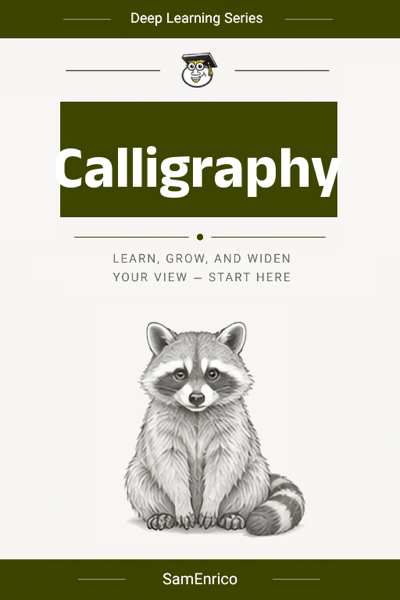
Calligraphy eBook
A Coursebook on Calligraphy
by Soliz Ja
A Coursebook on Calligraphy
Formats
Free sample
Chapter 1: Your Hidden Toolkit...--The moment you first saw elegant calligraphy—perhaps on a wedding invitation, a restaurant menu, or a handwritten quote framed on someone’s wall—you felt something shift inside you. That feeling wasn’t admiration for ink on paper. It was recognition. Somewhere deep in your brain, wired through millions of years of human evolution, you understood that this slow, deliberate act of mark-making was once the most powerful technology on earth. Before the printing press.
Before the typewriter. Before the glowing rectangle in your pocket, there was the written word, and the people who shaped those words were magicians.You are about to become one of them.But let me stop you before you buy anything. The calligraphy section of any art supply store is a swamp of confusing choices: nibs with numbers, holders made of wood and brass, inks that promise permanence, papers that range from tissue-thin to cardboard-stiff. Most beginners make the same mistake—they spend eighty or a hundred dollars on supplies they don’t need, then abandon the craft in frustration two weeks later because their ink bled through their paper, their nib rusted, or their hand cramped after ten minutes.This chapter exists to prevent that mistake.I am going to show you exactly what you need to start, what you can ignore until later, and how to set up a workspace that makes success inevitable rather than accidental. More importantly, I am going to give you permission to begin with almost nothing.
The best calligrapher I ever met—a woman whose work hangs in the Victoria and Albert Museum—told me she practiced for her first six months with a cheap poster nib, a bottle of black ink, and stack of printer paper she rescued from her office recycling bin. Fancy tools do not make beautiful letters. Repeated, deliberate practice does.So here is the promise of this chapter: by the time you finish reading these pages, you will understand every tool you might ever need, you will know which three items to buy tonight for under twenty dollars, and you will have prepared a workspace that supports rather than sabotages your success. You will also have built your first writing slope—not because you need one to start, but because building it with your own hands will teach you something about angles and posture that no photograph ever could.Let us begin.The Three Families of Writing Tools Before you spend a single dollar, you need to understand the three main categories of calligraphy tools. Think of them as three different musical instruments.
A violin, a cello, and a double bass all make sound by drawing a bow across strings, but you would not try to learn all three at once. The same principle applies here.Broad-Edge Pens These are the tools that created every historical script you have ever admired: Roman capitals carved into Trajan’s Column, the rounded letters of the Book of Kells, the dense black Gothic script of medieval Bibles, and the elegant Italic of Renaissance poets. A broad-edge nib has a flat, rectangular tip. When you hold it at different angles, it produces thick downstrokes and thin upstrokes. The relationship between the nib’s width and the height of your letters—what calligraphers call the “nib ladder”—determines the proportion of everything you write.For the first seven chapters of this book, you will use only broad-edge pens.
This is not arbitrary. Broad-edge calligraphy teaches you the fundamental skills that transfer to every other form of lettering: consistent pen angle, steady hand pressure, rhythmic spacing, and the ability to see negative space as clearly as positive marks. Master these, and pointed pen calligraphy (which we cover in Chapter 8) will feel like a natural extension rather than an entirely new discipline.Pointed Pens These are the tools behind Copperplate and Spencerian scripts—the delicate, shaded letters you see on formal wedding invitations, stock certificates, and eighteenth-century correspondence. A pointed nib comes to a sharp point like a needle. Unlike a broad-edge nib, which creates thick and thin strokes through angle alone, a pointed nib creates thick lines when you press down (spreading the two tines apart) and thin lines when you release pressure.
This is a fundamentally different mechanical action, which is why we separate it entirely from the broad-edge instruction.Do not buy a pointed pen yet. You will not need one until Chapter 8. If you buy one now, you will be tempted to experiment with it before you have built the foundational muscle memory from broad-edge practice. That would be like trying to learn the violin before you can hold a pencil. Trust the sequence.
Your future self will thank you.Markers and Parallel Pens These are modern adaptations of broad-edge technology. A Pilot Parallel Pen, for example, contains two metal plates separated by a tiny gap. Ink flows between the plates, creating a consistent broad-edge mark without the need for dipping. These pens are excellent for beginners because they eliminate the variables of ink consistency, nib flooding, and paper absorption. However, they cannot produce the subtle variations in ink density or the hairlines of a steel nib.
Think of them as training wheels—wonderful for learning, but eventually you will want to take them off.For your starter kit, I recommend a Pilot Parallel Pen in the 2.4mm size. It is forgiving, reliable, and will not rust if you forget to clean it. We will discuss steel nibs in the Enthusiast Kit section.Your Starter Kit: Everything You Need Tonight for Under Twenty Dollars Here is the truth that calligraphy supply companies do not want you to hear: you can begin learning with three items that cost less than a pizza. Do not let anyone convince you otherwise.Item One: A Pilot Parallel Pen (2.4mm nib)Cost: approximately twelve dollars.This pen comes with two ink cartridges (black and red) and a convenient cleaning tool. The 2.4mm nib is large enough to show your mistakes clearly—which is essential for learning—but small enough to write comfortably on standard paper.
The pen body is designed to encourage a relaxed grip, and the parallel plates ensure that every stroke has clean edges regardless of your ink or paper quality.Item Two: A Bottle of Sumi Ink Cost: approximately five dollars.Sumi ink is made from pine soot and animal glue, a formula that has remained essentially unchanged for over a thousand years. It is waterproof when dry, flows smoothly from most pens, and has a rich, deep black that photographs well. Do not buy India ink, which contains shellac that can clog and ruin your pen. Do not buy calligraphy ink in fancy bottles with gold labels—most of it is just diluted sumi at three times the price. A small bottle of Yasutomo or Bokuju sumi will last you through this entire book and beyond.Item Three: A Pad of Layout Paper or HP Premium Choice Laser Paper Cost: approximately eight dollars for a pad of layout paper, or ten dollars for a ream of HP paper.Here is where most beginners go wrong.
They buy expensive “calligraphy paper” with rough textures designed for watercolor, or they use cheap printer paper that turns their…
This is the end of the free sample. Get the eBook to keep going. Buy now
About this book
Details
- Author
- Soliz Ja
- Publisher
- SamEnrico
- Language
- English
- Genre
- Non-Fiction, Informative, Educational
- Released
- 2026-06-02
- Pages (approx.)
- 149
- Available as
- eBook, Audiobook

Read better in the ZLOADR app
Your eBooks on your phone or tablet. Sign in with your SamEnrico account and start reading.
More by Soliz Ja
 Alcohol And Trauma DreamsSoliz Ja$11.99
 Parenting Stress And Digital OverloadSoliz Ja$11.99
 Energy Management AssessmentSoliz Ja$11.99
 Comparison Trap Couples GuideSoliz Ja$11.99
 Whispers of the Marid: The Djinn King’s Forgotten OathSoliz Ja$11.99
 The Bone Setter of Babylon: Imhotep’s Forgotten LegacySoliz Ja$11.99
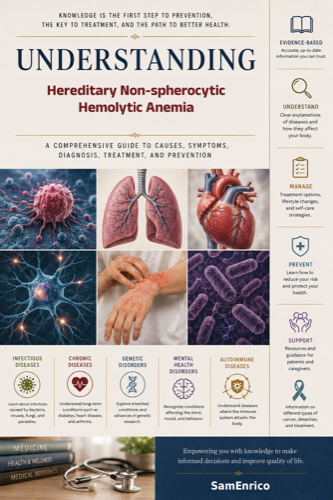 Understanding Hereditary Non-spherocytic Hemolytic AnemiaSoliz Ja$17.99
 Cloud Call Center OutlookSoliz Ja$12.99
 Messaging Sales Funnel WorkbookSoliz Ja$12.99
 How to Start a Cask Assembly Machines Business (Beginners Guide)Soliz Ja$11.99