
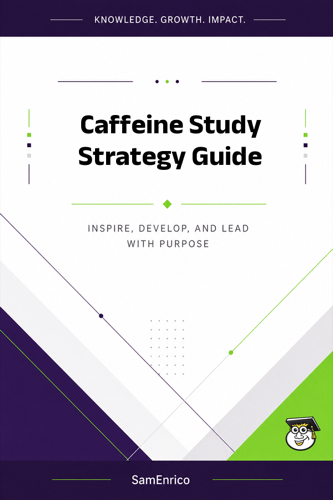
Non-FictionSelf-HelpCaffeine Management
Caffeine Study Strategy Guide eBook
Time coffee intake strategically to avoid crashes
Time coffee intake strategically to avoid crashes and sleep disruption.
Formats
Free sample
Chapter 1: The Borrowed Alertness--–- The most dangerous word in the vocabulary of the exhausted student is not “failure.” It is not “procrastination.” It is not even “caffeine.” The most dangerous word is “more.”Just one more cup. Just one more shot. Just one more energy drink before this exam. Just one more to get through this study session. Just one more because I am already shaking and I need to feel something else.I have heard this word from thousands of students.
I have said it to myself hundreds of times. More is the lie we tell ourselves when the truth is too uncomfortable to face: that the caffeine stopped working long ago, that we are chasing a feeling we will never catch, that the very substance we rely on to study has become the primary obstacle to learning.Before we can build a better strategy, we must understand how we arrived at this point. Not just the biochemistry, though that will come. But the psychology. The habits.
The slow, creeping normalization of a relationship with caffeine that has quietly turned toxic.This chapter is about the trap. Not to shame you. Not to scare you. But to show you the gears turning beneath the floorboards so that, for the first time, you can see exactly why your current approach is failing and what must change.The Moment I Realized I Was Not In Control I was a second-year medical student, and I was in the middle of a caffeine-induced panic attack during a pharmacology exam. The irony was not lost on me even as it happened.
I was being tested on the autonomic nervous system, on adrenergic receptors, on the very pathways that caffeine was currently hijacking in my own body. I knew exactly what was happening. I knew that my heart rate of 130 beats per minute was not a heart attack. I knew that the trembling in my hands was sympathetic overactivation. I knew that the sensation of impending doom was just my amygdala responding to an excess of norepinephrine.Knowing did not help.
The knowledge sat in my prefrontal cortex, cool and academic, while my limbic system ran screaming in circles. I could not focus. I could not read the questions. I could not remember the material I had stayed up until 3 AM memorizing. I looked at the clock.
Forty-five minutes remained. I had answered twelve of eighty questions.I failed that exam. Not because I was stupid. Not because I had not studied. I failed because I had drunk four shots of espresso in the two hours before the test, chasing alertness that was never going to arrive.That night, I calculated my caffeine consumption for the previous week.
The number staggered me: 2,400 milligrams. An average of 340 milligrams per day, but with huge variation. Some days were light—maybe 150 milligrams. But on exam days or heavy study days, I routinely exceeded 500 milligrams. I was drinking coffee at 8 PM to study, then lying awake until 1 AM, then waking up exhausted, then drinking more coffee to function, then repeating the cycle.I was not using caffeine.
Caffeine was using me.The turning point came three days later, when I tried to stop. I made it to noon before the headache hit—a throbbing, nauseating pressure behind my eyes that made it impossible to read. I made it to 2 PM before I gave up and drank a cup of coffee. The headache vanished within twenty minutes. That was when I understood: I was not choosing to drink coffee.
I was medicating withdrawal.Something had to change. But quitting entirely was not the answer. Caffeine, used correctly, is a powerful tool. The problem was not caffeine itself. The problem was my complete ignorance of how it worked and when to use it.This book is the manual I wish I had.The Biochemistry of Borrowed Time To understand why caffeine works—and why it so often backfires—you need to understand a single molecule: adenosine.Adenosine is a byproduct of cellular energy use.
Every time your brain fires a neuron, every time your muscles contract, every time your heart beats, your cells burn a molecule called ATP (adenosine triphosphate) for energy. When ATP is burned, it loses phosphate groups and eventually becomes adenosine. This adenosine floats out of your cells and into the extracellular fluid, where it binds to specialized receptors on the surface of neurons.When adenosine binds to its receptors—specifically the A1 and A2A receptors—it slows down neural activity. It makes neurons less likely to fire. It reduces the release of excitatory neurotransmitters like dopamine, acetylcholine, and norepinephrine.
The result is a progressive feeling of fatigue, drowsiness, and reduced cognitive function.This is not a design flaw. This is a feature. Adenosine is your brain's homeostatic sleep regulator. The longer you stay awake, the more adenosine accumulates. The more adenosine accumulates, the stronger the signal to sleep becomes.
By the time you have been awake for sixteen hours, adenosine levels are high enough that sleep feels almost irresistible. When you finally sleep, your brain clears adenosine from the extracellular space, resetting the system for the next day.This is the biological basis of sleep pressure. It is why you feel tired at the end of the day and refreshed in the morning. It is also why studying for twelve hours straight is counterproductive: your adenosine levels are so high by hour ten that your neurons are literally less capable of firing and forming new memories.Now enter caffeine.Caffeine has a molecular structure that is strikingly similar to adenosine. Similar enough, in fact, that it can fit into adenosine receptors on your neurons.
But caffeine does not activate those receptors the way adenosine does. Instead, it sits in the receptor and blocks it, preventing adenosine from binding.This is called competitive antagonism. Caffeine competes with adenosine for the same binding sites, and because it is present in high enough concentration, it wins the competition. With adenosine blocked from its receptors, the brakes come off neural activity. Dopamine release increases.
Norepinephrine rises. Acetylcholine signaling ramps up. You feel alert, focused, and energetic—not because caffeine has given you energy, but because it has temporarily silenced your brain's “slow down” signal.Think of it this way: Your brain has a natural braking system. Adenosine is the foot on the brake pedal. Caffeine does not press the accelerator.
Caffeine simply cuts the brake line.This is why caffeine does not actually give you energy. It prevents you from feeling how tired you really are. The energy was never created. It was borrowed.And like any loan, it comes with interest.The Crash Is Not An Accident When caffeine blocks adenosine receptors, your brain does not stop producing adenosine. It cannot.
Adenosine production is a direct consequence of cellular energy use, and you are still using energy—studying, thinking, moving, living. So while caffeine sits in the receptors, adenosine continues to accumulate in the extracellular space, waiting for its chance.That chance comes when caffeine is metabolized and cleared from your system. The half-life of caffeine varies from person to person (we will cover this extensively in Chapter 3), but…
This is the end of the free sample. Get the eBook to keep going. Buy now
About this book
Details
- Author
- Gallagher Milagro
- Publisher
- SamEnrico
- Language
- English
- Genre
- Non-Fiction, Self-Help, Caffeine Management
- Released
- 2026-06-09
- Pages (approx.)
- 130
- Available as
- eBook, Audiobook

Read better in the ZLOADR app
Your eBooks on your phone or tablet. Sign in with your SamEnrico account and start reading.
More by Gallagher Milagro
 VA Housing Benefits for Retirees ManualGallagher Milagro$11.99
 Polish Resistance Horse CavalryGallagher Milagro$11.99
 Remote Retreats for Large OrganizationsGallagher Milagro$11.99
 Deep Work for Real Estate AgentsGallagher Milagro$11.99
 The Silent Experiment: How a Forgotten Cold War Study Manipulated DreamsGallagher Milagro$11.99
 The Shot That Stole the Show: The 1992 NBA Finals' Unforgettable Walk-OffGallagher Milagro$11.99
 Department Budgeting PitfallsGallagher Milagro$12.99
 JEE Coaching Institute GuideGallagher Milagro$12.99
 Purple Team MemberGallagher Milagro$11.99
 Understanding Chromom–chromopGallagher Milagro$17.99
 10 Ways to Use Cheshire Cheese (Recipe Book)Gallagher Milagro$11.99
You may also like
 Hong Kong Handover 1997Dunn Johnnie$11.99
 Zumba For Postnatal Recovery CourseNeal Christian$11.99
 Zumba for BeginnersLadner Nikia$11.99
 YouTube Comment Mining GuideHumes Pandora$12.99
 Worry Box MeditationCarlin Rudy$11.99
 Workplace Stress MeditationNguyen Lynn$11.99
 Workplace Stress and Sleep RepairHawley Ivory$11.99
 Workplace Perfectionism CureDelaney Jeffry$11.99
 Workplace Injustice Anger GuideWallen Isabelle$11.99
 Work Addiction and Burnout LinkGreenwood Ester$11.99
 Women in Yoga and WellnessBeattie Galina$11.99
 Women in Stand Up ComedyChun Evangeline$11.99