
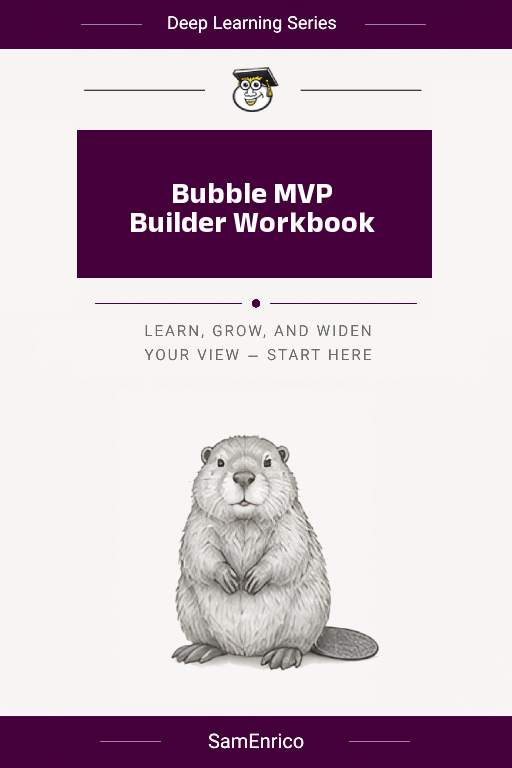
Non-FictionStartup GuideNo-Code Build
Bubble MVP Builder Workbook eBook
Build a functional web MVP using Bubble's visual p
Build a functional web MVP using Bubble's visual programming interface including database design, user authentication, and responsive workflows without code.
Formats
Free sample
Chapter 1: The Idea Graveyard--You have an idea that keeps you up at night.It arrives at 2:37 AM, fully formed, demanding attention. A tool your team desperately needs. A side project that could replace your income. A marketplace that connects two hungry audiences. A dashboard that solves a problem you experience every single day.You grab your phone.
You type furiously into a notes app. By morning, the idea feels electric. Real. Inevitable.Then reality sets in.You don't know how to code. You priced out developers — eighteen thousand dollars for a minimum viable product, delivered in six months if you're lucky.
You considered learning Python or Java Script, but the thought of spending nights and weekends debugging syntax errors makes your chest tighten. You looked at "no-code" tools before, built a clickable prototype in Figma, showed it to friends. They said it looked great. But when someone asked, "Can I actually sign up?" you had nothing.So the idea goes into the graveyard.Not because it was bad. Because the gap between "thought" and "working software" felt impossible to cross alone.This book exists because that gap is a lie.The Myth You Have Been Sold Here is what the traditional software industry wants you to believe: building web applications requires years of training, mastery of multiple programming languages, and a team of specialists.
Frontend developers for what the user sees. Backend developers for how the data moves. Database administrators for where everything lives. Dev Ops engineers to keep it running. UI designers to make it not ugly.And if you try to build something yourself without these skills?
You will create an insecure, unscalable, ugly mess that falls apart the moment more than twelve people visit.That narrative serves the industry very well. It keeps salaries high. It keeps consulting fees flowing. It makes you feel like you need to hire them.But here is what they do not tell you: the vast majority of successful software businesses — including billion-dollar companies like Airbnb, Uber, and Door Dash — started with embarrassingly simple, imperfect, borderline-ugly first versions. Airbnb's first MVP was a barebones website with photos of the founders' apartment.
No payment system. No reviews. No search filters. Just a way to say "we have an air mattress and breakfast."They did not build the castle first. They built a tent.
And only after people actually slept in the tent did they add walls, then a roof, then rooms.Bubble is your tent-building tool.What Bubble Actually Is (And Is Not)Before we open the editor, let me clear up three dangerous misconceptions that have wasted months of other builders' time.Misconception 1: Bubble is a prototyping tool like Figma or Adobe XD.Wrong. Prototyping tools create static, clickable illusions. You can design a screen, link buttons to other screens, and pretend it is an app. But when you close the prototype, nothing saves. No users exist in a database.
No workflows run. No data changes.Bubble is a full-stack application builder. When you build something in Bubble, real data is created, real users can sign up and log in, real workflows execute on servers, and real people can use your application at a real URL. The same URL you could put on a business card.Misconception 2: No-code tools cannot scale.This is the most persistent myth, and it is demonstrably false. Bubble powers applications with millions of users.
Dividend Finance, a renewable energy lender, built their entire loan origination platform on Bubble and has processed hundreds of millions of dollars. Plato, a mentorship platform for engineering leaders, scaled to thousands of paying users. The key is understanding that "scalable MVP" means something specific: your first version should handle your first thousand users comfortably. When you get to ten thousand users, you will have revenue to hire developers or optimize. Most startups never reach the point where Bubble becomes the bottleneck.
Their bottleneck is lack of users.Misconception 3: You are not a "real builder" if you use no-code.This is gatekeeping, pure and simple. The purpose of software is to solve problems and create value. The user does not care whether your login system was written in Python or configured in ten minutes with Bubble's visual editor. Your customer cares about one thing: does the application solve their problem reliably? Bubble has been used to build internal tools for Fortune 500 companies, customer portals for healthcare providers, marketplaces that process millions in transactions, and Saa S products that exit for eight figures.
The tool does not determine the builder's legitimacy. The outcome does.Your First Ten Minutes In Bubble Let me walk you through opening Bubble for the first time. I want you to actually do this as you read. The workbook format only works if you work along.Open your browser. Go to bubble.io.
Click the "Sign Up" button in the top right corner. Use your real email address — you will need to verify it.After verification, Bubble will ask you to name your first application. Name it "Job Board MVP — [Your Name]." This will be our consistent example throughout the book. Every chapter builds on the same application. By Chapter 12, you will have deployed a real, working job board that allows companies to post jobs and job seekers to apply.Once your application is created, Bubble drops you into the editor.
This is where you will spend most of your building time. Take a breath. It looks overwhelming. But you are about to learn the three most important landmarks.Look at the top of the screen. You will see three tabs: Design, Workflow, and Data.These three tabs represent the three layers of every web application ever built.The Data tab is your database.
This is where you define what kinds of things your application stores — users, jobs, applications, companies, messages. Every piece of information that lives beyond a single click lives here. We spend all of Chapter 2 on this tab because bad database design is the single biggest predictor of MVP failure.The Design tab is what users see. This is where you drag and drop buttons, text, images, input forms, and containers onto a canvas. This is the "frontend" or "user interface." We cover this in Chapter 3.The Workflow tab is where magic happens.
When a user clicks a button, submits a form, or loads a page, workflows determine what happens next. Does the application save data? Send an email? Navigate to a different page? Charge a credit card?
All of that lives in workflows. Chapters 4 through 6 are entirely dedicated to workflows because they are the engine of your application.Take thirty seconds right now. Click each tab. Notice how the editor changes. Do not click anything else.
Just observe. You are looking at the same three layers that power every application from Gmail to Twitter to Amazon. The difference is that those companies built their layers with millions of lines of code. You are about to build yours with visual blocks.Why Most MVPs Fail (And Yours Will Not)Before we build anything, I want to tell you the truth about why most MVPs fail. It is not what you think.The #1 reason MVP projects fail is not bad…
This is the end of the free sample. Get the eBook to keep going. Buy now
About this book
Details
- Author
- Frizzell Sterling
- Publisher
- SamEnrico
- Language
- English
- Genre
- Non-Fiction, Startup Guide, No-Code Build
- Released
- 2026-05-30
- Pages (approx.)
- 131
- Available as
- eBook, Audiobook

Read better in the ZLOADR app
Your eBooks on your phone or tablet. Sign in with your SamEnrico account and start reading.
More by Frizzell Sterling
 The Gym And Yoga Mat SafetyFrizzell Sterling$11.99
 The Land Rover LegendFrizzell Sterling$11.99
 Corporate Executive Burnout GuideFrizzell Sterling$11.99
 Antwerp Heist Suspect DeathsFrizzell Sterling$11.99
 Menopause Brain Fog RecoveryFrizzell Sterling$11.99
 The Silent Summit: The Deadly Race to Conquer K2 in the Shadow of WarFrizzell Sterling$11.99
 Silk Road Whispers: The Untold Journey of Marco Polo’s Lost DaughterFrizzell Sterling$11.99
 Specialist Safety & EnvironmentFrizzell Sterling$11.99
 Remote Team Charter GuideFrizzell Sterling$12.99
 Understanding Fetal Parainfluenza Virus Type 3 SyndromeFrizzell Sterling$17.99
 How to Become a Joiner HelperFrizzell Sterling$11.99
You may also like
 Hong Kong Handover 1997Dunn Johnnie$11.99
 Zumba For Postnatal Recovery CourseNeal Christian$11.99
 Zumba for BeginnersLadner Nikia$11.99
 YouTube Comment Mining GuideHumes Pandora$12.99
 Worry Box MeditationCarlin Rudy$11.99
 Workplace Stress MeditationNguyen Lynn$11.99
 Workplace Stress and Sleep RepairHawley Ivory$11.99
 Workplace Perfectionism CureDelaney Jeffry$11.99
 Workplace Injustice Anger GuideWallen Isabelle$11.99
 Work Addiction and Burnout LinkGreenwood Ester$11.99
 Women in Yoga and WellnessBeattie Galina$11.99
 Women in Stand Up ComedyChun Evangeline$11.99