
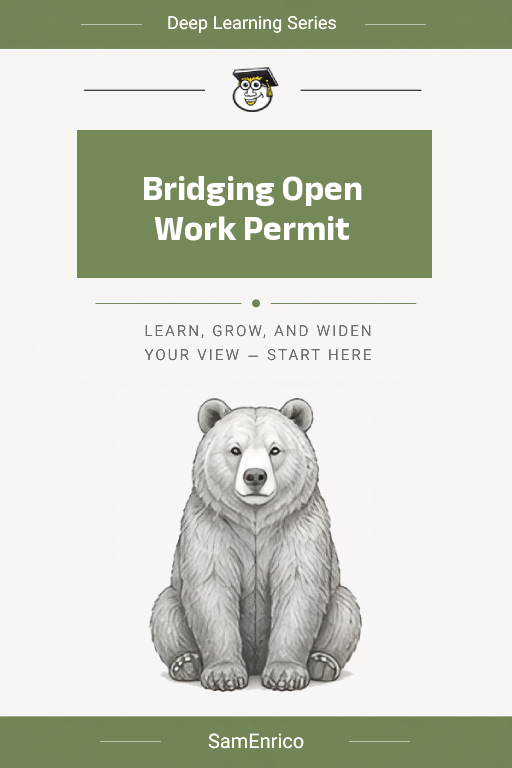
Non-FictionStudent's ShortcutBOWP
Bridging Open Work Permit eBook
Apply for BOWP while waiting for Express Entry PR
Apply for BOWP while waiting for Express Entry PR decision to continue working without interruption.
Formats
Free sample
Chapter 1: The 4-Month Lie--–- It was a Tuesday morning in March when Maria’s heart stopped. Not literally, of course—but the email from her HR department might as well have stopped it. “We’ve received a notification from the government. Your work permit expires in 47 days. Please provide proof of renewed work authorization by April 15th or we will be forced to place you on unpaid leave.”Maria had done everything right.
She had graduated from a recognized Canadian university. She had worked for two years in a skilled occupation. She had submitted her Express Entry application for Permanent Residence eight months ago. She had even received her Acknowledgment of Receipt—that golden AOR that everyone said meant she was safe. She had checked every box, dotted every “i,” crossed every “t.”But her Post-Graduation Work Permit was dying, and her Permanent Residence application was still reading “We are reviewing your eligibility.” No one had told her about the gap.
No one had told her about the BOWP. And no one had told her that the “4-month rule” that everyone on Reddit kept talking about was, in fact, a lie—or at least, a ghost of a rule that no longer existed.Maria is not real. But her situation is. Thousands of skilled workers in Canada face this exact panic every single month. They watch their permits tick down like a timer on a bomb.
They scroll through forums filled with contradictory advice. They hear whispers of a “Bridging Open Work Permit” but have no idea if they qualify, when to apply, or whether applying too early or too late will get them refused. And worst of all, they are haunted by a number: four months.This chapter dismantles that number. It explains where the 4-month rule came from, why it terrorized applicants for years, and—most importantly—why it no longer applies to you. By the end of this chapter, you will understand the single most important shift in BOWP policy in the last decade, and you will never again lose sleep over how many days remain on your current permit.The Origins of Terror: Why “Four Months” Became a Curse To understand why the 4-month rule caused so much damage, you have to go back to the way the BOWP program worked before 2021.
The Bridging Open Work Permit was introduced in 2012 as a solution to a very specific problem: skilled workers in Canada who had applied for Permanent Residence were losing their status and being forced to leave the country while IRCC processed their applications. The BOWP was supposed to be the bridge—a temporary permit that would keep you working from the time your old permit expired until the day you became a Permanent Resident.But the original rules contained a poison pill. Buried deep within IRCC’s operational instructions was a requirement that still haunts forum posts to this day: applicants needed to have at least four months of validity remaining on their current work permit at the time of their BOWP application.Let me say that again. You needed four months left on your current permit just to apply for the permit that was supposed to bridge you to Permanent Residence.Think about the absurdity of this requirement for a moment. The BOWP was designed to help people who were running out of time.
But the rules said you could only apply if you had plenty of time left. This created a devastating catch-22 that immigration consultants still describe with a shake of their heads.The Impossible Math of the Old System Consider a typical Post-Graduation Work Permit holder in 2019. She receives her PGWP, which is valid for three years. She works for one year to gain Canadian experience. She then submits her Express Entry application.
At that moment, she has approximately two years left on her PGWP. That sounds like plenty of time, right?Wrong. Because Express Entry processing times in 2019 were averaging six to eight months for the first stage (the R10 completeness check and eligibility review) and another four to six months for the final decision. Total processing time: ten to fourteen months. She submits her application with two years left.
She waits. Months pass.Now imagine that her application hits a snag. Maybe IRCC requests additional documents. Maybe her medical exam takes longer than expected. Maybe her application gets transferred to a secondary office for workload distribution.
Suddenly, six months have passed, then eight, then ten. Her two remaining years have dwindled to fourteen months, then twelve, then ten.She is now at the ten-month mark. She checks her permit expiry date. She has ten months left. She reads online that she needs four months of remaining status to apply for a BOWP.
She is safe—for now.But she waits. Because she doesn’t want to apply too early. She wants to see progress on her PR application first. Another three months pass. She now has seven months left.
She is still above the four-month threshold. She waits one more month. She now has six months left.And then IRCC sends her a Procedural Fairness Letter. They have concerns about her proof of work experience. She needs to gather additional letters from former employers, translate documents, and submit a detailed response.
That takes two months. She now has four months left. Exactly four months. She submits her response. She is still within the window.
She breathes a sigh of relief.But then IRCC takes three months to review her response. She now has one month left on her PGWP. She rushes to apply for her BOWP. She logs into her IRCC account. She starts the application.
And then she reads the requirement: “You must have at least four months of validity remaining on your current work permit at the time of application.”She has one month. She is ineligible. Her PGWP expires in thirty days. She has no BOWP. She has no maintained status because she didn’t apply in time.
She has thirty days to either leave Canada, switch to visitor status (which prohibits work), or hope that her PR application is approved before her permit dies.Spoiler: it won’t be. The PR application takes another three months. She loses her job. Her employer withdraws their job offer for her permanent position. She has to leave Canada.
Her PR application is eventually approved—but she is now outside Canada, without a job, without Canadian work experience continuing, and with a bitter taste in her mouth.This was not a rare scenario. This was the norm. Immigration consultants built entire practices around trying to time BOWP applications perfectly—not too early, not too late, but exactly within that shrinking window where you had enough status to apply but not so much that you were wasting your application.The Psychological Toll of the 4-Month Rule Beyond the mathematical impossibility, the 4-month rule created a psychological prison for temporary residents. Every day that passed was a day closer to ineligibility. Every delay from IRCC was a nail in the coffin.
Applicants found themselves checking their permit expiry dates obsessively, calculating and recalculating how many days they had left, whether they…
This is the end of the free sample. Get the eBook to keep going. Buy now
About this book
Details
- Author
- Tracy Joaquina
- Publisher
- SamEnrico
- Language
- English
- Genre
- Non-Fiction, Student's Shortcut, BOWP
- Released
- 2026-05-30
- Pages (approx.)
- 158
- Available as
- eBook, Audiobook

Read better in the ZLOADR app
Your eBooks on your phone or tablet. Sign in with your SamEnrico account and start reading.
More by Tracy Joaquina
 Body Scan for Mindfulness PracticeTracy Joaquina$11.99
 Open Water Swimming SightingTracy Joaquina$11.99
 LBO Industry Multiples DatabaseTracy Joaquina$11.99
 Crime Scene Reconstruction EthicsTracy Joaquina$11.99
 Never Miss Twice RuleTracy Joaquina$11.99
 Self Hypnosis for NightmaresTracy Joaquina$11.99
 Empathy for Social WorkersTracy Joaquina$11.99
 Cremated Remains TeethTracy Joaquina$11.99
 The Wealth Architects of Kush: Economic Mastery in the Kingdom of GoldTracy Joaquina$11.99
 The Phantom of the Andes: Bolivia's Unsolved Serial Killer Mystery (1970s-1980s)Tracy Joaquina$11.99
 How to Start a Mail Order (retail) Business (Beginners Guide)Tracy Joaquina$11.99
 How to Produce Cycling EquipmentTracy Joaquina$11.99
You may also like
 Hong Kong Handover 1997Dunn Johnnie$11.99
 Zumba For Postnatal Recovery CourseNeal Christian$11.99
 Zumba for BeginnersLadner Nikia$11.99
 YouTube Comment Mining GuideHumes Pandora$12.99
 Worry Box MeditationCarlin Rudy$11.99
 Workplace Stress MeditationNguyen Lynn$11.99
 Workplace Stress and Sleep RepairHawley Ivory$11.99
 Workplace Perfectionism CureDelaney Jeffry$11.99
 Workplace Injustice Anger GuideWallen Isabelle$11.99
 Work Addiction and Burnout LinkGreenwood Ester$11.99
 Women in Yoga and WellnessBeattie Galina$11.99
 Women in Stand Up ComedyChun Evangeline$11.99