
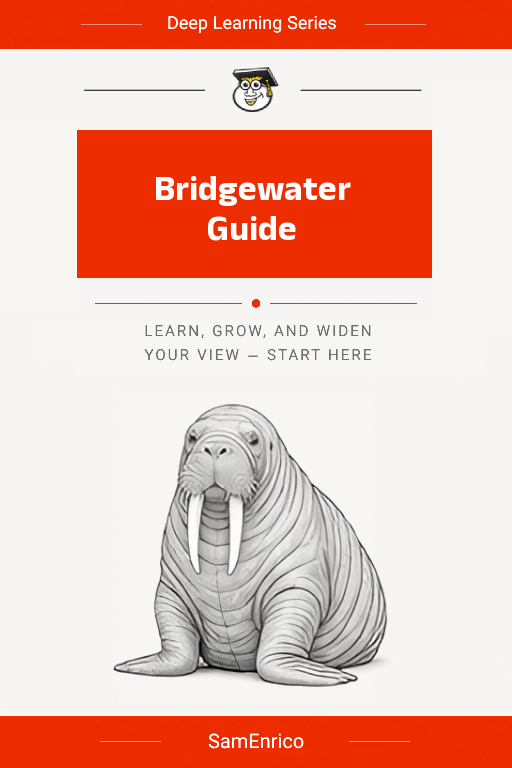
Non-FictionStrategic AtlasTalent Intelligence
Bridgewater Guide eBook
Decode radical transparency, dot collector tool, a
Decode radical transparency, dot collector tool, and baseball-card employee profiles for meritocratic fit.
Formats
Free sample
Chapter 1: The $20 Billion Silence--The email arrived at 9:47 AM. A junior analyst named Sarah had spotted a discrepancy in a trade confirmation—a mismatch between what the counterparty believed it had agreed to and what Bridgewater's system showed. She flagged it to her manager, who flagged it to his manager, who flagged it to the committee. By 3:00 PM, the trade had been executed. By 4:30 PM, the loss was confirmed.
By 5:00 PM, $20 million had evaporated.The post-mortem was brutal. Not because of the money—Bridgewater had lost twenty times that on other days without much fuss. The post-mortem was brutal because of the silence. Sarah had seen the discrepancy at 9:47 AM. She had flagged it to her manager at 9:52 AM.
Her manager had said, "I'll look into it," and then done nothing for three hours because he was in back-to-back meetings and did not want to interrupt. His manager had seen the email at 11:30 AM, thought "This is probably nothing," and moved on. The committee had reviewed the trade at 2:00 PM, someone had mentioned the discrepancy, and no one had said a word because no one wanted to be the person who delayed a $200 million trade over a "maybe."Twenty million dollars. Gone. Because no one spoke up.When Ray Dalio gathered the team the next morning, he did not ask who was to blame.
He asked a different question: "How many other discrepancies are sitting in inboxes right now that no one is talking about?"The room was silent.That silence was the problem. Not the error, not the delay, not the bad decision. The silence. The polite, professional, career-preserving silence that infects every organization where telling the truth feels more dangerous than hiding it.The Anatomy of Organizational Silence Let us name this phenomenon: the politeness tax.Every organization pays it. The tax is the value destroyed by conversations that do not happen—the feedback withheld, the warning unspoken, the question not asked.
The tax compounds daily, invisibly, until one day a $20 million trade blows up and everyone says, "I knew something was wrong."But they did not say it. And that is the difference between a nice culture and a good one.The cost of silence is staggering. Research from Georgetown University's Christine Porath found that in organizations where people hesitate to speak up, employee engagement drops by 40%, turnover increases by 50%, and decision quality declines by an estimated 30%. A study of hospital operating rooms found that in teams where junior nurses felt unable to correct a senior surgeon, surgical errors were three times more likely. Three times.
Because the person who saw the problem was afraid to say, "Stop."Most organizations have accepted this as normal. They have built elaborate systems to manage silence—anonymous surveys, suggestion boxes, "skip-level" meetings—all of which are workarounds for the fundamental problem: people do not trust that telling the truth will end well for them.The Bridgewater Guide rejects this compromise. It argues that silence is not a cost of doing business. It is a design flaw. And like any design flaw, it can be fixed.The Two Yous: Why We Lie to Each Other To understand why silence dominates most organizations, we must first understand a fundamental fact about human psychology: you have two selves.The lower-level you is emotional, defensive, and fast.
It evolved to keep you safe from predators, social rejection, and threats to your status. When someone criticizes your work, the lower-level you does not distinguish between "your report had a calculation error" and "you are a bad person." Both feel like attacks. Both trigger the same defensive response: fight, flight, or freeze. Your heart rate spikes. Your jaw tightens.
You prepare to argue, deflect, or withdraw.The higher-level you is logical, reflective, and slow. It can step back and ask: "Is this criticism accurate? Is there something I can learn? Does this person want to help me or hurt me?" The higher-level you can separate identity from action: "I made a mistake" is not the same as "I am a mistake." But the higher-level you is also exhausting to maintain. It requires effort.
It requires practice. It requires a culture that rewards it.Most organizations are designed for the lower-level you. Performance reviews happen annually (so feedback is rare and therefore high-stakes). Criticism is delivered in private (so it feels secret and shameful). Mistakes are hidden (so the lower-level you's fear of exposure is validated).
Every structural feature of traditional management tells the lower-level you: Be afraid. Defend yourself. Do not speak.The result is predictable. People learn to smile and nod. They learn to say "great idea" when they mean "that will never work." They learn to write glowing performance reviews for colleagues they cannot stand.
They learn to hide their mistakes and hope no one notices.This is not weakness. This is rational behavior in an irrational system.The Bridgewater Guide proposes a different system: one designed for the higher-level you. A system where feedback is frequent (so it becomes low-stakes). Where criticism is public (so it loses its shameful secrecy). Where mistakes are logged, analyzed, and learned from (so the fear of exposure is replaced by the relief of catharsis).
A system where the default assumption is not "this person is attacking me" but "this person is trying to help me see something I cannot see myself."This is radical transparency. And it begins with a single, uncomfortable idea: pain is progress.The Idea Meritocracy: A New Operating System The destination of this journey is what Ray Dalio calls an Idea Meritocracy: a system where the best ideas win, regardless of who proposes them.In an Idea Meritocracy, the intern and the CEO have equal standing in the debate. Their arguments are judged on their merits—their logic, their evidence, their track record—not on the seniority of the person making them. The janitor can correct the CFO about cafeteria coffee (the janitor drinks it every day; the CFO drinks it once a week). The junior engineer can challenge the CTO about a technical decision (the junior engineer wrote the code; the CTO reviewed it once).This sounds chaotic.
In practice, it is the opposite. Hierarchies create politics—the quiet lobbying, the back-channel conversations, the careful management of who knows what. Idea Meritocracies replace politics with process. They replace "who you know" with "what you can prove." They replace fear with data.The Idea Meritocracy rests on three pillars:1. Radical Truth.
Say what you really believe. Do not soften it. Do not withhold it to spare someone's feelings. Do not tell your boss what you think she wants to hear. If you have a concern, voice it.
If you have a doubt, express it. If you think someone is wrong, say so—and be prepared to defend your position with logic and evidence.2. Radical Transparency. Let everyone see everything. Meeting notes, performance data, decision logs, compensation ranges—all of it.
No hidden information. No secret dossiers. No "you would not understand" or "we will share that when the time is right." Transparency is the antidote to politics. When everyone can see the same data, the gap between public statements and private beliefs collapses.3. Believability-Weighted…
This is the end of the free sample. Get the eBook to keep going. Buy now
About this book
Details
- Author
- Cooke Argelia
- Publisher
- SamEnrico
- Language
- English
- Genre
- Non-Fiction, Strategic Atlas, Talent Intelligence
- Released
- 2026-05-29
- Pages (approx.)
- 139
- Available as
- eBook, Audiobook

Read better in the ZLOADR app
Your eBooks on your phone or tablet. Sign in with your SamEnrico account and start reading.
More by Cooke Argelia
 Gen X Gamer DemographicsCooke Argelia$11.99
 Lead Paint Safe RenovationCooke Argelia$11.99
 Affirmations for LoversCooke Argelia$11.99
 The Microaggression Address GuideCooke Argelia$11.99
 Body Scan During Physical TherapyCooke Argelia$11.99
 The Billionaire's Gamble: How Richard Branson Defied GravityCooke Argelia$11.99
 Understanding PsychosisCooke Argelia$17.99
 Brand Awareness One Page PlanCooke Argelia$12.99
 How to Become a CompilerCooke Argelia$11.99
You may also like
 Hong Kong Handover 1997Dunn Johnnie$11.99
 Zumba For Postnatal Recovery CourseNeal Christian$11.99
 Zumba for BeginnersLadner Nikia$11.99
 YouTube Comment Mining GuideHumes Pandora$12.99
 Worry Box MeditationCarlin Rudy$11.99
 Workplace Stress MeditationNguyen Lynn$11.99
 Workplace Stress and Sleep RepairHawley Ivory$11.99
 Workplace Perfectionism CureDelaney Jeffry$11.99
 Workplace Injustice Anger GuideWallen Isabelle$11.99
 Work Addiction and Burnout LinkGreenwood Ester$11.99
 Women in Yoga and WellnessBeattie Galina$11.99
 Women in Stand Up ComedyChun Evangeline$11.99