
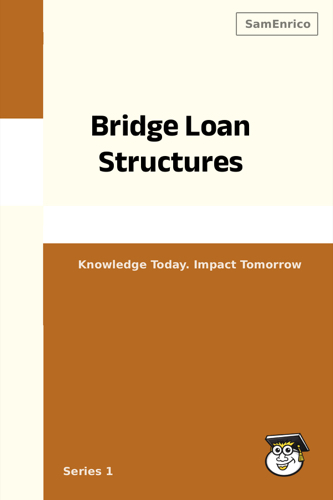
Non-FictionCapital & Valuation RegisterShort Term Finance
Bridge Loan Structures eBook
Outlines short term financing between equity close
Outlines short term financing between equity close and permanent debt.
Formats
Free sample
Chapter 1: The Velocity Trap--–- The email arrived at 4:47 PM on a Tuesday. The developer, a thirty-year veteran of multifamily acquisitions, had been waiting seventy-two hours for this message. He was the highest bidder on a 248-unit garden-style apartment complex in a fast-growing Sun Belt suburb. His offer was $42.7 million, fully underwritten, with proof of funds from a regional bank that had lent him money on seven previous deals. The seller's broker had one question: can you close in ten days?The developer could not close in ten days.
His bank needed forty-five days minimum – underwriting, appraisal, environmental review, credit committee. He explained this, politely, professionally, with spreadsheets to prove his earnestness. The broker thanked him and sold the property to the second-highest bidder, who offered $41.5 million with a bridge loan commitment from a private credit fund that promised to fund in eight days.The developer lost the deal because he had a timing problem, not a credit problem. He had the equity. He had the permanent loan commitment.
He had decades of experience. What he did not have was a bridge.This book is the weapon he needed.The Million-Dollar Misunderstanding Most people who lose money in real estate, private equity, or venture capital believe they lost because they made a bad bet on an asset. They bought too high. They overestimated rent growth. They misjudged the market.
These are real risks, but they are not the primary destroyer of deal value. The primary destroyer of deal value is something far more mundane and far more preventable: timing mismatch.Timing mismatch is the gap between when money is needed and when money is available. It is the reason a perfectly good deal dies. It is the reason a startup with a working product and paying customers runs out of cash before the Series A closes. It is the reason a private equity firm loses an auction to a competitor that simply has faster financing.Bridge loans exist to solve timing mismatch.
That is their only purpose. A bridge loan is not a sign of weakness, desperation, or poor planning. It is a strategic tool for velocity – the ability to move faster than the market, to capture value that slower competitors cannot reach, to execute a business plan that requires capital before permanent financing is available.The developer who lost the $42.7 million deal learned this lesson the hard way. The buyer who won the deal paid $1.2 million less, but that buyer closed in ten days and began executing a renovation plan that increased rents by 28% over eighteen months. When the permanent loan funded, the property was worth $54 million.
The bridge loan cost the buyer 11% interest and 2.5 points in fees – roughly $1.1 million over the hold period. The profit on the flip was $11.3 million. The bridge was not a cost. It was an investment in speed.Three Gaps, One Solution The timing mismatch that bridge loans solve appears in three distinct forms. Every deal falls into one of these categories.
Understanding which gap you face is the first step to structuring the right bridge.The Velocity Gap The velocity gap occurs when a competitive acquisition requires a closing timeline that traditional lenders cannot meet. The most common scenario is an auction. A seller hires a broker, sets a bid deadline, and asks for proof of financing. The seller does not care about your long-term relationship with your bank. The seller cares about certainty of closing.
The bidder who can close fastest wins, even if that bidder pays slightly less.Traditional banks take forty-five to ninety days to close a commercial real estate loan. The timeline looks like this: ten days for initial underwriting and term sheet, fifteen days for appraisal and environmental, ten days for legal review of loan documents, ten days for credit committee approval. That is forty-five days in a best-case scenario with no issues. In reality, most bank closings take sixty to ninety days.Private credit bridge lenders close in ten to fifteen days. Hard money lenders close in five to seven days.
The difference is not magic. Bridge lenders do less diligence. They rely on asset value rather than cash flow. They use third-party appraisals that take five days instead of fifteen. They have smaller credit committees or no credit committees at all.
They charge more for this speed – typically 800 to 1200 basis points over SOFR, compared to 300 to 500 basis points for a bank permanent loan – but the cost is justified by the ability to win the deal.The velocity gap is not limited to real estate. In corporate M&A, a public company auction requires a fully committed financing letter within days of the bid. The winning bidder almost always uses a bridge loan from an investment bank, then replaces it with permanent financing (bonds or term loans) after closing. In venture capital, a startup raising a Series A may need to close a bridge in two weeks to pay salaries while the lead investor completes due diligence. Speed is a weapon.The Value Gap The value gap occurs when an asset is not yet eligible for permanent financing because it lacks stabilized cash flow.
Permanent lenders – banks, agencies, CMBS, insurance companies – require a track record of income. For commercial real estate, that typically means 85% occupancy for ninety consecutive days, with trailing twelve-month operating statements. For a startup, that means recurring revenue and a path to profitability. For a corporate acquisition, that means audited financial statements and a clear capital structure.The value gap is the gap between what an asset is worth today (distressed, vacant, under-renovation, pre-revenue) and what it will be worth after executing a business plan. A bridge loan finances the execution of that plan.Consider a class B office building in a market that is transitioning from suburban office to mixed-use.
The building is 45% occupied. The rent roll is weak. No permanent lender will touch it. But a developer sees an opportunity: convert the top two floors to luxury apartments, add a ground-floor gym and coffee shop, and reposition the remaining office space as creative office for technology tenants. The business plan requires $8 million in renovation costs over eighteen months.
The developer has $4 million in equity. A bridge loan provides the remaining $4 million, plus an interest reserve to cover debt service during construction and lease-up.Eighteen months later, the building is 92% leased, the apartments are fully rented, and the coffee shop is generating foot traffic. The property is now worth $35 million, up from a $22 million purchase price. The bridge loan is repaid from a permanent loan – in this case, a Fannie Mae multifamily loan for the apartment component and a CMBS loan for the office component. The bridge was the engine of value creation.The value gap is not about speed.
It is about transformation. The bridge lender is betting on the future, not the present. That is why forward bridges (the technical name for value gap bridges) require interest reserves and have milestone-based covenants. The lender wants to ensure the borrower has the capital and discipline to complete the transformation.The Liquidity Event Gap The liquidity event gap occurs when a borrower is waiting for a known, contracted, or highly probable liquidity event –…
This is the end of the free sample. Get the eBook to keep going. Buy now
About this book
Details
- Author
- Garrison Chante
- Publisher
- SamEnrico
- Language
- English
- Genre
- Non-Fiction, Capital & Valuation Register, Short Term Finance
- Released
- 2026-06-10
- Pages (approx.)
- 144
- Available as
- eBook, Audiobook

Read better in the ZLOADR app
Your eBooks on your phone or tablet. Sign in with your SamEnrico account and start reading.
More by Garrison Chante
 Parental Addiction and ParentingGarrison Chante$11.99
 Podcast Overconsumption WorkbookGarrison Chante$11.99
 Sleeve Gastrectomy Long Term SuccessGarrison Chante$11.99
 Gluten Free Baking Basics CourseGarrison Chante$11.99
 The Billionaire's Gamble: Inside the 2018 Tesla Short SqueezeGarrison Chante$11.99
 Echoes of the Last Broadcast: The Mysterious Final Transmission of the RMS TitanicGarrison Chante$11.99
 Energy AnalystGarrison Chante$11.99
 Understanding Cat Eye SyndromeGarrison Chante$17.99
 Speaking Exam Proctoring GuideGarrison Chante$12.99
 Business Credit for Non ProfitsGarrison Chante$12.99
 How to Start a Pottery Making Machinery Business (Beginners Guide)Garrison Chante$11.99
You may also like
 Hong Kong Handover 1997Dunn Johnnie$11.99
 Zumba For Postnatal Recovery CourseNeal Christian$11.99
 Zumba for BeginnersLadner Nikia$11.99
 YouTube Comment Mining GuideHumes Pandora$12.99
 Worry Box MeditationCarlin Rudy$11.99
 Workplace Stress MeditationNguyen Lynn$11.99
 Workplace Stress and Sleep RepairHawley Ivory$11.99
 Workplace Perfectionism CureDelaney Jeffry$11.99
 Workplace Injustice Anger GuideWallen Isabelle$11.99
 Work Addiction and Burnout LinkGreenwood Ester$11.99
 Women in Yoga and WellnessBeattie Galina$11.99
 Women in Stand Up ComedyChun Evangeline$11.99