
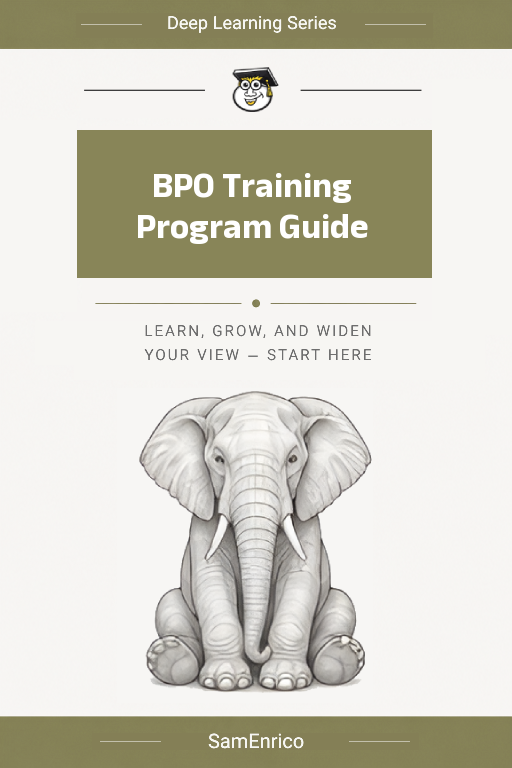
BPO Training Program Guide eBook
Design training programs for outsourced agents in
by North Glynda
Design training programs for outsourced agents in India and Jamaica on product and culture.
Formats
Free sample
Chapter 1: The $47 Million Mistake--It was a Tuesday morning in March when the email arrived. The VP of Customer Experience at a Fortune 500 telecom—let’s call her Sarah—had been dreading this moment for weeks. The subject line read: “Q1 Attrition and Performance Review – Urgent.”Sarah clicked open. The numbers hit her like a physical blow. In Montego Bay, Jamaica, 40 percent of the agents hired just ninety days earlier had already quit.
The ones who stayed had customer satisfaction scores hovering near record lows. In Mumbai, India, attrition was stable—only 12 percent—but performance was mediocre at best. First-call resolution rates had dropped 18 percent year over year. Customers were escalating to supervisors at twice the normal rate.Sarah had done everything by the book. She had hired a top-tier consulting firm to design the training program.
She had flown instructional designers to both sites to deliver the same curriculum. She had invested in the same e-learning modules, the same certification tests, the same role-play scenarios. She had spent $47 million on training that year alone.And it had failed. Spectacularly.The problem wasn’t the budget. It wasn’t the trainers.
It wasn’t even the agents. The problem was hiding in plain sight, embedded in every slide deck, every SOP, every compliance module that Sarah had approved. The problem was this: she had treated India and Jamaica as if they were the same place.This chapter dismantles the assumption that “English-speaking” equals “culturally identical.” It exposes the hidden costs of one-size-fits-all training and introduces the framework that will guide every chapter of this book: The Hybrid-Human Model. By the end of this chapter, you will understand not only why generic training fails but also how to diagnose the specific gaps in your own programs—before they cost you millions.The False Promise of Uniformity The call center industry has a dirty secret. For decades, BPOs have sold clients on a seductive promise: that any English-speaking agent, anywhere in the world, can be trained to sound, think, and act like a agent sitting in Kansas City.
The promise is built on a foundation of standardization—identical scripts, identical quality scores, identical training modules deployed across Manila, Mumbai, Montego Bay, and Mexico City.It has never been true.The illusion persists because it is profitable—for the consultants who sell one-size-fits-all solutions, for the software vendors who build platforms with no localization features, and for the BPO executives who prefer simple answers to complex problems. But the illusion has a cost. That cost appears on spreadsheets as “attrition,” “re-work,” “escalation,” and “customer churn.” In Sarah’s case, it added up to $47 million.Let me show you exactly where that money went.The Case Study That Changed Everything Sarah’s telecom had launched a new internet service package in late 2022. The product was complex—bundled home wifi, mobile hotspots, and a streaming subscription. The training program was designed by a well-known consulting firm with offices in twelve countries.
The consulting firm delivered the same 40-hour curriculum to both sites: eight hours per day for five days, followed by two weeks of nesting (supervised calls).In Mumbai, the agents sat through the training quietly. They took notes. They memorized the scripts. They passed the certification tests with flying colors. But when they got on the phones, something strange happened.
Customers complained that the agents sounded “robotic.” They read the scripts verbatim but couldn’t answer follow-up questions. When a customer said, “This is the worst service I’ve ever had,” the Mumbai agent would pause, then continue reading the next bullet point.In Montego Bay, the agents rebelled. Not openly—they were too polite for that. But they stopped showing up. By day three of training, attendance had dropped to 60 percent.
Those who remained complained that the training was “boring,” “disrespectful,” and “nothing like real life.” One agent told a supervisor, “They want us to be robots. But Jamaican people don’t do robots.”Sarah’s consulting firm conducted an exit survey of the Jamaican agents who quit. The top three reasons: “Training didn’t prepare me for real calls” (82 percent), “The scripts felt fake” (76 percent), and “I didn’t feel respected as a person” (68 percent).The same training. Two countries. Two completely different failures.The Psychometric Mismatch: Why India and Jamaica Are Not the Same To understand what went wrong, we need to go beneath the surface of “culture” and look at measurable psychological dimensions.
The most useful framework comes from Geert Hofstede, whose research on cultural dimensions has been validated across more than seventy countries. Two dimensions are particularly relevant for BPO training: Power Distance Index (PDI) and Individualism vs. Collectivism.Power Distance Index measures how comfortable people are with hierarchy. In high-PDI cultures, people accept that power is distributed unequally. They expect clear top-down instructions.
They hesitate to question authority. In low-PDI cultures, people expect to be consulted. They challenge decisions. They view hierarchy as a necessary evil rather than a natural order.India has a high PDI score of 77 (on a 0-100 scale). This means Indian agents are trained from childhood to respect authority.
When a supervisor or a training manual says “do it this way,” the agent’s default response is compliance—even if the instruction is flawed. This explains why the Mumbai agents memorized the scripts perfectly but couldn’t adapt when customers asked unexpected questions. They were waiting for permission to think differently.Jamaica has a moderate PDI score of 45. This is significantly lower than India and closer to the United States (40). Jamaican agents expect to be treated as equals.
They will push back against instructions that seem illogical. When the Montego Bay agents said the training “felt fake,” they were expressing a low-PDI response: “This doesn’t make sense to me, so I’m not going to comply.”But here is the trap that caught Sarah and her consultants. When Jamaican agents push back, Western quality assurance managers often interpret it as insubordination. They think, “This agent is difficult.” In reality, the agent is doing exactly what a low-PDI culture rewards: questioning authority to improve the outcome. The training program had failed to channel that impulse productively.The second relevant dimension is Individualism vs.
Collectivism. Individualist cultures prioritize personal achievement and autonomy. Collectivist cultures prioritize group harmony and loyalty. India is collectivist (score 48, moderately so). Jamaica is more individualist (score 39, but with strong family-based collectivism that complicates the picture).For training, this means Indian agents respond well to team-based recognition and loyalty incentives.
They will stay with a company if they feel part of a family. Jamaican agents respond better to individual achievement and flexibility. They will stay if the job respects their autonomy and pays fairly—but they will leave without guilt if a better opportunity appears.The Four Faces of Attrition: A Unified Framework One of the most common mistakes in BPO training is treating all attrition as the same problem. It is not. Based on analysis of more than fifty BPOs across India and Jamaica, I have identified four distinct drivers of attrition.
Each requires a different solution. Each is addressed in a different chapter of this book.Type 1: Poaching (India, months 6-9)This…
This is the end of the free sample. Get the eBook to keep going. Buy now
About this book
Details
- Author
- North Glynda
- Publisher
- SamEnrico
- Language
- English
- Genre
- Non-Fiction, Business Brief, Training
- Released
- 2026-05-30
- Pages (approx.)
- 143
- Available as
- eBook, Audiobook

Read better in the ZLOADR app
Your eBooks on your phone or tablet. Sign in with your SamEnrico account and start reading.
More by North Glynda
 Group Chat Participation HandbookNorth Glynda$11.99
 Minimalism Habit GuideNorth Glynda$11.99
 Nobel Laureates In Quark PhysicsNorth Glynda$11.99
 Walking Meditation for ArthritisNorth Glynda$11.99
 Repositioning Strategy MapNorth Glynda$11.99
 The Element Hunters: The Race to Discover the Last Natural ElementsNorth Glynda$11.99
 Whispers of the First Garden: The Untold Story of Enkidu’s LamentNorth Glynda$11.99
 Payment Reconciliation Automation WorkbookNorth Glynda$12.99
 Social Media Content CreatorNorth Glynda$11.99
 Understanding Gray Platelet SyndromeNorth Glynda$17.99
 How to Start a Cement (wholesale) Business (Beginners Guide)North Glynda$11.99
You may also like
 Email Micro Learning UseStevens Rosemarie$11.99
 Customer Service Training SystemHammett Diamond$11.99
 Hybrid Leadership Training GuideRayford Velva$11.99
 The Remote Training GuideRasmussen Maira$11.99
 Persuasive Training ProposalLuke Eugene$11.99
 VAT on Cross Border TrainingMoon Ouida$12.99
 Upskilling and Training Remote StaffGamble Lanell$12.99
 Pop Up Staff Training WorkbookRounds Naoma$12.99
 AI Accounting Training For TeamsHightower Kimberlee$12.99
 Training International Franchisees GuideStiltner Collene$12.99
 Franchisee Training Across CulturesDow Loma$12.99
 Pop Up Retail Sales TrainingSimpkins Larita$12.99