
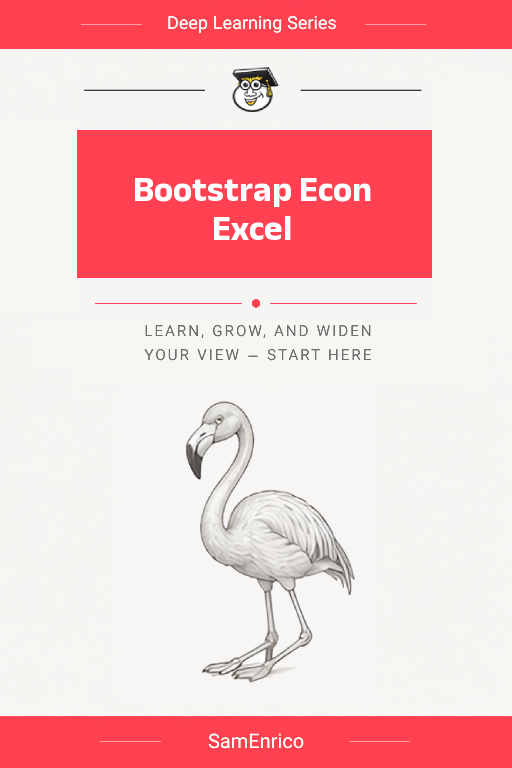
Non-FictionStudent's ShortcutBootstrap
Bootstrap Econ Excel Audiobook
Perform bootstrap resampling for standard errors i
Perform bootstrap resampling for standard errors in Excel for economics.
Formats
Free sample
Chapter 1: The $10 Billion Blind Spot–- In the autumn of 2008, as Lehman Brothers collapsed and global markets seized, a quiet mathematical crime was exposed. For years, the world’s most sophisticated economists had run models assuming that financial returns followed a neat, well-behaved normal distribution. They calculated standard errors using formulas perfected in the 1920s, when data came on punch cards and computation was done by hand. Those formulas assumed that the future would look like the past, that errors would scatter evenly, and that extreme events were essentially impossible. Then the future arrived, and it looked nothing like the past.
Housing prices, which their models said could never drop more than 3% in a single quarter, fell 20%. Default correlations, assumed to be independent, moved in perfect lockstep. The standard errors—those carefully computed measures of uncertainty—were off by factors of ten or more. The problem wasn’t greed alone, though there was plenty of that. The problem was a statistical blind spot that had been hiding in plain sight for decades: the assumption that real-world economic data obeys the same rules as textbook examples.This chapter is about that blind spot.
It is about why classical statistics, for all its elegance, systematically fails with the kind of data economists actually work with. And it is about the first step toward a solution: recognizing that the problem exists in your own work, often without your knowledge.The Paradox of Precision Every economist learns the mantra in their first statistics course: “The standard error measures the precision of your estimate.” The smaller the standard error, the more confident you can be. But there is a hidden clause that textbooks often gloss over: provided the assumptions hold. Those assumptions—normality, independence, homoskedasticity—are the fine print of classical inference. And like the fine print on a credit card agreement, they contain most of the important information.Consider a simple example.
You are asked to estimate the average income in a mid-sized city. You take a random sample of 100 households. The sample mean is 65,000,andtheclassicalstandarderror—calculatedasthesamplestandarddeviationdividedbythesquarerootof100—is65,000, and the classical standard error—calculated as the sample standard deviation divided by the square root of 100—is 65,000,andtheclassicalstandarderror—calculatedasthesamplestandarddeviationdividedbythesquarerootof100—is2,000. Your 95% confidence interval runs from 61,080to61,080 to 61,080to68,920. You present this to the mayor, who asks a sensible question: “How sure are you that the true average is between 61,000and61,000 and 61,000and69,000?”If the data were perfectly normal, independent…
This is the end of the free sample. Get the Audiobook to keep going. Buy now
About this book
Details
- Author
- Wilt Germaine
- Publisher
- SamEnrico
- Language
- English
- Genre
- Non-Fiction, Student's Shortcut, Bootstrap
- Released
- 2026-06-01
- Pages (approx.)
- 158
- Available as
- eBook, Audiobook

Listen in the VoxFlicks app
Audiobooks and audio dramas wherever you go. Sign in with your SamEnrico account and press play.
More by Wilt Germaine
 Meditation for Racing ThoughtsWilt Germaine$11.99
 Sugar Detox Symptoms ListWilt Germaine$11.99
 The Greenhouse Warmth GuideWilt Germaine$11.99
 Barbell Basics WorkbookWilt Germaine$11.99
 Parent Heart Attack Sudden DeathWilt Germaine$11.99
 The Silent Symphony: How a Defective Robot Composed a MasterpieceWilt Germaine$11.99
 The Dragon’s Heart: A Ballad of Fire and FateWilt Germaine$11.99
 Understanding Glucosidase Acid-1,4-alpha DeficiencyWilt Germaine$17.99
 How to Start a Cellular Network Operations Business (Beginners Guide)Wilt Germaine$11.99
 Employment Agreement Drafting TrapWilt Germaine$12.99
 Logistics Operations ManagerWilt Germaine$11.99
You may also like
 Hong Kong Handover 1997Dunn Johnnie$11.99
 Zumba For Postnatal Recovery CourseNeal Christian$11.99
 Zumba for BeginnersLadner Nikia$11.99
 YouTube Comment Mining GuideHumes Pandora$12.99
 Worry Box MeditationCarlin Rudy$11.99
 Workplace Stress MeditationNguyen Lynn$11.99
 Workplace Stress and Sleep RepairHawley Ivory$11.99
 Workplace Perfectionism CureDelaney Jeffry$11.99
 Workplace Injustice Anger GuideWallen Isabelle$11.99
 Work Addiction and Burnout LinkGreenwood Ester$11.99
 Women in Yoga and WellnessBeattie Galina$11.99
 Women in Stand Up ComedyChun Evangeline$11.99