
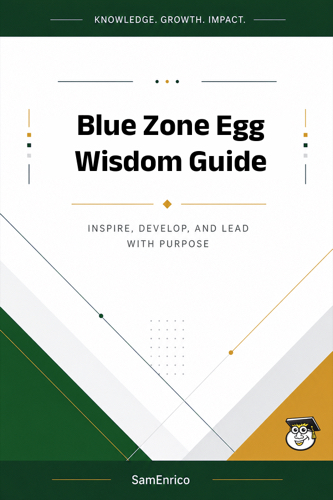
Non-FictionHealth & WellnessEgg Nutrition
Blue Zone Egg Wisdom Guide eBook
Eat eggs from free-range chickens as Nicoyans do,
Eat eggs from free-range chickens as Nicoyans do, but only a few weekly.
Formats
Free sample
Chapter 1: The Longevity Paradox...--The first time I watched Don Oscar crack an egg, I thought I was witnessing a heart attack in slow motion.He was 102 years old. His hands, spotted with age but steady as a surgeon's, held a brown speckled egg against the rim of a clay bowl. With one swift motion, he broke the shell and let the yolk—a deep, almost unsettling shade of orange—slide into a simmering pot of black beans and rice. Within seconds, the egg was lost in a sea of fiber, indistinguishable from the meal itself. Don Oscar looked up at me, smiled with most of his original teeth, and said something in Spanish that my translator rendered as: "This is why I am still here."I was in the Nicoya Peninsula of Costa Rica, one of the world's five Blue Zones—regions where people regularly live past 100 without the chronic diseases that define American aging.
I had traveled thousands of miles expecting to find a secret. A special berry. A rare root. A meditation technique locked away for centuries. Instead, I found Don Oscar eating an egg.
Just one. On top of beans. Three times a week. For ninety years.That moment broke something in me. Not my body—my assumptions.I had spent the previous decade bouncing between every major diet trend.
Keto told me to eat eggs by the dozen, fried in butter, bacon on the side. Vegan told me to avoid eggs entirely, that they were cholesterol bombs wrapped in protein. Paleo said eggs were nature's perfect food but only if the chicken ate what a caveman ate. Mediterranean said eggs were fine but olive oil was the real star. Every expert had a different answer.
Every study seemed to contradict the last one. And through it all, my own health markers were sliding in the wrong direction.My fasting cholesterol had crept from 180 to 210 over five years. My inflammation markers—specifically high-sensitivity C-reactive protein (hs-CRP)—had doubled. My energy levels, once reliably high through afternoon work sessions, now crashed by 2 PM. I was forty-three years old, eating what I thought was a healthy diet, and aging like a man fifteen years older.The problem, I would eventually discover, was not the egg.
The problem was everything surrounding the egg.The Confession of a Health-Obsessed Hypocrite Before we go any further, let me confess something embarrassing. I am exactly the kind of person who should have known better. I had read the Blue Zones books. I had watched the documentaries. I could recite the longevity statistics of Okinawa, Sardinia, and Icaria from memory.
But knowing and doing are separated by a gulf that reason alone cannot bridge.In practice, my diet looked nothing like a Blue Zone diet. I would read about Nicoyans eating eggs as a condiment on beans, nod approvingly, and then the next morning crack four eggs into a hot skillet with grass-fed butter and leftover brisket. I told myself this was "keto-adjacent" and therefore healthy. I told myself the Blue Zones were outliers, that their genetics or their water or their altitude explained their longevity. I told myself that my way—the high-protein, high-fat, low-carb American way—was simply a more efficient path to the same destination.I was wrong.The data on Blue Zones is not subtle.
It does not whisper. It shouts. The Nicoya Peninsula has a 20 percent lower mortality rate than the rest of Costa Rica. Their rate of reaching 100 is more than double the global average. And unlike the other Blue Zones, which rely on near-vegetarian diets (Okinawa, Loma Linda) or daily cheese consumption (Sardinia, Icaria), Nicoyans eat eggs and chicken as their primary animal proteins.
Not beef. Not pork. Not processed meats. Eggs and chicken, in moderation, always paired with beans, rice, corn, and squash.Don Oscar was not a genetic outlier. I later learned that his brother had died of a heart attack at sixty-two—in Florida, after moving to the United States and adopting the Standard American Diet.
The same genes. Different environment. Different egg. Different outcome.That difference is what this book is about.The Three Problems with How You Currently Eat Eggs Before we can build a new relationship with eggs, we need to understand why the old relationship failed. Through my research and my own painful experimentation, I have identified three fundamental problems with how most health-conscious people eat eggs today.Problem One: You Eat Too Many The average American eats approximately 280 eggs per year.
That is nearly five and a half eggs per week. If you are health-conscious, your number is likely higher—closer to 7 or 8 per week, often in the form of a daily three-egg omelet. The Nicoyan centenarians I interviewed ate approximately 150 eggs per year. That is three per week. Not three per day.
Not three per meal. Three per week.The difference between three eggs per week and eight eggs per week is not small. It is the difference between consuming eggs as a nutrient-dense condiment and consuming eggs as a primary protein source. And as we will explore in Chapter 3, that distinction matters enormously for the hormone pathways that control aging.Problem Two: You Eat the Wrong Eggs The eggs Don Oscar ate came from the three chickens scratching around his backyard. Those chickens ate insects, kitchen scraps, and whatever greens they could find.
They spent their days in the sun and their nights in a simple wooden coop. They were not vaccinated, medicated, or industrialized. They were, in every sense of the word, natural.The eggs you buy at the supermarket—even the ones labeled "free-range" or "cage-free"—come from a radically different system. Commercial hens are fed a diet of corn and soy, often genetically modified and grown with pesticides. They are kept indoors under artificial light.
They live in flocks of tens of thousands. And the eggs they produce are nutritionally distinct from the eggs Don Oscar ate.The difference is not subtle. As we will see in Chapter 5, pastured eggs contain twice the Omega-3 fatty acids, three times more Vitamin E, and seven times more beta-carotene than factory eggs. They also have a dramatically different Omega-6 to Omega-3 ratio—the difference between an anti-inflammatory food and a pro-inflammatory one. You cannot get Nicoyan results from a factory egg.Problem Three: You Eat Eggs Alone This is the most important problem and the one that took me the longest to understand.
When Don Oscar ate his egg, he never ate it by itself. The egg was always embedded in a matrix of plants—specifically beans, rice, and vegetables. The egg was a condiment, not the main event. The opposite of a three-egg omelet.Why does this matter? Because the soluble fiber in beans and vegetables binds to cholesterol and bile acids in your digestive tract, escorting them out of your body before they can be absorbed.
An egg eaten alone has a different metabolic effect than an egg eaten on top of a bowl of black beans. The Nicoyans understood this intuitively. We have ignored it completely.When I finally started eating my eggs the Nicoyan way—one egg at a time, on a bed of…
This is the end of the free sample. Get the eBook to keep going. Buy now
About this book
Details
- Author
- William Renay
- Publisher
- SamEnrico
- Language
- English
- Genre
- Non-Fiction, Health & Wellness, Egg Nutrition
- Released
- 2026-06-09
- Pages (approx.)
- 139
- Available as
- eBook, Audiobook

Read better in the ZLOADR app
Your eBooks on your phone or tablet. Sign in with your SamEnrico account and start reading.
More by William Renay
 Elder Care Charity Fraud GuideWilliam Renay$11.99
 Teen Food Addiction RecoveryWilliam Renay$11.99
 The Dinner Prep Morning GuideWilliam Renay$11.99
 Subway Commuter ConversationWilliam Renay$11.99
 The Silent Hunters of the Pacific: The First Submarine War (1863-1865)William Renay$11.99
 Ghana Accounting Firms GuideWilliam Renay$12.99
 Founder Depression and ProductivityWilliam Renay$12.99
 Understanding Wilms Tumor Radial Bilateral AplasiaWilliam Renay$17.99
 Web Systems EngineerWilliam Renay$11.99
 How to Start a Photograph Finishing Business (Beginners Guide)William Renay$11.99
You may also like
 Hong Kong Handover 1997Dunn Johnnie$11.99
 Zumba For Postnatal Recovery CourseNeal Christian$11.99
 Zumba for BeginnersLadner Nikia$11.99
 YouTube Comment Mining GuideHumes Pandora$12.99
 Worry Box MeditationCarlin Rudy$11.99
 Workplace Stress MeditationNguyen Lynn$11.99
 Workplace Stress and Sleep RepairHawley Ivory$11.99
 Workplace Perfectionism CureDelaney Jeffry$11.99
 Workplace Injustice Anger GuideWallen Isabelle$11.99
 Work Addiction and Burnout LinkGreenwood Ester$11.99
 Women in Yoga and WellnessBeattie Galina$11.99
 Women in Stand Up ComedyChun Evangeline$11.99