
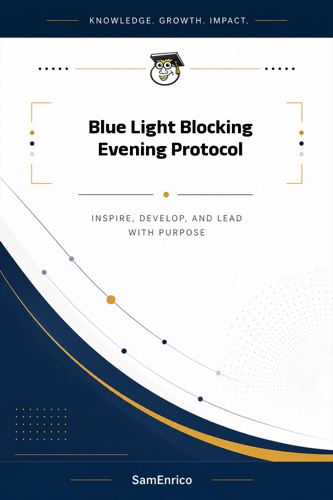
Blue Light Blocking Evening Protocol
Dim screens and use amber glasses two hours before
Dim screens and use amber glasses two hours before bedtime to preserve melatonin.
Formats
About this book
Free sample
Chapter 1: The Third Eye...–- Most people believe they understand light. They know that brightness keeps them awake and darkness helps them sleep. They close their eyes at night and assume that’s enough. They reach for their phones in bed and think, “It’s fine—I’ll just lower the brightness.” This intuition, which every human being shares, is catastrophically wrong. And the mistake begins with a fundamental misunderstanding of what the eye actually does.For centuries, scientists believed the human eye had two jobs.
Rods handled vision in low light. Cones handled color vision in bright light. That neat division appeared in every medical textbook, every biology lecture, every explanation of how we see the world. It made intuitive sense: light enters the eye, hits the retina, activates rods and cones, and the brain constructs an image. Vision solved.
But this tidy story left one glaring mystery unsolved. Throughout the 1990s, researchers studying circadian rhythms kept finding evidence that something else was happening inside the retina—something that had nothing to do with vision.Blind patients provided the first clue. Some individuals who were completely blind—no conscious perception of light whatsoever—still showed normal circadian rhythms. Their bodies knew when it was day and night even though their eyes could not see. Other blind patients, equally sightless, had completely disrupted sleep cycles, their internal clocks drifting unpredictably.
The difference between these two groups suggested that the eye contained a second system entirely separate from rods and cones, a system dedicated not to seeing the world but to timing the body. The hunt for this mysterious photoreceptor became one of the most exciting detective stories in modern neuroscience.The breakthrough came in the early 2000s. A team of researchers led by David Berson at Brown University identified a third type of photoreceptor hidden in plain sight. These cells, called intrinsically photosensitive retinal ganglion cells (ip RGCs) , had been overlooked for decades because they looked like ordinary ganglion cells—the neurons that normally just relay signals from rods and cones to the brain. But Berson’s team discovered that ip RGCs…
This is the end of the free sample. Get the eBook to keep going. Buy now
Contents
- Chapter 1
- Chapter 2
- Chapter 3
- Chapter 4
- Chapter 5
- Chapter 6
- Chapter 7
- Chapter 8
- Chapter 9
- Chapter 10
- Chapter 11
- Chapter 12
Details
- Author
- Whittle Felicidad
- Publisher
- SamEnrico
- Language
- English
- Genre
- Non-Fiction, Health & Wellness, Digital Health
- Released
- 2026-06-08
- Pages (approx.)
- 146
- Available as
- eBook, Audiobook

Read better in the ZLOADR app
Your eBooks on your phone or tablet. Sign in with your SamEnrico account and start reading.
More by Whittle Felicidad
 Retirement Reinvention PlanWhittle Felicidad$11.99
 Parenting Stress and Childcare SearchWhittle Felicidad$11.99
 The Alchemist's Last Pill: The Untold Fortune of ParacelsusWhittle Felicidad$11.99
 10 Ways to Use Aerva Javanica (Recipe Book)Whittle Felicidad$11.99
 Payment Failure Recovery for ExportersWhittle Felicidad$12.99
 How to Produce a Bucket Chain ExcavatorWhittle Felicidad$11.99
 Emergency ManagementWhittle Felicidad$11.99
You may also like
 Social Anxiety Apps GuideDanielson Josefa$11.99
 Prostate Health Tracking App GuideGaylord Sherrell$11.99
 FODMAP Apps GuideKroll Solange$11.99
 Tension Headache and Tech NeckWilke Celestine$11.99
 Shift Work Smartphone ManagementPak Candra$11.99
 Blue Light Management GuideReardon Doreatha$11.99
 Relapse Prevention Digital Therapeutics CourseShaw Troy$11.99
 Blue Light Filtering for SADMabry Rosette$11.99
 Online Gambling Self Exclusion GuideJarvis Daryl$11.99
 Bipolar Smartphone App GuideAnderson Roberto$11.99
 OCD And Digital HoardingGalvez Inga$11.99
 Nicotine Cessation Mobile Apps GuideHiatt Celina$11.99