
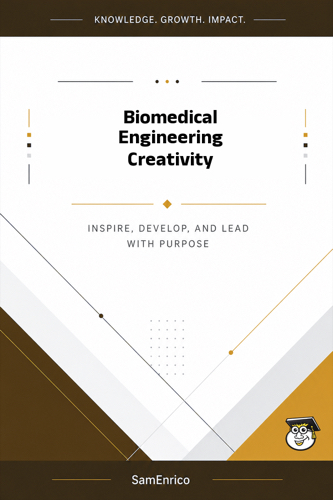
Biomedical Engineering Creativity eBook
Generate novel medical devices and diagnostic appr
Generate novel medical devices and diagnostic approaches using structured methods.
Formats
Free sample
Chapter 1: The Million-Dollar Mistake--–- The young biomedical engineer pressed "send" on the final design files, leaned back in her chair, and smiled. Eighteen months of work. Three million dollars in grant funding. A prototype that worked flawlessly on the benchtop. She had solved a problem that dozens of engineers before her had failed to solve: a laparoscopic tissue retractor that could articulate in six degrees of freedom while maintaining suction pressure.–- The device was elegant.
The carbon fiber shaft was lighter than anything on the market. The actuation mechanism, inspired by the tendons in a human finger, allowed for smooth, intuitive control. Her team had filed three provisional patents. A prominent surgical journal had accepted their paper. The university's technology transfer office was already talking to investors.–- There was only one problem, and she didn't discover it until the day of the live porcine surgery demonstration.–- The attending surgeon picked up her device, held it for exactly four seconds, and placed it back on the tray.
"I can't use this," he said. "The grip is textured. I wear size 8 gloves, and that texture will give me blisters after the third case of the day. Also, the balance point is two centimeters too far forward. My wrist will fatigue by noon."–- The engineer stared at him.
"But the articulation—"–- "I don't need six degrees of freedom," the surgeon interrupted. "I need three. I need it to be quiet so I can hear my team. And I need it to cost less than four hundred dollars because my hospital's supply chain won't approve anything above that. You've built a Formula One car.
I need a pickup truck."–- The demonstration proceeded with the surgeon using a standard, twenty-year-old retractor that cost eighty-seven dollars. The engineer's device sat untouched. The investors who had flown in for the demo left early.–- Three million dollars. Eighteen months. Zero clinical adoption.–- The problem was not the engineering.
The problem was not the science. The problem was that no one had asked a simple question before writing the first line of code or machining the first part: What problem am I actually solving, and for whom?The Myth That Is Killing Medical Innovation–- This story is not unusual. In fact, it is the norm.–- Across biomedical engineering programs, research labs, and medical device startups, brilliant engineers are building elegant solutions to problems that do not exist. They are optimizing features that no clinician wants. They are reducing costs on components that no payer will reimburse.
They are perfecting technologies that no patient can use.–- The root cause is a seductive myth: the lone genius who has a sudden "eureka" moment and changes the world.–- We love this story. We tell it about Alexander Fleming discovering penicillin when a petri dish was contaminated. We tell it about Wilson Greatbatch accidentally grabbing the wrong resistor and inventing the implantable pacemaker. We tell it about how a spilled chemical led to the Post-it Note. These stories are compelling because they suggest that creativity is a mysterious spark—something you either have or you don't, something that arrives unbidden in a flash of inspiration.–- They are also mostly wrong.–- Fleming did not discover penicillin because of luck.
He discovered it because he had trained himself to notice unusual patterns in bacterial growth and had the discipline to investigate a contaminant that ninety-nine other scientists would have discarded. Greatbatch did not invent the pacemaker because of an electrical mistake. He invented it because he recognized that the wrong resistor's behavior—a steady, rhythmic pulse—could solve a problem he had been thinking about for years. The "accident" was only useful because his mind was already primed with a deep understanding of the unmet need.–- In biomedical engineering, the lone genius myth is not just misleading. It is dangerous.–- Medical devices operate in a world of regulation, reimbursement, and human physiology.
A device that fails is not just a commercial failure—it can injure or kill patients. Unstructured brainstorming, the kind celebrated in tech startup lore, produces ideas that are unconstrained by reality. And in medicine, reality has sharp teeth.The Evidence: Why Unstructured Brainstorming Fails–- The research on creativity is unambiguous: brainstorming as it is traditionally practiced does not work.–- In a landmark study at Yale University, researchers asked participants to generate ideas for solving a specific problem. One group was told to brainstorm "freely" with no constraints. Another group was given a structured technique: they had to generate ideas by subtracting an essential component from existing solutions.
The structured group produced twice as many novel, feasible solutions. More importantly, the unstructured group spent most of their time generating obvious, incremental ideas—the same ideas that every other group generated.–- This finding has been replicated dozens of times. In 2011, a meta-analysis of seventy-one independent studies on brainstorming concluded that individuals working alone with structured prompts outperform groups engaged in unstructured brainstorming by a factor of two to one. The reasons are well understood: unstructured groups fall prey to social loafing (some members stop contributing), production blocking (only one person can speak at a time), and evaluation apprehension (people censor their own ideas for fear of judgment).–- But the most damning finding came from a study of medical device innovation specifically. Researchers at the Stanford Biodesign program analyzed three hundred medical device concepts generated through unstructured brainstorming sessions.
Only seven—less than three percent—progressed to prototyping. Of those seven, exactly zero received regulatory clearance or commercial funding. The ideas were not bad because the engineers were incompetent. They were bad because they were unconstrained by the realities of clinical practice, regulatory pathways, and reimbursement models.–- Contrast that with a different approach. In the same study, concepts generated through a structured need-finding process—where engineers were required to observe clinical procedures, document workarounds, and screen needs against explicit criteria—had a thirty-five percent success rate in reaching prototyping.
Fifteen percent received regulatory clearance. Eight percent became commercial products.–- Structured creativity is not less creative. It is more creative because it directs creative energy toward problems that actually matter.The Equation That Changes Everything–- This book is built on a single equation, and if you remember nothing else, remember this:–- Innovation = (Idea Generation) × (Validation) × (Execution)–- Multiplication matters here. If any term is zero, the entire product is zero. You can generate a thousand brilliant ideas.
If you validate none of them, you have nothing. You can validate the perfect need. If you execute poorly, you have nothing. You can execute flawlessly. If you generated the wrong idea, you have nothing.–- Most books on creativity focus exclusively on the first term: Idea Generation.
They teach you how to brainstorm, how to think outside the box, how to unlock your creative potential. These are valuable skills. But they are insufficient.–- This book is different. It teaches you all three terms, with an emphasis on the two that are most neglected in biomedical engineering: Validation and Execution.–- Idea Generation is what you think of as "creativity." It is the process of…
This is the end of the free sample. Get the eBook to keep going. Buy now
About this book
Details
- Author
- Stacy Georgetta
- Publisher
- SamEnrico
- Language
- English
- Genre
- Non-Fiction, Self-Help, Biomedical Engineering
- Released
- 2026-06-08
- Pages (approx.)
- 150
- Available as
- eBook, Audiobook

Read better in the ZLOADR app
Your eBooks on your phone or tablet. Sign in with your SamEnrico account and start reading.
More by Stacy Georgetta
 The Incremental Progress GuideStacy Georgetta$11.99
 Forgiving an Absent ParentStacy Georgetta$11.99
 Digital Detox for Addiction RecoveryStacy Georgetta$11.99
 The France Salary Negotiation GuideStacy Georgetta$11.99
 The Siege of Chittorgarh: Akbar's Unyielding FortressStacy Georgetta$11.99
 Understanding Trophoblastic TumorStacy Georgetta$17.99
 VAT Invoice RequirementsStacy Georgetta$12.99
 African Marketplace YC GuideStacy Georgetta$12.99
 Composing MusicStacy Georgetta$11.99
 How to Become a Pipe-organ BuilderStacy Georgetta$11.99