
Non-FictionInformativeEducational
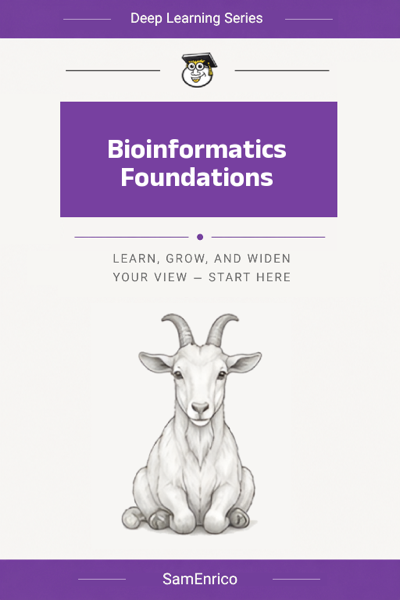
Bioinformatics Foundations eBook
A Coursebook on Bioinformatics Foundations
A Coursebook on Bioinformatics Foundations
Formats
Free sample
Chapter 1: The Data Imperative-- Every second of every day, your body performs a feat of information management that would bankrupt Google. Within the nucleus of a single cell, six feet of DNA is folded, read, copied, and repaired without a single blue screen of death. The four chemical letters—A, T, G, C—are not just molecules. They are a language. And like any language, they can be parsed, searched, aligned, and translated.
But unlike human languages, this one carries the instructions for life itself. Welcome to the datafication of biology.If you picked up this book, you already suspect that bioinformatics is more than just typing commands into a black terminal window. You may have tried to learn it before. Perhaps you opened a textbook only to be buried under algorithms named after people you've never heard of. Perhaps you installed a tool only to be told you have the wrong version of Python, and then the wrong version of something else, until you gave up and went back to the bench.
This chapter exists because you need a different starting point—not a list of facts, but a way of thinking.Bioinformatics is not a subfield of computer science that happens to look at DNA. It is not a subfield of biology that happens to use computers. It is a third space—a discipline with its own rules, its own tools, and its own culture. To succeed here, you need to understand three things before you write a single line of code. First, what makes biological data fundamentally different from the data your computer science friends work with.
Second, how the central dogma of molecular biology becomes a data pipeline when viewed through the right lens. And third, the actual landscape of this field: what bioinformatics is, what computational biology is, and what genomics is—and why confusing them will get you lost.Let us begin with the data itself.The Messiness of Life: Why Your Spreadsheet Is Lying to You In a physics laboratory, if you measure the speed of light, you get 299,792,458 meters per second. If you measure it again, you get the same number, within an exquisitely small margin of error. In a computer science classroom, if you write 2 + 2, the machine returns 4 every single time, forever, without exception.In a molecular biology laboratory, if you measure the expression of the BRCA1 gene in a sample of breast tissue, and then measure the exact same sample again on a different day, you might get numbers that differ by thirty percent. This is not because you made a mistake.
This is because biology is fundamentally, irreducibly messy.Biological data has three properties that make it unlike the tidy datasets you may have encountered elsewhere. Understanding these properties is not optional—it is the difference between being confused by your results and being able to trust them.Property One: High Dimensionality with Low Sample Size.A typical RNA sequencing experiment measures the expression level of roughly twenty thousand genes. That is twenty thousand variables. How many samples does the same experiment usually have? Three replicates per condition.
Six samples total. Maybe twelve if the grant is generous.Twenty thousand variables, six observations. Mathematicians call this the "curse of dimensionality." Biologists call it Tuesday.This imbalance has profound consequences. With so many variables and so few samples, the probability of finding a "statistically significant" result purely by chance approaches certainty. If you test twenty thousand hypotheses at the conventional p-value threshold of 0.05, you expect one thousand false positives even if nothing is actually different between your groups.
This is why bioinformatics is obsessed with multiple testing correction—not because statisticians are pedantic, but because the numbers demand it.Property Two: Non-Independence and Hidden Structure.The genes in your experiment do not act independently. They are locked in a dense web of regulatory relationships, physical interactions, and shared pathways. When you measure gene A going up, the probability that gene B also changes is not random—it is determined by biology. This violates a core assumption of many statistical tests, which assume that each measurement brings new, independent information.Worse, the structure is often hidden. Batch effects—systematic differences between groups of samples processed on different days, by different technicians, or on different machines—can easily overwhelm the biological signal you actually care about.
The most famous example in the literature involves a study of drug response in cancer cells. When the authors analyzed their data, they found a strong signature that perfectly separated the treatment group from the control group. The problem? The treatment samples had all been processed on Tuesday, and the controls on Wednesday. The "signature" was actually the lab technician's coffee consumption.Property Three: Non-Linearity and Emergence.Linear models are beautiful because they are simple.
Gene X goes up by ten percent, so protein Y goes up by ten percent, so pathway Z is activated by ten percent. This is how we wish biology worked. It is almost never how biology actually works.Biological systems are full of thresholds, switches, feedback loops, and saturation effects. A transcription factor might have no effect until its concentration crosses a critical threshold, at which point it binds cooperatively to DNA and turns on hundreds of genes in a switch-like manner. A signaling pathway might adapt to constant stimulation, turning off even as the input remains high.
A small change in one gene might be compensated by a paralog, while a large change in the same gene causes catastrophic failure.This non-linearity means that the tools of classical statistics, designed for well-behaved Gaussian distributions, often fail. It is why RNA-seq analysis uses the negative binomial distribution instead of the normal distribution. It is why machine learning methods like random forests and neural networks have become essential tools in bioinformatics—they can approximate the non-linear relationships that linear models miss.What This Means For You.If you come away from this chapter with one idea, let it be this: when your bioinformatics analysis produces a result that seems too good to be true, it probably is. When you run a differential expression analysis and get ten thousand significantly differentially expressed genes, you should be suspicious, not celebratory. When your PCA plot shows perfect separation between cases and controls, check the date stamps.
When your machine learning classifier achieves ninety-nine percent accuracy, ask yourself whether it has learned biology or batch effects.The messiness of biological data is not a bug to be fixed. It is a feature to be understood. The best bioinformaticians are not the ones who never encounter problems. They are the ones who recognize problems when they appear and have the tools to diagnose them.The Central Dogma as a Data Pipeline You have seen the central dogma before. DNA makes RNA makes protein.
A simple arrow diagram, memorized for an exam, then filed away. But the central dogma, when viewed through an information science lens, is something else entirely. It is a data pipeline with specific transformations, specific file formats, and specific points where errors can be introduced.DNA: The Master Archive.In computational terms, DNA is a master archive. It is stored in a highly compressed format (histones…
This is the end of the free sample. Get the eBook to keep going. Buy now
About this book
Details
- Author
- Alexander George
- Publisher
- SamEnrico
- Language
- English
- Genre
- Non-Fiction, Informative, Educational
- Released
- 2026-06-02
- Pages (approx.)
- 147
- Available as
- eBook, Audiobook

Read better in the ZLOADR app
Your eBooks on your phone or tablet. Sign in with your SamEnrico account and start reading.
More by Alexander George
 Twelve Step Adaptation GuideAlexander George$11.99
 Intervention SurvivorsAlexander George$11.99
 Betting and Mental HealthAlexander George$11.99
 Svalbard Polar Bear GuardAlexander George$11.99
 Blood Injury Phobia Fainting FixAlexander George$11.99
 Anger Trigger Wearable AlertAlexander George$11.99
 Ransomware Hostage StoryAlexander George$11.99
 Bankruptcy Trustee RelationsAlexander George$11.99
 Twitter 2020: Verified and VulnerableAlexander George$11.99
 The Vanishing Act of the Library of AlexandriaAlexander George$11.99
 The Battle of the Delta: Ramses III and the Sea Peoples' Last Stand (1175 BC)Alexander George$11.99
 University of London GuideAlexander George$12.99
You may also like
 Hong Kong Handover 1997Dunn Johnnie$11.99
 Zumba For Postnatal Recovery CourseNeal Christian$11.99
 Zumba for BeginnersLadner Nikia$11.99
 YouTube Comment Mining GuideHumes Pandora$12.99
 Worry Box MeditationCarlin Rudy$11.99
 Workplace Stress MeditationNguyen Lynn$11.99
 Workplace Stress and Sleep RepairHawley Ivory$11.99
 Workplace Perfectionism CureDelaney Jeffry$11.99
 Workplace Injustice Anger GuideWallen Isabelle$11.99
 Work Addiction and Burnout LinkGreenwood Ester$11.99
 Women in Yoga and WellnessBeattie Galina$11.99
 Women in Stand Up ComedyChun Evangeline$11.99