
Non-FictionSelf-HelpPsychopharmacology
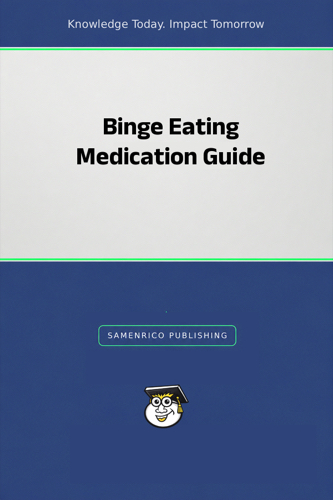
Binge Eating Medication Guide eBook
Overview of pharmaceutical options for treating fo
by Lackey Bambi
Overview of pharmaceutical options for treating food addiction.
Formats
Free sample
Chapter 1: The Uninvited Guest--Imagine waking up at 3:00 a.m. not because of a nightmare or a crying child, but because your brain is already planning breakfast. Not what you will eat—you already know that. What time you will allow yourself to eat it. Whether you can hold off until 6:00 a.m.
to seem normal. Whether you can sneak the extra piece of toast before anyone sees. Whether you can pretend you only had coffee.Now imagine that this internal monologue never stops. It accompanies you through morning meetings, where you sit silently while your colleagues discuss deadlines, but you hear none of it because you are calculating how many hours until lunch. It follows you to the grocery store, where you buy healthy food for your family while simultaneously hiding a separate bag of food you will eat alone in your car.
It whispers to you as you brush your teeth at night, already promising that tomorrow will be different—and already knowing it won't be.This voice, this constant, intrusive, exhausting presence, has a name. In clinical settings and increasingly in patient communities, it is called food noise.Not hunger. Hunger is a biological signal that fades after eating. Food noise is something else entirely. It is the obsessive, repetitive, compulsive thinking about food that does not respond to fullness, reason, or shame.
It is the uninvited guest who moved into your head years ago and refuses to leave. And for the millions of people who struggle with binge eating disorder and food addiction, naming this experience is often the first moment they realize they are not broken, not lazy, not morally deficient. They have a brain condition—and like many brain conditions, it may respond to medication.This book is written for those people. For the ones who have tried every diet, every app, every promise of willpower. For the ones who have sat in doctors' offices and heard "just eat less and move more" as if they had never considered that.
For the ones who have secretly wondered if there is a pill that could finally turn down the volume. There is. Several, in fact. But the landscape of pharmaceutical options for binge eating is confusing, rapidly changing, and poorly explained to patients. This book is your guide.Before we talk about medications, however, we must talk about what we are actually treating.
This chapter will accomplish three things. First, it will give you a precise language for your experience, moving from vague shame to clinical clarity. Second, it will introduce the medical paradigm shift that recognizes binge eating and food addiction as brain diseases, not character flaws. Third, it will walk you through the official diagnostic criteria for Binge Eating Disorder, distinguishing it from simple overeating or occasional indulgence. By the end of this chapter, you will understand that your struggle has a biological basis—and that this understanding is not an excuse but the essential first step toward effective treatment.The Phenomenon That Has No Name Let us start with a simple exercise.
Think about how much of your waking mental energy is spent on food-related thoughts. Not just planning meals or enjoying a good dinner. The intrusive thoughts. The counting and re-counting of calories. The negotiation with yourself about whether you are "allowed" to eat.
The review of what you ate yesterday, accompanied by shame. The fantasy of what you will eat tomorrow, accompanied by anticipation. The calculating of how to eat in public versus how you will eat when you are alone.For a person without food addiction, this is a very small number. Perhaps five percent of their mental bandwidth, mostly centered around genuine hunger and social eating. For a person with binge eating disorder, this number can reach eighty, ninety, even ninety-five percent.
There is simply no room left for other things. Relationships suffer. Work suffers. The ability to be present with your own children suffers. The food noise has colonized your consciousness.A 2023 qualitative study published in the journal Appetite interviewed thirty-two individuals with severe binge eating disorder.
When asked to describe their internal experience, participants used phrases like "a radio that won't turn off," "a second voice in my head that never sleeps," and "a constant hum that gets louder when I try to ignore it." One participant, a forty-three-year-old woman who had struggled with bingeing since adolescence, said: "I don't even know who I would be without the food thoughts. They have been there longer than anything else."This is not hyperbole. It is a clinical reality that has been ignored for decades because the medical establishment, like the culture at large, preferred to see binge eating as a failure of self-discipline rather than a neurological condition. That is changing. And the first step of that change is giving the experience a name.The Paradigm Shift: From Moral Failing to Brain Disease For most of modern medical history, obesity and binge eating were classified as behavioral problems.
The prevailing assumption was straightforward: people overate because they lacked willpower. They lacked willpower because they were lazy or undisciplined. And the solution was simply to try harder. This framework was not only cruel; it was scientifically wrong.Over the past three decades, a revolution has occurred in our understanding of addiction. We now know that substance use disorders are not moral failings but chronic, relapsing brain diseases.
The same brain circuits involved in addiction to alcohol, cocaine, and nicotine are involved in compulsive eating—particularly of ultra-processed foods engineered to be hyper-palatable.This paradigm shift has been driven by several lines of evidence. Neuroimaging studies show that individuals with binge eating disorder have altered dopamine receptor availability in the striatum, the brain's reward center, similar to what is seen in substance use disorders. Genetic studies have identified polymorphisms in dopamine-related genes that increase risk for both substance addiction and compulsive eating. Animal models demonstrate that intermittent access to sugar produces withdrawal symptoms—including anxiety and teeth-chattering—that are indistinguishable from opioid withdrawal.Perhaps most compellingly, medications developed for substance use disorders have shown efficacy for binge eating. This is not a coincidence.
The brain does not distinguish between a hit of cocaine and a hit of sugar in the way we might assume. Both trigger dopamine release in the nucleus accumbens. Both create conditioned cues that drive craving. Both produce tolerance, withdrawal, and relapse.The clinical implications of this paradigm shift are profound. If binge eating is a brain disease, then shame is not a treatment.
Blame is not a treatment. "Just stop" is not a treatment. What works is what works for other brain diseases: a combination of medication to correct underlying neurochemistry and behavioral therapy to retrain learned patterns. This is precisely the model used in addiction medicine, and it is increasingly the model used in eating disorder treatment.A note of caution is necessary here. Recognizing binge eating as a brain disease does not mean that individuals are passive victims of their neurochemistry.
The disease model of addiction has sometimes been misinterpreted as fatalism—as if a brain disease means there is nothing you can do. This is incorrect. Diabetes is a disease of the pancreas, but…
This is the end of the free sample. Get the eBook to keep going. Buy now
About this book
Details
- Author
- Lackey Bambi
- Publisher
- SamEnrico
- Language
- English
- Genre
- Non-Fiction, Self-Help, Psychopharmacology
- Released
- 2026-06-08
- Pages (approx.)
- 158
- Available as
- eBook, Audiobook

Read better in the ZLOADR app
Your eBooks on your phone or tablet. Sign in with your SamEnrico account and start reading.
More by Lackey Bambi
 Deep Sleep Breathing MeditationLackey Bambi$11.99
 Burnout In Military PersonnelLackey Bambi$11.99
 Self Worth Military Family GuideLackey Bambi$11.99
 Parent Cancer Death GuideLackey Bambi$11.99
 The Phantom Depths: The USS Scorpion’s Final DiveLackey Bambi$11.99
 The Dragon’s Lament: A Ballad of Saint George and the BeastLackey Bambi$11.99
 Understanding Glucose 6 Phosphate Dehydrogenase DeficiencyLackey Bambi$17.99
 Legrandite MiningLackey Bambi$11.99
 Instrumental Variables ExcelLackey Bambi$12.99
 Employee Personnel File Access TrapLackey Bambi$12.99
 How to Start a Cellular Wood Panel Business (Beginners Guide)Lackey Bambi$11.99
You may also like
 Hong Kong Handover 1997Dunn Johnnie$11.99
 Zumba For Postnatal Recovery CourseNeal Christian$11.99
 Zumba for BeginnersLadner Nikia$11.99
 YouTube Comment Mining GuideHumes Pandora$12.99
 Worry Box MeditationCarlin Rudy$11.99
 Workplace Stress MeditationNguyen Lynn$11.99
 Workplace Stress and Sleep RepairHawley Ivory$11.99
 Workplace Perfectionism CureDelaney Jeffry$11.99
 Workplace Injustice Anger GuideWallen Isabelle$11.99
 Work Addiction and Burnout LinkGreenwood Ester$11.99
 Women in Yoga and WellnessBeattie Galina$11.99
 Women in Stand Up ComedyChun Evangeline$11.99