
Non-FictionInformativeEducational
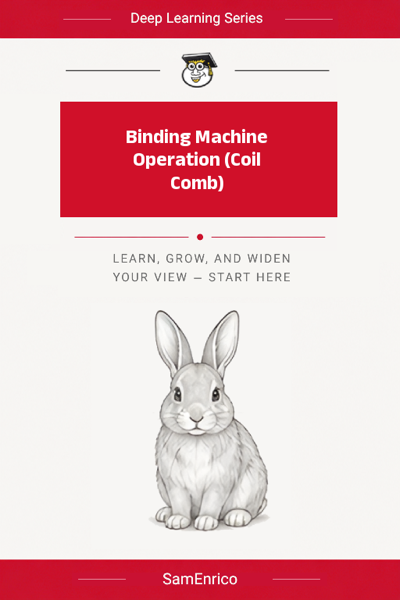
Binding Machine Operation (Coil Comb) eBook
A Coursebook on Binding Machine Operation (Coil Co
A Coursebook on Binding Machine Operation (Coil Comb)
Formats
Free sample
Chapter 1: The Binding Blindspot...–- Most people who own a binding machine have never actually been taught how to use it. They unbox it, glance at the illustrated manual—the one with the tiny, blurry diagrams and translations that read like they were run through three different language models—and then they guess. They punch a stack of paper. They thread a coil or snap a comb. And when the finished document looks slightly crooked, or the pages don’t turn smoothly, or the binding falls apart after a week, they assume the machine is cheap, or the supplies are low-quality, or that binding is just harder than it looks.None of those assumptions are correct.The real problem is that binding machines occupy an odd space in the world of office equipment.
They are not as simple as a stapler, where the margin for error is measured in millimeters and the consequences of a mistake are trivial. But they are also not as complex as a commercial printing press, which requires formal training and certification. They sit in the middle—too sophisticated for pure guesswork, too accessible for most users to seek out instruction. The result is that tens of thousands of binding machines sit on office shelves, school supply closets, and home workshop benches, operating at perhaps forty percent of their actual capability. Their owners have no idea what they are missing.This chapter exists to close that gap.
It will not simply list the parts of a binding machine, though it will do that. It will not merely compare manual versus electric models, though that comparison is essential. Instead, this chapter will fundamentally reframe how you think about binding equipment—from a mysterious black box that sometimes produces good results and sometimes doesn’t, into a predictable, controllable tool that rewards precision and punishes shortcuts. By the end of this chapter, you will understand not just what each component does, but why it exists, how it can fail, and how to select a machine that matches your actual needs rather than the one the salesperson wanted to clear from the warehouse.The Three Families of Binding Machines Before we examine individual components or evaluation criteria, we must understand the three fundamental categories of binding machines. These categories are not arbitrary marketing distinctions.
They represent different mechanical philosophies, different price points, and—most importantly—different relationships between the operator and the machine.Manual Lever Machines The oldest and most mechanically straightforward category is the manual lever machine. You place paper against the back guide, pull a lever (usually on the right side of the machine), and a set of punch pins descends through the paper, creating holes. Release the lever, and springs return the pins to their resting position. That is the entire mechanism.Manual machines are often dismissed as “entry level” or “beginner” equipment, but this characterization is unfair and inaccurate. High-end manual machines—the kind that cost four hundred dollars rather than forty—use all-metal gears, precision-ground punch pins, and lever linkages designed for hundreds of thousands of cycles.
Print shops have kept the same manual binding machines on their counters for twenty years, punching thousands of sheets per week, because the mechanism is fundamentally robust. There is simply less to break.The primary limitation of manual machines is physical. You provide the force. If you are punching twenty sheets of standard paper, the resistance is noticeable but not strenuous. If you are punching ten sheets of heavy cardstock, you will feel every sheet.
If you are punching laminated covers or plastic divider sheets, the lever will require significant effort. This is not a flaw—it is feedback. A manual machine tells you, through the lever, exactly how much resistance your materials are creating. Experienced operators use this feedback to diagnose problems before they become jams.Manual machines excel in four specific scenarios. First, low-volume offices that bind fewer than fifty documents per month.
Second, home offices and small studios where budget is constrained but quality cannot be sacrificed. Third, educational environments where students will operate the equipment and need the tactile feedback that prevents overloading. Fourth, any setting where the machine may sit unused for months at a time—manual machines have no electronics to degrade, no motors to seize, no circuit boards to fail.The primary disadvantage is speed. Each pull of the lever punches one stack of paper. If you are binding a hundred documents per day, your forearm will tire, and your productivity will plateau.
For high-volume users, manual operation becomes a bottleneck.Electric Punching Machines Electric machines replace the manual lever with an electric motor and gear train. You place the paper against the guide and press a button (or, on more sophisticated models, a foot pedal). The motor drives the punch pins through the paper and automatically returns them. Your only physical effort is feeding paper.The shift from manual to electric is not merely a convenience upgrade. It is a consistency upgrade.
Human beings are inconsistent. The speed at which you pull a lever, the angle of your pull, whether you pull all the way to the stop or stop slightly short—these variables affect hole quality. Electric machines remove that variability. Every punch is identical to every other punch, assuming the mechanism is properly maintained.Electric machines also enable higher punch capacities. A manual machine rated for fifteen sheets might comfortably handle ten.
An electric machine rated for twenty-five sheets can often handle the full twenty-five because the motor applies steady, even force that no human arm can replicate over hundreds of repetitions. However—and this is crucial—the same 50–60 percent rule for daily heavy use applies to electric machines as well. The motor can punch twenty-five sheets. Whether it should punch twenty-five sheets, eight hundred times per day, for five years, is a different question. Mechanical sympathy matters for machines with motors just as much as for machines with levers.Electric machines are the right choice for medium-volume offices (fifty to five hundred documents per month), print shops that bind as a secondary service, churches and nonprofits that produce periodic booklets and reports, and any environment where multiple operators will use the same machine.
Consistency across users is perhaps the strongest argument for electric punching. When five different people use a manual machine, you get five different techniques. When five different people press the same button on an electric machine, you get the same result every time.The disadvantages include higher cost (typically two to five times the price of a comparable manual machine), dependence on electricity (obvious but worth stating), and the eventual failure of electronic components. A manual machine from 1995 probably still works. An electric machine from 1995 may have a control board that is no longer manufactured.Combo Units (Coil, Comb, and Wire)The third category is the combo unit—a single machine capable of punching patterns for multiple binding styles.
Most combo units support coil and comb binding. Premium units add wire binding (twin-loop or double-loop wire) as a third option.Combo units are tempting because they promise versatility. Why buy two machines when one machine can do everything? The answer is that combo units…
This is the end of the free sample. Get the eBook to keep going. Buy now
About this book
Details
- Author
- Warfield Cedrick
- Publisher
- SamEnrico
- Language
- English
- Genre
- Non-Fiction, Informative, Educational
- Released
- 2026-05-18
- Pages (approx.)
- 151
- Available as
- eBook, Audiobook

Read better in the ZLOADR app
Your eBooks on your phone or tablet. Sign in with your SamEnrico account and start reading.
More by Warfield Cedrick
 Teacher Classroom Management Stress GuideWarfield Cedrick$11.99
 The Microbiota Gut Brain TrilogyWarfield Cedrick$11.99
 Expectation Reset Meditation GuideWarfield Cedrick$11.99
 Body Language for PsychologistsWarfield Cedrick$11.99
 Breaking the Slot Machine Trance GuideWarfield Cedrick$11.99
 The Lost Codex: How a 16th-Century Bible Vanished from a Spanish MonasteryWarfield Cedrick$11.99
 Understanding Lambert SyndromeWarfield Cedrick$17.99
 How to Start a Bakery Products (wholesale) Business (Beginners Guide)Warfield Cedrick$11.99
 Automated Report Scheduler ManualWarfield Cedrick$12.99
 Green Technology Investment GuideWarfield Cedrick$12.99
You may also like
 Hong Kong Handover 1997Dunn Johnnie$11.99
 Zumba For Postnatal Recovery CourseNeal Christian$11.99
 Zumba for BeginnersLadner Nikia$11.99
 YouTube Comment Mining GuideHumes Pandora$12.99
 Worry Box MeditationCarlin Rudy$11.99
 Workplace Stress MeditationNguyen Lynn$11.99
 Workplace Stress and Sleep RepairHawley Ivory$11.99
 Workplace Perfectionism CureDelaney Jeffry$11.99
 Workplace Injustice Anger GuideWallen Isabelle$11.99
 Work Addiction and Burnout LinkGreenwood Ester$11.99
 Women in Yoga and WellnessBeattie Galina$11.99
 Women in Stand Up ComedyChun Evangeline$11.99