
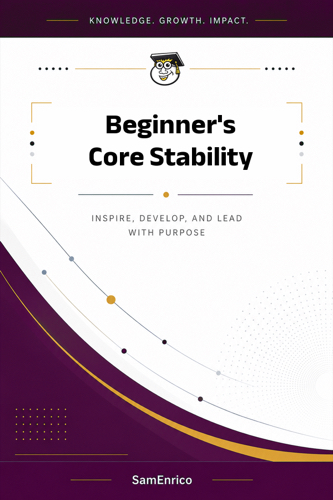
Non-FictionHealth & WellnessCore Training
Beginner's Core Stability eBook
Activate deep abs with dead bugs and bird dogs bef
Activate deep abs with dead bugs and bird dogs before crunches.
Formats
Free sample
Chapter 1: The Corset You Cannot See--It is the single most humbling moment in any fitness journey: the moment you lie on your back, lift your legs into a tabletop position, reach your right arm overhead, and immediately feel your lower back peel off the floor like a cheap sticker. You try again, slower this time. You squeeze your stomach. Nothing changes. Your lumbar spine arches dramatically, a gap wide enough to slide a fist through, and you realize—perhaps for the first time—that you have no idea how to use the muscles that are supposed to protect your spine.You are not alone.
And you are not weak.You are simply untrained in the one muscle group that matters most.For decades, the fitness industry has sold you a lie wrapped in a six-pack. The lie says that visible abdominal muscles equal a strong core. The lie says that crunches, sit-ups, and leg lifts are the path to back health. The lie says that if your stomach looks flat and segmented, you are safe from injury. But orthopaedic clinics, physical therapy offices, and surgical wards are filled with people who have perfectly sculpted rectus abdominis muscles and completely debilitated lumbar spines.
Their "six-packs" are strong. Their inner corsets are silent. And their backs are paying the price.This chapter is an intervention. It will dismantle everything you thought you knew about your midsection. It will introduce you to the muscles you cannot see, cannot feel with your fingers, and likely have never consciously activated in your entire life.
And it will explain, in plain language, why your obsession with visible abs has been working against your long-term health.You are about to meet your inner corset. And nothing in your training will ever be the same.The Anatomy of a Lie Stand in front of a mirror. Flex your stomach. If you have low enough body fat, you will see the familiar topography of the rectus abdominis—those vertical bands of muscle tissue that create the coveted "six-pack" appearance. This muscle runs vertically from your sternum to your pubic bone, and its primary job is to flex your spine forward, bringing your ribcage toward your pelvis.
It is a mover, not a stabilizer.Now take your hand and press it into the side of your waist, just above your hip bone. Feel around. You are palpating the external and internal obliques, which run diagonally across your torso. Their job is rotation and lateral flexion—twisting and side-bending. They are also movers.Here is the uncomfortable truth: the muscles you can see and flex in the mirror are not the muscles that protect your spine.
They are the show muscles. The glamour muscles. The ones that look good in a swimsuit but do almost nothing to prevent a herniated disc when you lift a suitcase out of the car trunk.The muscles that actually matter are buried deep beneath those surface layers. They attach directly to your lumbar spine and wrap around your torso like a natural weightlifting belt. You cannot see them.
You cannot palpate them with any precision. And most people—including many gym regulars—have never learned to fire them voluntarily.This is not your fault. No one taught you. The fitness industry has a financial incentive to sell you visible results, not invisible protection. A muscle you cannot see does not sell workout programs.
A six-pack sells workout programs. And so we have collectively spent billions of dollars and millions of hours training the wrong muscles for the wrong job.It is time to correct the record.The Inner Unit: Your Body's Natural Weight Belt Let us introduce four muscles you have likely never heard of, in order of their importance to your spinal health.The Transverse Abdominis (TVA). This is the deepest layer of your abdominal wall. Its muscle fibers run horizontally, like the straps of a corset, wrapping from your spine around to the front of your abdomen. When the TVA contracts, it compresses the contents of your abdominal cavity, creating intra-abdominal pressure.
That pressure pushes outward against the walls of your torso and, crucially, pushes upward against your diaphragm and downward against your pelvic floor. The result is a rigid, pressurized cylinder that stabilizes your lumbar spine from all directions.Think of the TVA as the air in a bicycle tire. The tire's rubber exterior (your outer abs) provides shape, but the air pressure inside (your TVA activation) provides the actual load-bearing capacity. A tire with no air collapses under weight regardless of how thick the rubber is. A spine with no TVA activation compresses and shears regardless of how strong your rectus abdominis appears.The Multifidus.
This is a series of small, segmental muscles that run along the back of your spine, connecting each vertebra to the ones above and below it. Unlike the long, powerful erector spinae muscles that you can feel on either side of your spine (the "global" extensors), the multifidus provides fine-tuned, segmental control. Each multifidus fiber is short—typically spanning only two to three vertebrae—and its job is to stabilize each spinal joint individually. When the multifidus atrophies (which it does rapidly after back injury or prolonged inactivity), your vertebrae can micro-move relative to each other, creating wear, tear, and pain.The Pelvic Floor. This is a hammock-like sheet of muscles stretching from your pubic bone to your tailbone.
Most people associate the pelvic floor only with urinary continence and sexual function, but its role in core stability is equally critical. The pelvic floor forms the bottom of your abdominal cylinder. When your diaphragm descends during inhalation and your TVA contracts, the pelvic floor must co-contract to contain the resulting intra-abdominal pressure. A weak or poorly coordinated pelvic floor leaks pressure, and your spine loses stability.The Diaphragm. Yes, your primary breathing muscle is also a core stabilizer.
The diaphragm forms the top of the abdominal cylinder. It does not simply move up and down like a piston; its muscle fibers also contract horizontally, creating tension that stabilizes the lower ribcage and lumbar spine. This is why shallow, chest-only breathing completely bypasses your core stability system.Together, these four muscles form what exercise physiologists call the inner unit. They are the foundation. They are the first responders.
And they must activate before any significant limb movement occurs if your spine is to remain safe.The Outer Unit: The Movers and Shakers For contrast, let us briefly acknowledge the muscles you already know.The Rectus Abdominis. The six-pack muscle. Its primary action is spinal flexion (crunching forward). It has almost no role in resisting spinal extension or rotation. In fact, an overactive rectus abdominis can actually create instability by pulling the ribcage downward and forward, flattening the natural lumbar curve and reducing the spine's ability to absorb shock.The External and Internal Obliques.
These diagonal muscles produce rotation and lateral flexion. They have some stabilizing function, particularly in anti-rotation tasks, but they are predominantly phasic muscles designed for movement, not sustained postural control.The Erector Spinae. The long muscles on either side of your spine that extend (arch) your back. Like the rectus abdominis, they are global movers…
This is the end of the free sample. Get the eBook to keep going. Buy now
About this book
Details
- Author
- Laster Lorrine
- Publisher
- SamEnrico
- Language
- English
- Genre
- Non-Fiction, Health & Wellness, Core Training
- Released
- 2026-06-09
- Pages (approx.)
- 149
- Available as
- eBook, Audiobook

Read better in the ZLOADR app
Your eBooks on your phone or tablet. Sign in with your SamEnrico account and start reading.
More by Laster Lorrine
 Sugar Addiction and Candida Overgrowth GuideLaster Lorrine$11.99
 Driving Route Pattern MemoryLaster Lorrine$11.99Driving Route Pattern MemoryLaster Lorrine$11.99
 Co-Parenting Without ExplodingLaster Lorrine$11.99
 Dental Student Burnout PreventionLaster Lorrine$11.99
 The Cartographer’s Gambit: Unlocking the Amazon’s SecretsLaster Lorrine$11.99
 Nefertiti: The Lost Queen’s Last SecretLaster Lorrine$11.99
 Cargo Insurance ProvidersLaster Lorrine$12.99
 Midjourney Redbubble Side HustleLaster Lorrine$12.99
 Understanding Enchondromatosis (Benign)Laster Lorrine$17.99
 Franchise ManagerLaster Lorrine$11.99
 How to Start a Prefabricated Buildings Made of Wood Business (Beginners Guide)Laster Lorrine$11.99
You may also like
 Hong Kong Handover 1997Dunn Johnnie$11.99
 Zumba For Postnatal Recovery CourseNeal Christian$11.99
 Zumba for BeginnersLadner Nikia$11.99
 YouTube Comment Mining GuideHumes Pandora$12.99
 Worry Box MeditationCarlin Rudy$11.99
 Workplace Stress MeditationNguyen Lynn$11.99
 Workplace Stress and Sleep RepairHawley Ivory$11.99
 Workplace Perfectionism CureDelaney Jeffry$11.99
 Workplace Injustice Anger GuideWallen Isabelle$11.99
 Work Addiction and Burnout LinkGreenwood Ester$11.99
 Women in Yoga and WellnessBeattie Galina$11.99
 Women in Stand Up ComedyChun Evangeline$11.99