
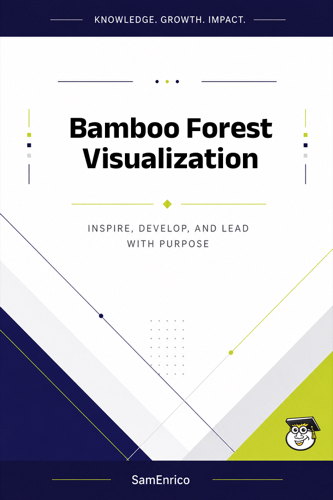
Non-FictionSelf-HelpForest Calm
Bamboo Forest Visualization eBook
Walk through swaying bamboo listening to hollow kn
Walk through swaying bamboo listening to hollow knocking sounds.
Formats
Free sample
Chapter 1: The Hollow Invitation...--–- You are about to discover why your brain has been waiting for a sound it has never heard.Not the crash of waves. Not the rustle of leaves. Not the crackle of a fireplace or the distant rumble of thunder. Those are the usual suspects—the ambient wallpaper of a thousand meditation apps, sleep machines, and relaxation playlists. They are pleasant.
They are safe. And they are, for the most part, ignored. Your brain, that marvelous and merciless efficiency engine, habituates to white noise within minutes. The ocean becomes a dull hum. The wind through pines becomes sonic furniture.
You stop listening because there is nothing left to anticipate.But there is another sound. It lives in the collision of hollow cylinders, in the percussive conversation between stalks of bamboo swaying in a breeze. It is not smooth. It is not continuous. It is the hollow knock—a sound that decays rapidly, that arrives unexpectedly, that asks your nervous system a question rather than feeding it a lullaby.
And your brain, trained by millions of years of evolution to attend to sudden, discrete, non-continuous sounds, cannot ignore it.This book is an invitation to build an entire inner world around that single sound. Not a passive recording to fall asleep to, but an active, multi-sensory visualization practice that will transform how you regulate attention, process emotion, and access creativity. The bamboo forest is your new sanctuary. The hollow knock is your anchor. And the path begins now.Why Not Another Beach?If you have ever tried to visualize a peaceful scene during meditation, you have almost certainly been directed to a beach.
The script writes itself: warm sand, gentle waves, seagulls in the distance. There is nothing wrong with the beach. It is genuinely pleasant. But it has three problems that make it less effective than a bamboo grove for sustained visualization practice.First, the beach is horizontally infinite. Your mind can wander forever across that flat expanse of sand and water without encountering any natural stopping point.
Horizontal spaces encourage diffuse attention. They are the visual equivalent of white noise—calming but not focusing. A bamboo grove, by contrast, is vertical. Stalks rise like cathedral columns, directing your gaze upward and inward. The repetition of those vertical lines creates a rhythmic structure that the visual cortex finds deeply satisfying.
Your eye moves from stalk to stalk, each one similar but not identical, creating a pattern that holds attention without exhausting it.Second, the beach has no enclosure. You are exposed on all sides. Psychologically, this can feel liberating, but for deep concentration, a sense of containment is essential. The bamboo grove has walls—walls of living green that filter light into dappled fragments, that create distinct zones of shadow and illumination, that give your mind a bounded container in which to roam safely. You are not lost in an infinite landscape.
You are held in a living cathedral.Third, and most critically, the beach sounds are continuous. Waves crash in a predictable rhythm. The brain habituates. But the bamboo grove offers the hollow knock—an intermittent, percussive event that the brain cannot fully predict. Each knock is a small question: will there be another?
When? How loud? This gentle uncertainty keeps the auditory cortex engaged without triggering anxiety. It is the difference between a metronome and a jazz drummer. Both keep time, but one invites you to listen.The Acoustic Draw: Why Your Brain Needs the Knock Let us speak frankly about the neuroscience, because understanding the mechanism will deepen your practice.
The human auditory system is wired for threat detection and event prediction. Continuous sounds—a fan, a highway, rainfall—are rapidly suppressed by the brainstem's habituation circuits. They become irrelevant. Intermittent sounds, especially those with variable timing and intensity, are treated as potentially significant. The brain allocates attentional resources to them.This is why the hollow knock is so effective as a meditation anchor.
It is not aggressive enough to startle you. It is not repetitive enough to bore you. It exists in a sweet spot of acoustic ecology: percussive but organic, variable but patterned, hollow but warm. When you visualize walking through a bamboo grove and hear the knock of stalk against stalk, your brain does not file that sound away as background noise. It holds it in working memory, waiting for the next knock, gently pulled back from rumination or planning or self-criticism with each small sonic event.Consider the difference between trying to focus on your breath versus focusing on the hollow knock.
Breath is continuous. It is always there. And precisely because it is always there, it is easy to forget. You breathe without thinking. The knock, even an imagined knock, is discrete.
It has a beginning, a middle, and an end. It arrives, it decays, it is gone. Then another arrives. This event-based attention is far more sustainable for beginners and far more deepen-able for advanced practitioners than continuous sensation monitoring.Throughout this book, you will learn to generate this knock in your mind's ear with such clarity that it becomes as real as any external sound. But before we get to technique, we must understand the space in which that knock lives.The Concept of Ma: Emptiness as a Container The Japanese aesthetic concept of Ma (間) is notoriously difficult to translate.
It means something like "negative space," "interval," or "the pause that gives meaning." In traditional Japanese architecture, the empty space between two walls is not an absence but a presence—a deliberate void that shapes how you experience the solid forms around it. In music, the silence between notes is Ma. In garden design, the empty gravel courtyard between stones is Ma.The bamboo stalk is a physical embodiment of Ma. Each segment of the stalk is hollow. The walls are strong—bamboo has a higher tensile strength than steel by weight—but the interior is empty.
That emptiness is not a flaw. It is the engineering secret that allows bamboo to grow so tall without toppling, to bend without breaking, to resonate with a hollow knock rather than a dull thud.In your visualization practice, Ma becomes the container for your thoughts. Most meditation traditions treat thoughts as distractions to be eliminated or observed from a distance. The bamboo forest offers a different metaphor: thoughts are not invaders. They are the empty space itself, moving through the hollow stalks.
When a thought arises, you do not fight it or watch it. You let it pass through the hollow interior of your attention, as wind passes through a bamboo grove, creating only a brief knock before dissolving.This is not dissociation. It is not suppression. It is a radical reframing of the relationship between self and thought. You are not your thoughts.
You are not even the observer of your thoughts. You are the hollow space through which thoughts move—empty, resonant, and utterly undisturbed by their passage.The Japanese tea master Sen no Rikyū once said that the highest quality of a tea bowl is not its decoration but its emptiness, because that emptiness is what holds the tea. Your mind, like the bamboo stalk…
This is the end of the free sample. Get the eBook to keep going. Buy now
About this book
Details
- Author
- Goodman Beatrice
- Publisher
- SamEnrico
- Language
- English
- Genre
- Non-Fiction, Self-Help, Forest Calm
- Released
- 2026-06-07
- Pages (approx.)
- 135
- Available as
- eBook, Audiobook

Read better in the ZLOADR app
Your eBooks on your phone or tablet. Sign in with your SamEnrico account and start reading.
More by Goodman Beatrice
 Non US Trademark RegistrationGoodman Beatrice$11.99
 Franchise Validation Visits AbroadGoodman Beatrice$11.99
 The Stay at Home Parent Recharge GuideGoodman Beatrice$11.99
 Tunnel Induction TechniqueGoodman Beatrice$11.99
 The Siege of Eger: The Castle That Stood Against the Ottoman StormGoodman Beatrice$11.99
 Invoicing SpecialistGoodman Beatrice$11.99
 Understanding Renal Dysplasia Diffuse CysticGoodman Beatrice$17.99
 Returns and Refunds ComparisonGoodman Beatrice$12.99
 PY, NAATI, and Work ExperienceGoodman Beatrice$12.99
 How to Start a Narrow Fabric Mills BusinessGoodman Beatrice$11.99
You may also like
 Hong Kong Handover 1997Dunn Johnnie$11.99
 Zumba For Postnatal Recovery CourseNeal Christian$11.99
 Zumba for BeginnersLadner Nikia$11.99
 YouTube Comment Mining GuideHumes Pandora$12.99
 Worry Box MeditationCarlin Rudy$11.99
 Workplace Stress MeditationNguyen Lynn$11.99
 Workplace Stress and Sleep RepairHawley Ivory$11.99
 Workplace Perfectionism CureDelaney Jeffry$11.99
 Workplace Injustice Anger GuideWallen Isabelle$11.99
 Work Addiction and Burnout LinkGreenwood Ester$11.99
 Women in Yoga and WellnessBeattie Galina$11.99
 Women in Stand Up ComedyChun Evangeline$11.99