
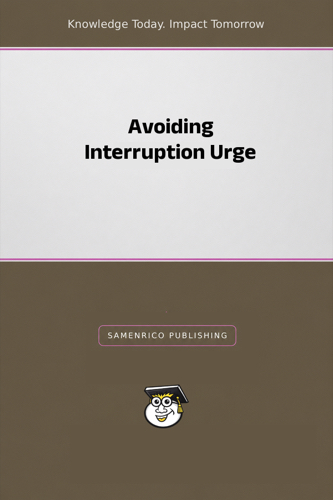
Avoiding Interruption Urge eBook
Teaches impulse control when you want to jump in.
by Ly Criselda
Teaches impulse control when you want to jump in.
Formats
Free sample
Chapter 1: The Dopamine Trap--–- You are about to learn something that will unsettle you. The urge to interrupt—the one that rises in your chest like a hot wave when someone else is speaking—is not a sign that you are rude, arrogant, or socially broken. It is a sign that your brain is doing exactly what evolution designed it to do. And that is precisely the problem.Every time you sit in a meeting, a dinner conversation, or a heated discussion with your partner, your brain runs a silent race. On one side is the ancient limbic system, the part that prioritizes speed, survival, and reward.
On the other side is the prefrontal cortex, the relatively newer region responsible for impulse control, foresight, and social grace. In most modern conversations, the limbic system wins. Not because you are weak, but because it is faster. It was built for a world where hesitation meant becoming someone else’s dinner. The interruption urge is a vestigial reflex, a ghost of a survival instinct that no longer serves you.This book exists because that reflex is now sabotaging your relationships, your career, and your reputation.
But here is the good news: you cannot hate your way out of a neurological pattern. You can only understand it, reroute it, and replace it with something better. This chapter is where that understanding begins.The Neuroscience of Cutting Someone Off Let us start with the moment just before you interrupt. Someone is speaking. They are taking too long to reach their point.
You already know what they are going to say—or you think you do. Your mind leaps ahead, completing their sentence internally. And then, a small but unmistakable surge of satisfaction arrives. That feeling is dopamine.Dopamine is often called the “pleasure chemical,” but that is imprecise. Dopamine is the anticipation chemical.
It spikes not when you receive a reward, but when you expect one. And what does your brain anticipate when you prepare to speak? Social validation, the opportunity to share your superior insight, the relief of correcting an error, the status boost of being heard. Every time you feel the urge to jump in, your brain is literally rewarding you for the anticipation of speaking. The actual interruption is almost secondary.This insight comes from research into conversational turn-taking.
Neuroscientists using f MRI have observed that the brain’s reward centers activate approximately 200 milliseconds before a person begins speaking—well before any words are uttered. In other words, the interruption urge is not a response to what the other person is saying. It is a response to your own brain’s prediction that you have something better to say.The prefrontal cortex, which might otherwise apply the brakes, is at a structural disadvantage. It is slower to activate, requires more energy, and fatigues more quickly than the limbic system. In high-energy conversations—especially those involving disagreement, excitement, or time pressure—the prefrontal cortex simply cannot keep up.
You are not failing at self-control. You are losing a race that your biology rigged against you.Understanding this distinction is the first and most important step. Interruption is not a character flaw. It is a neurological glitch that can be patched with deliberate practice. The moment you stop blaming yourself for the urge and start observing it as a biological event, you gain the distance necessary to change it.Assertive Engagement Versus Impulsive Hijacking Not all interruptions are equal.
And not all speaking while someone else is speaking counts as a violation. This book draws a firm line between two fundamentally different behaviors: assertive engagement and impulsive hijacking.Assertive engagement occurs when you enter a conversation in a way that adds value, builds on what has been said, and respects the speaker’s turn. It includes asking clarifying questions, offering a relevant perspective after a natural pause, or signaling agreement without derailing the speaker’s train of thought. Assertive engagement is collaborative. It makes the other person feel heard, even when you disagree.Impulsive hijacking is different.
It is the act of seizing the conversational floor to redirect attention to your own point, your own story, or your own correction. It often begins with the word “actually,” “well,” or “but.” It finishes the speaker’s sentence for them. It dismisses their emotion with “don’t worry about it” or “here’s what you should do.” Impulsive hijacking feels urgent, but it is rarely necessary. And it leaves a wake of quiet resentment.Here is the challenge: impulsive hijacking feels exactly like assertive engagement in the moment. Your brain does not distinguish between the two.
Both trigger dopamine. Both feel productive. The difference is entirely in the effect on the other person. That is why self-perception is a poor guide to interruption behavior. Most chronic interrupters believe they are enthusiastic, engaged, and helpful.
Ask their colleagues or partners, and you will hear a different story.The remainder of this book will teach you to recognize the difference in real time, not in hindsight. But for now, simply hold this distinction in mind. Every time you feel the urge to speak, there are two paths. One leads to collaboration. The other leads to domination.
The choice is not about suppressing your voice. It is about learning which voice to use and when.The Silent Cost of Jumping In If interrupting were harmless, this book would not exist. But the costs are substantial, measurable, and cumulative. Researchers have quantified the relational damage of chronic interruption, and the numbers are sobering.In workplace studies, employees who are interrupted report feeling 40 percent less trusted by the interrupter. Trust is not an abstract feeling; it is a practical currency.
When trust drops, collaboration slows, information hoarding increases, and psychological safety evaporates. Teams with high interruption rates generate fewer innovative ideas because junior members learn to stay silent. Over time, the interrupter is perceived as less competent, not more. The irony is sharp: the person who talks the most is often assumed to know the least.In romantic relationships, interruption is one of the strongest predictors of divorce. Research from the Gottman Institute, based on decades of observational studies, found that couples who interrupt each other frequently—especially when one partner dismisses the other’s emotional expression—are significantly more likely to separate within six years.
Interruption is not merely annoying. It is corrosive. Each interruption sends a silent message: What I have to say matters more than what you are saying.In parenting, the cost is different but no less real. Children who are routinely interrupted learn that their thoughts are not valuable. They stop sharing.
They stop asking questions. They stop bringing problems to their parents. The interruption is not remembered as a single event. It becomes a pattern, and the pattern becomes a belief: I am not worth listening to.These costs do not announce themselves. There is no dramatic confrontation after most interruptions.
Instead, people quietly withdraw. They find someone else to talk to. They stop bringing ideas to the person who always cuts them off. The interrupter is often the last to know. And that is perhaps the cruelest asymmetry: you feel energized by…
This is the end of the free sample. Get the eBook to keep going. Buy now
About this book
Details
- Author
- Ly Criselda
- Publisher
- SamEnrico
- Language
- English
- Genre
- Non-Fiction, Self-Help, Impulse Control
- Released
- 2026-06-09
- Pages (approx.)
- 124
- Available as
- eBook, Audiobook

Read better in the ZLOADR app
Your eBooks on your phone or tablet. Sign in with your SamEnrico account and start reading.
More by Ly Criselda
 The Breath For Decision FatigueLy Criselda$11.99
 School Principal Stress HandbookLy Criselda$11.99
 New Manager Imposter GuideLy Criselda$11.99
 Sundance Ceremony Leadership GuideLy Criselda$11.99
 Osmotic Laxatives GuideLy Criselda$11.99
 Pain Management ImageryLy Criselda$11.99
 Malcolm X BlackLy Criselda$11.99
 South Africa Jobs Fund GrantLy Criselda$11.99
 The Silk Road's Forgotten Empress: A Trade Empire ReimaginedLy Criselda$11.99
 The Lost Fleet of the Red Sea: Ancient Egypt's Underwater OdysseyLy Criselda$11.99
 Silent Shadows: The Untold Story of the First Drone Strike That Changed EverythingLy Criselda$11.99
 Fast MVP Launch TechniquesLy Criselda$11.99
You may also like
 The Urge Delay TechniqueDunaway Buffy$11.99
 Road Rage And Impulse ControlKimmel Britta$11.99
 Cut Off Response PlanCrandall Branda$11.99
 Curbing Impulse Purchases GuideSimonson Saundra$11.99
 The 5 Second Affirmation RuleBush Margarita$11.99
 Curbing Impulse Buys At Checkout CourseBourgeois Kalyn$11.99
 The Three Second Rule InterventionBowie Marget$11.99
 The Self Regulation CourseConaway Kenton$11.99
 Listening Without Interrupting GuideFord Virgil$11.99
 Aggressive Driver Self ControlHinkle Irwin$11.99
 The Three Second Binge InterruptionAlcala Ali$11.99
 The STOP DBT Crisis Skill GuideRatliff Hana$11.99