
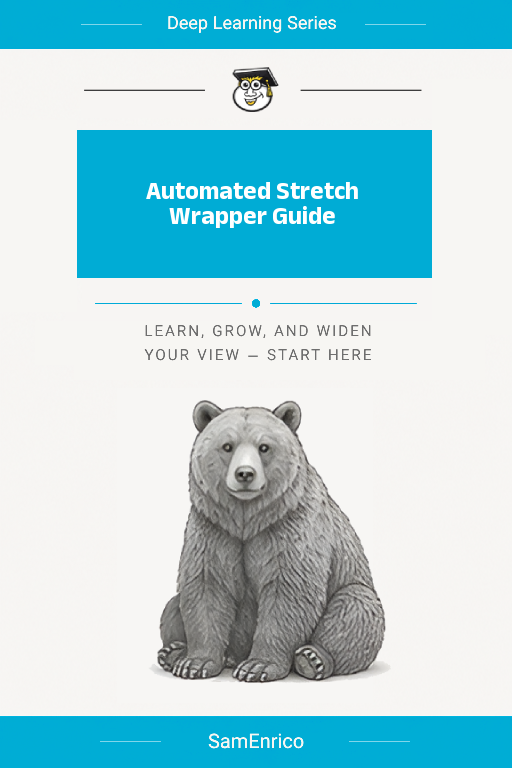
Non-FictionForecast & OutlookPalletizing
Automated Stretch Wrapper Guide Audiobook
Explore robotic pallet wrapping with consistent te
Explore robotic pallet wrapping with consistent tension, film reduction, and integration with conveyor lines.
Formats
Free sample
Chapter 1: The $7 Billion Lie--–- Every year, American manufacturers and distributors spend approximately 7billiononstretchfilm.Hereisthetruththatfilmsupplierswillneverputintheirmarketingbrochures:roughly407 billion on stretch film. Here is the truth that film suppliers will never put in their marketing brochures: roughly 40% of that money—7billiononstretchfilm.Hereisthetruththatfilmsupplierswillneverputintheirmarketingbrochures:roughly402.8 billion—is completely unnecessary. It buys film that serves no structural purpose, adds zero containment force, and exists only because someone, somewhere, decided that "more wraps must be better."This chapter is not about stretch wrapping. Not really. This chapter is about unlearning.
It is about dismantling the myths that have cost your industry billions of dollars and caused countless loads to crash onto warehouse floors. It is about understanding why a pallet wrapped with fourteen perfectly tensioned layers of film will out-perform a pallet wrapped with thirty sloppy layers every single time. And it is about giving you a framework so simple, so powerful, that you can walk onto your plant floor tomorrow morning and find at least $50,000 in waste within the first hour.Let me tell you about a plant manager named Diane. Diane ran a beverage distribution facility in Ohio that shipped 80,000 pallets per year. Her damage rate was 1.8%—not terrible by industry standards, but not good either.
Every month, her customer service team fielded calls from grocery stores receiving crushed cases and torn packaging. Every quarter, her finance team wrote off $340,000 in claims. Diane's solution, inherited from the previous manager, was simple: more wraps. When in doubt, add more. The standard work instruction said "18-22 wraps minimum." Some operators, fearing complaints, would run 25 or even 30 wraps on unstable-looking loads.Diane's film cost was 156,000peryear.Herdamageclaimswere156,000 per year.
Her damage claims were 156,000peryear.Herdamageclaimswere340,000 per year. She had accepted both as the cost of doing business.Then Diane attended a training session where someone showed her a hand-held tension gauge and a concept she had never encountered: containment force. Not wrap count. Not film thickness. Containment force—the actual net inward pressure that film exerts on a load.
Within six months, Diane had reduced her standard wrap count from 22 to 14, cut her film usage by 38%, and dropped her damage claims by 62%. Her annual savings: 59,000infilm,59,000 in film, 59,000infilm,210,000 in avoided claims. Total cost of the change: a $400 tension gauge and two hours of operator training.This chapter is the reason Diane succeeded and why so many others fail. It is the foundation…
This is the end of the free sample. Get the Audiobook to keep going. Buy now
About this book
Details
- Author
- Glass Juliann
- Publisher
- SamEnrico
- Language
- English
- Genre
- Non-Fiction, Forecast & Outlook, Palletizing
- Released
- 2026-05-29
- Pages (approx.)
- 145
- Available as
- eBook, Audiobook

Listen in the VoxFlicks app
Audiobooks and audio dramas wherever you go. Sign in with your SamEnrico account and press play.
More by Glass Juliann
 Email Automation Tools GuideGlass Juliann$11.99
 CBD And Sleep MeditationGlass Juliann$11.99
 Loneliness Support Group GuideGlass Juliann$11.99
 Construction Worker StretchingGlass Juliann$11.99
 The Last Broadcast: The Titanic's Wireless RoomGlass Juliann$11.99
 Nefertiti's Last Oracle: The Exile of the Sun PriestessGlass Juliann$11.99
 Continuing Care CoordinatorGlass Juliann$11.99
 How to Start a Hobby in MusicGlass Juliann$11.99
 Remote Work Benefit Trends PrimerGlass Juliann$12.99
 Understanding Hypophosphatemic RicketsGlass Juliann$17.99
You may also like
 Hong Kong Handover 1997Dunn Johnnie$11.99
 Zumba For Postnatal Recovery CourseNeal Christian$11.99
 Zumba for BeginnersLadner Nikia$11.99
 YouTube Comment Mining GuideHumes Pandora$12.99
 Worry Box MeditationCarlin Rudy$11.99
 Workplace Stress MeditationNguyen Lynn$11.99
 Workplace Stress and Sleep RepairHawley Ivory$11.99
 Workplace Perfectionism CureDelaney Jeffry$11.99
 Workplace Injustice Anger GuideWallen Isabelle$11.99
 Work Addiction and Burnout LinkGreenwood Ester$11.99
 Women in Yoga and WellnessBeattie Galina$11.99
 Women in Stand Up ComedyChun Evangeline$11.99