
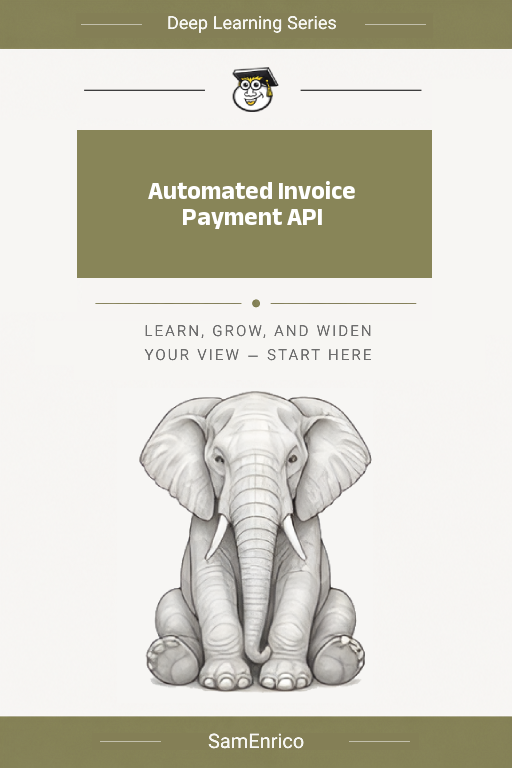
Non-FictionBusiness BriefPayments
Automated Invoice Payment API eBook
Generate payment links and collect customer paymen
Generate payment links and collect customer payments directly through your banking API.
Formats
Free sample
Chapter 1: The Billion-Dollar Float--–- On a Tuesday morning in March, the CFO of a fifteen-million-dollar Saa S company did something unusual: she manually copied a bank statement line into an Excel spreadsheet, cross-referenced it against an invoice PDF that had arrived via email seventeen days earlier, and then typed the word "RECONCILED" in bold green letters. This took her forty-seven seconds. She did this two hundred and thirty times that month. Her company paid her one hundred and sixty thousand dollars per year to do this.The math is devastating. At forty-seven seconds per invoice, two hundred thirty invoices per month, twelve months per year, she spent seventy-two hours annually—almost two full work weeks—doing nothing but matching numbers between systems that refused to talk to each other.
Her bank knew the payment had occurred. Her accounting system knew an invoice existed. But the bridge between them was a human being with a spreadsheet and a set of tired eyes.This is not a story about bad software. It is a story about a structural gap in the global financial system that has persisted for four decades, quietly transferring billions of dollars from sellers to no one in particular—just to the inefficiency itself.The Gap That Everyone Pretends Doesn't Exist Here is a question that sounds simple but reveals the entire problem: When a customer pays an invoice, how does the seller know which invoice was paid?If you have ever used Stripe, Pay Pal, or Square, you might think this is trivial. Those platforms attach a unique identifier to every transaction.
The payment arrives, and the system says: "This is for invoice INV-2024-0012." Done.But those are card payments. They are real-time, expensive, and designed for e-commerce. The B2B economy—the one where companies buy from other companies—does not run on cards. It runs on bank transfers, direct debits, wires, and ACH. And those payment methods have a dirty secret: they arrive with almost no context.When a customer clicks "Pay" in their banking portal and sends ten thousand dollars to your account, the only information that arrives with that payment is:The amount The date The sender's account number (often masked)A reference field that is limited to 18 characters in many banking systems Nothing else No invoice number.
No line items. No customer ID. No PO number. Just a blob of numbers and a date stamp.This is the invoice-bank gap. It is the space between "customer paid" and "we know what they paid for." And it costs the global economy an estimated three trillion dollars per year in manual reconciliation labor, delayed cash flow, and write-offs from misapplied payments.The Three-Way Matching Trap To understand why this gap is so expensive, you need to understand a process that accountants hate and software developers rarely think about: three-way matching.When a company buys something from another company, three documents are generated:The Purchase Order (PO).
The buyer creates this internally. It says: "We agree to buy ten servers at five thousand dollars each."The Invoice. The seller creates this. It says: "We shipped ten servers. Please pay fifty thousand dollars by net thirty days."The Payment Receipt (Bank Statement).
The bank creates this. It says: "Fifty thousand dollars left buyer's account and arrived in seller's account."In a perfect world, these three documents would share a common identifier. The buyer would include the PO number on the invoice. The seller would include the invoice number in the payment reference. The bank would preserve that reference all the way to the seller's statement.In the real world, none of this happens reliably.A 2023 study by the Accounts Payable Association found that only 23 percent of B2B invoices in the United States include a PO number.
Only 31 percent of bank transfers include a reference that matches the original invoice number. And less than 10 percent of companies have automated systems that can perform three-way matching without human intervention.The result is a ritual performed in finance departments around the world every month. Someone prints a bank statement. Someone else prints an aging report of unpaid invoices. They sit together, highlight matching amounts, and staple the papers together.
This is not hyperbole. In 2024, a survey of mid-sized manufacturing companies found that 68 percent still perform manual reconciliation using printed documents.The Hidden Cost of Manual Reconciliation Let us put real numbers on this problem.According to data from the Institute of Finance and Management, the average cost to manually reconcile a single invoice is $4.67 in direct labor. That does not include the cost of errors, delays, or the opportunity cost of cash sitting unapplied.Now consider a typical B2B company with five thousand invoices per month. That is twenty-three thousand three hundred fifty dollars per month in reconciliation labor, or two hundred eighty thousand dollars per year, just to match payments to invoices.But the labor cost is the smallest part of the problem.The real cost is days sales outstanding—DSO in accounting terms. DSO measures how many days it takes, on average, for a company to collect payment after issuing an invoice.
Industry benchmarks show that manual reconciliation adds five to ten days to DSO. Why? Because a payment can arrive on day fifteen, but if it takes until day twenty-two to figure out which invoice it paid, the cash is effectively unavailable until then.For a company with fifty million dollars in annual revenue and a sixty-day DSO, a five-day increase in DSO ties up an additional six hundred eighty thousand dollars in working capital. That is money that could have been used for payroll, inventory, or growth. Instead, it sits as a receivable, waiting for someone to match a bank line to an invoice.There is also the error cost.
When a human manually reconciles, they make mistakes. A payment gets applied to the wrong customer. A partial payment gets marked as full. A credit memo is overlooked. According to the Accounts Receivable Benchmarking Report, human reconciliation errors cause an average of 1.2 percent of annual revenue to be written off as uncollectible—not because the customer didn't pay, but because the seller couldn't figure out what the customer paid for.The Saa S Margin Leak That Nobody Talks About The previous numbers apply to any B2B company.
But there is a special case that is particularly painful: Saa S companies that invoice annually.A typical Saa S company with ten million dollars in annual recurring revenue (ARR) might have forty percent of that revenue coming from annual invoices paid by credit card. The rest might be monthly subscriptions paid by direct debit or ACH.The forty percent that comes through cards is bleeding margin.Let us do the math. Stripe charges 2.9 percent plus thirty cents per transaction. For a fifty-thousand-dollar annual Saa S contract, that is 1,450infees.Forahundredannualcontractsatthatsize,thatis1,450 in fees. For a hundred annual contracts at that size, that is 1,450infees.Forahundredannualcontractsatthatsize,thatis145,000 in fees.
For a thousand contracts, it is $1.45 million.Now compare that to a direct bank payment via open banking APIs. The cost is typically a flat fee of twenty to fifty cents per transaction, regardless of…
This is the end of the free sample. Get the eBook to keep going. Buy now
About this book
Details
- Author
- Edwards Roberto
- Publisher
- SamEnrico
- Language
- English
- Genre
- Non-Fiction, Business Brief, Payments
- Released
- 2026-05-30
- Pages (approx.)
- 142
- Available as
- eBook, Audiobook

Read better in the ZLOADR app
Your eBooks on your phone or tablet. Sign in with your SamEnrico account and start reading.
More by Edwards Roberto
 DBT For Non Suicidal Self InjuryEdwards Roberto$11.99
 The Neighbor Who Built a PlaygroundEdwards Roberto$11.99
 The Priority Procrastination FixEdwards Roberto$11.99
 Pelvic Floor for Flight AttendantsEdwards Roberto$11.99
 Antwerp Heist PsychologyEdwards Roberto$11.99
 Pomodoro For Art ProjectsEdwards Roberto$11.99
 Evening Breath Wind DownEdwards Roberto$11.99
 Childhood Comparison ScarsEdwards Roberto$11.99
 Operation Gold: The Cuban Spy Who Stole the OlympicsEdwards Roberto$11.99
 The Marble Merchants of Rome: Building an Empire Through TradeEdwards Roberto$11.99
 How to Produce Studio BackgroundsEdwards Roberto$11.99
 A Collector's Handbook to the Ferrari 166Edwards Roberto$11.99
You may also like
 Hong Kong Handover 1997Dunn Johnnie$11.99
 Zumba For Postnatal Recovery CourseNeal Christian$11.99
 Zumba for BeginnersLadner Nikia$11.99
 YouTube Comment Mining GuideHumes Pandora$12.99
 Worry Box MeditationCarlin Rudy$11.99
 Workplace Stress MeditationNguyen Lynn$11.99
 Workplace Stress and Sleep RepairHawley Ivory$11.99
 Workplace Perfectionism CureDelaney Jeffry$11.99
 Workplace Injustice Anger GuideWallen Isabelle$11.99
 Work Addiction and Burnout LinkGreenwood Ester$11.99
 Women in Yoga and WellnessBeattie Galina$11.99
 Women in Stand Up ComedyChun Evangeline$11.99