
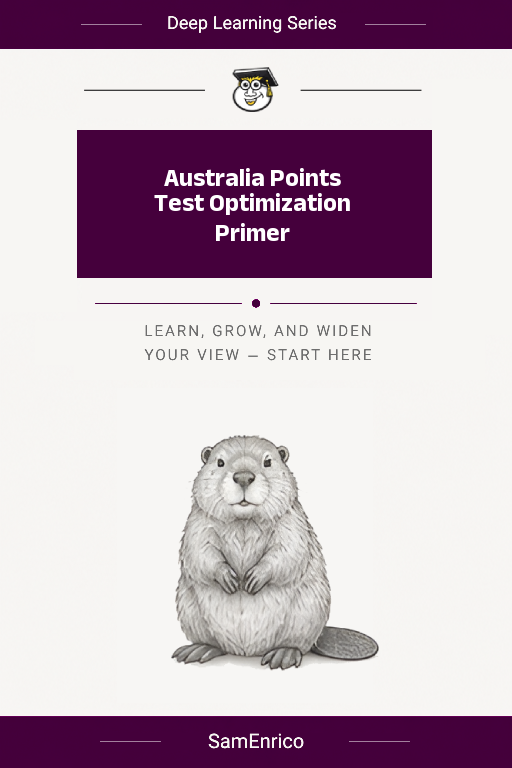
Non-FictionStudent's ShortcutPrimerPoints Optimization Guide
Australia Points Test Optimization Primer eBook
Maximize your CRS-equivalent score for subclass 18
by Messer Loura
Maximize your CRS-equivalent score for subclass 189 and 491 visas. Includes age, English, work experience, and partner skill strategies specifically for recent graduates.
Formats
Free sample
Chapter 1: The 65-Point Graveyard--–- Every year, thousands of international graduates walk across Australian stages, collect their degrees, and hug their families. They post photos on Instagram with captions like "Mission accomplished" and "Dream come true." They have done everything right. They attended every lecture, submitted every assignment, graduated with merit, and followed every rule. Then they spend the next twelve months watching their dreams die, one email at a time.This chapter is not for those graduates. This chapter is for the one who refuses to become a statistic.The most dangerous myth in Australian migration is that scoring 65 points on the Skill Select points test guarantees you an invitation to apply for a permanent residency visa.
Migration agents repeat it. University career counselors whisper it. Online forums echo it. And it is catastrophically wrong.Welcome to the 65-Point Graveyard.The Invitation Round That Broke Everyone On the morning of August 15, 2025, the Department of Home Affairs released its monthly invitation round results. For software engineers with 85 points, the waiting time had extended to eleven months.
For general accountants with 90 points, the previous round had invited exactly zero applicants. For IT graduates with 80 points, the system showed the same message month after month: "No invitation in this round."Meanwhile, registered nurses with 70 points received invitations within six weeks. Secondary school teachers with 65 points barely had time to update their resumes before the invitation arrived. Social workers with 75 points were invited in the very next round.The same points test. The same Department.
Radically different outcomes.This is the first truth this book forces you to confront: 65 points is not a finish line. It is a minimum entry ticket to a waiting room where some people wait three months and others wait three years.The points test is not a meritocracy. It is a triage system.The Four-Tier Reality In late 2024, the Department quietly implemented what migration agents began calling the "Four-Tier" prioritization system for Subclass 189 visas. The Department never officially announced it with a press release. There was no fanfare.
But the invitation round data told the story.Tier 1 – Critical Shortage Occupations (Invitation cut-off: 65–75 points)These are occupations where Australia faces a severe and immediate shortage. Registered nurses. Secondary school teachers. Social workers. General practitioners.
Occupational therapists. Physiotherapists. If you are in Tier 1, your invitation is not a matter of if but when.Tier 2 – Moderate Shortage Occupations (Invitation cut-off: 75–85 points)These occupations face shortages in specific regions or specific sub-specialties. Civil engineers in regional Queensland. Electricians in Western Australia.
Carpenters in Tasmania. Early childhood teachers nationally. Your invitation is likely but not guaranteed.Tier 3 – Balanced Occupations (Invitation cut-off: 85–95 points)Supply and demand are roughly equal. You will need more than the minimum. Mechanical engineers.
Management consultants. Multimedia specialists. Web developers. You can succeed, but you must optimize.Tier 4 – Oversupply Occupations (Invitation cut-off: 95–105 points, often no invitation)This is where dreams go to die. General accountants.
Software engineers. ICT business analysts. Marketing specialists. Cafe and restaurant managers. If you are in Tier 4, the system is not your friend.
It is your adversary.The cruel irony is that Tier 4 contains the degrees Australian universities market most aggressively to international students. The universities do not warn you. The migration agents do not warn you. The glossy brochures showing happy graduates in mortarboards certainly do not warn you.This book warns you.Sarah vs. Rohan: A Case Study in Tiered Destruction Let me introduce you to two people.
Both are real. Both applied for Subclass 189 visas in January 2025. Both had exactly 80 points. Both were twenty-nine years old, single, with Proficient English, no Australian work experience, and no community language points. The only difference was their occupations.Sarah is a registered nurse.
She completed her Master of Nursing at the University of Melbourne. She works in the emergency department of a metropolitan hospital. Her 80 points came from: age (30 points), Proficient English (10 points), Australian study requirement (5 points), and her nursing degree (20 points for occupation, but this is not how points actually work – more on that in Chapter 10). She did nothing special. She followed no optimization strategy.
She simply existed in the right occupation.Sarah submitted her EOI on January 10, 2025. She received an invitation on February 15, 2025 – thirty-six days later. She had her permanent residency visa granted in August 2025. Total time: seven months.Rohan is a software engineer. He completed his Master of Information Technology at the same university.
He builds backend systems for a fintech startup. His 80 points were identical to Sarah's. He did everything the university recommended. He attended career fairs. He built a portfolio.
He networked.Rohan submitted his EOI on January 10, 2025. On February 15, 2025, he saw the invitation round results: zero software engineers invited. On March 15, same result. On April 15, same. He added a Professional Year (now 85 points).
Still no invitation. He added NAATI (90 points). Finally, after eleven months and a complete overhaul of his points profile, he received an invitation in December 2025.By then, his age had ticked over to thirty-three. He lost 5 points. His 90-point EOI reset to 85.
He had to start again.Sarah and Rohan are not anomalies. They are the system working exactly as designed.The Department does not care about your degree. It does not care about your effort. It does not care about your dream. It cares about one thing: filling occupational shortages with the least administrative friction possible.Your job is to understand that reality and exploit it.The 485 Golden Hour The Subclass 485 Graduate Visa is the most valuable piece of paper you will ever hold.
It is also the most dangerous because it creates a false sense of security.The 485 visa gives you temporary work rights in Australia after graduation. The length varies: eighteen months for most graduates, two to three years for those with specific degrees or from specific countries, and up to six years for certain specialist qualifications under post-COVID extensions (though these are being phased out).During this period, you can work. You can travel. You can live like a permanent resident. But you are not a permanent resident.
And the clock is ticking.This book calls the 485 period the "Golden Hour" – a term borrowed from emergency medicine. In trauma care, the Golden Hour is the sixty-minute window after a severe injury during which immediate treatment can mean the difference between life and death. The 485 visa is exactly the same. The first twelve to eighteen months after graduation are when points can be rapidly accumulated. After that, competition intensifies.
Age penalties begin. Work experience becomes harder to claim because the clock is running out.Every day on your 485 visa is precious. Every week you waste is a week you cannot get back. The graduates who succeed are those who treat the 485 period like the emergency it is.The Anatomy of a Points Profile Before we go further, let me show you exactly where points come from. The Skill Select points test has eight categories.
Understanding each one is the difference between a 75-point EOI that rots in the system and a 95-point EOI that receives an invitation in sixty days.Age (maximum 30 points)18–24 years: 25 points25–32 years: 30 points33–39 years: 25 points40–44 years: 15 points Notice the cliff. At thirty-three, you lose five points…
This is the end of the free sample. Get the eBook to keep going. Buy now
About this book
Details
- Author
- Messer Loura
- Publisher
- SamEnrico
- Language
- English
- Genre
- Non-Fiction, Student's Shortcut, Primer, Points Optimization Guide
- Released
- 2026-05-29
- Pages (approx.)
- 155
- Available as
- eBook, Audiobook

Read better in the ZLOADR app
Your eBooks on your phone or tablet. Sign in with your SamEnrico account and start reading.
More by Messer Loura
 Sex Addiction Prevention For Teens CourseMesser Loura$11.99
 Remote Communication Blind GuideMesser Loura$11.99
 Period Cramp Yoga SequenceMesser Loura$11.99
 Dreams in Psychoanalytic Trauma WorkMesser Loura$11.99
 Dreams After Cult Recovery GuideMesser Loura$11.99
 The Unseen Hands: How a 19th-Century Quilt Saved a CommunityMesser Loura$11.99
 Anansi and the Round Table: A Trickster’s Quest for CamelotMesser Loura$11.99
 Early Intervention SpecialistMesser Loura$11.99
 Renewable Energy Recycling OutlookMesser Loura$12.99
 Understanding Helmerhorst–heaton–crossen SyndromeMesser Loura$17.99
 How to Become a Distiller IMesser Loura$11.99
You may also like
 Hong Kong Handover 1997Dunn Johnnie$11.99
 Zumba For Postnatal Recovery CourseNeal Christian$11.99
 Zumba for BeginnersLadner Nikia$11.99
 YouTube Comment Mining GuideHumes Pandora$12.99
 Worry Box MeditationCarlin Rudy$11.99
 Workplace Stress MeditationNguyen Lynn$11.99
 Workplace Stress and Sleep RepairHawley Ivory$11.99
 Workplace Perfectionism CureDelaney Jeffry$11.99
 Workplace Injustice Anger GuideWallen Isabelle$11.99
 Work Addiction and Burnout LinkGreenwood Ester$11.99
 Women in Yoga and WellnessBeattie Galina$11.99
 Women in Stand Up ComedyChun Evangeline$11.99