
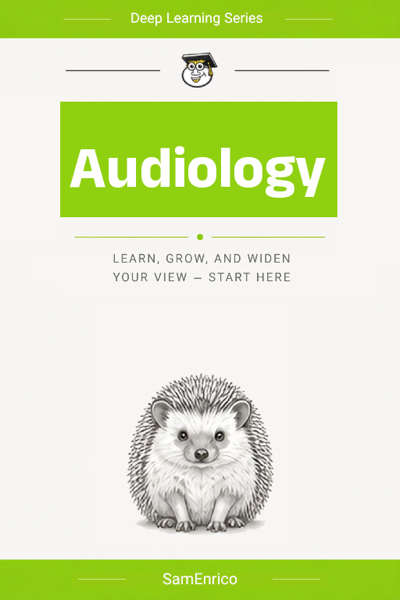
Non-FictionInformativeEducational
Audiology eBook
A Coursebook on Audiology
A Coursebook on Audiology
Formats
Free sample
Chapter 1: The Silent Epidemic--–- On a quiet Tuesday morning in 1945, a young Army private named James returned from the battlefields of Europe. He had no visible wounds, no shrapnel scars, no Purple Heart. But James could no longer understand his wife’s voice when she stood behind him in the kitchen. He flinched at the sound of a dropped fork but missed the punchline of every joke. His neighbors called him “distant.” His children thought he was angry.
James had a “silent injury”—one that would help birth an entirely new profession: audiology.This is the story of that profession, of the一百万 people like James who return from every war with noise-damaged ears, and of the hundreds of millions more—factory workers, musicians, grandparents, and newborns—whose ability to connect with the world hangs in the balance of a tiny, coiled organ no larger than a pea. Welcome to audiology: the science of hearing, the art of balance, and the quiet revolution happening inside your ears right now.The Hidden Burden No One Talks About Hearing loss is often called the “invisible disability,” and for good reason. Unlike a broken leg or a visible scar, a damaged inner ear hides behind the eardrum, silent and unseen. But the numbers are staggering. According to the World Health Organization, over 1.5 billion people worldwide live with some degree of hearing loss.
That is nearly one in five human beings. By 2050, that number is projected to rise to 2.5 billion. In the United States alone, approximately 48 million people report some trouble hearing—more than the populations of Texas and Florida combined.Yet, despite these numbers, the average person waits seven years from the time they first notice a hearing problem to the day they finally seek help. Seven years of misheard conversations, of avoided social gatherings, of relationships strained by the exhausting repetition of “What did you say?” Seven years during which the brain slowly forgets how to process certain sounds, making eventual treatment less effective.This is the silent epidemic. And it is the reason audiology exists.Why This Chapter Matters to You Whether you are a student considering a career in hearing healthcare, a patient who has struggled with unexplained dizziness or tinnitus, or simply a curious reader who wants to understand one of your most vital senses, this chapter will give you the foundation you need.
We will explore where audiology came from, what audiologists actually do, how they work alongside physicians and speech therapists, and—most importantly—why the patient sitting in the waiting room is not just a set of ears, but a whole person with a story.By the end of this chapter, you will understand why hearing is never just about hearing. It is about connection, identity, safety, and the fundamental human need to communicate.The Birth of a Profession: From Battlefield to Clinic To understand audiology, we must first travel back to World War II. Before the 1940s, if you had trouble hearing, you saw an otologist—a physician specializing in ear diseases. The otologist’s toolkit was limited: remove wax, lance an infected eardrum, or occasionally operate on the mastoid bone. For the vast majority of hearing problems, especially those caused by aging or noise, there was no treatment.
Patients were told to “live with it” or, cruelly, that they were simply not paying attention.The war changed everything. Millions of soldiers were exposed to deafening artillery fire, aircraft engines, and explosive blasts. By the end of the war, the Veterans Administration faced an unprecedented crisis: tens of thousands of young men with normal eardrums but profoundly damaged inner ears. The otologists were stumped. They could see no infection, no perforation, no surgical target.
Yet these men could not hear.Enter a new kind of professional. The military, desperate for solutions, began training “audiologists” (from the Latin audire, “to hear”)—technicians who could measure hearing accurately, fit the new electronic hearing aids emerging from wartime electronics research, and teach soldiers how to lip-read and communicate despite their losses. These early audiologists were often former speech-language pathologists or physicists pressed into service. They worked in “aural rehabilitation” centers, and their approach was radically different from the medical model. Instead of asking “What disease does this patient have?” they asked “What does this patient need to function in their daily life?”That question—functional, practical, human—remains the heart of audiology today.From Measurement to Doctoral Profession After the war, audiology spread rapidly into civilian life.
The first university training programs emerged in the late 1940s at Northwestern, Iowa, and Wisconsin. For decades, audiology was a master’s-level profession. Audiologists tested hearing, fitted hearing aids, and worked with deaf and hard-of-hearing children in schools. They were skilled, respected, but always worked under the supervision of a physician.That changed in the 1990s. A growing movement within the profession argued that with the complexity of modern diagnostic equipment, implantable devices like cochlear implants, and the direct patient care responsibilities, audiology required doctoral-level training.
In 2007, the last master’s programs closed, and the entry-level degree became the Doctor of Audiology (Au.D.) —a four-year clinical doctorate analogous to optometry or physical therapy.Today, audiologists are autonomous healthcare providers. They can diagnose and treat hearing and balance disorders without a physician’s referral in most states. They prescribe and dispense hearing aids, program cochlear implants, manage tinnitus, and provide vestibular (balance) rehabilitation. They are not doctors of medicine, but they are doctors of hearing science—and their expertise is irreplaceable.What an Audiologist Does: The Nine Domains of Practice The American Academy of Audiology (AAA) has defined nine distinct domains that capture the full scope of the profession. Think of these as the “instruments” in an audiologist’s orchestra.
No single day looks the same; an audiologist might perform all nine in a single morning.Prevention of Hearing Loss – Audiologists are public health advocates. They design hearing conservation programs for factories, advise musicians on earplugs that preserve sound quality, and educate teenagers about the dangers of earbuds at maximum volume. Prevention is always cheaper than treatment.Identification of Hearing and Balance Problems – This begins with screening. The newborn in the hospital nursery who fails his hearing screening? That screening was designed and overseen by audiologists.
The elderly woman who falls because her inner ear sends false signals? An audiologist will identify the problem.Assessment – This is the diagnostic core of audiology. Using sophisticated equipment, the audiologist measures exactly what the patient can and cannot hear, across frequencies, at different loudness levels, and in background noise. They also test the balance system using caloric irrigation (warm and cold water in the ear canal) or computerized rotational chairs.Treatment of Hearing Loss – Treatment is far more than “getting a hearing aid.” It includes selecting and fitting the right amplification device (from tiny invisible-in-canal aids to powerful behind-the-ear models), programming advanced digital signal processing, teaching the patient how to use and maintain the devices, and providing auditory training to help the brain relearn sounds it has forgotten.Treatment of Balance Disorders – Dizziness is one of the most common reasons adults over 65 see a doctor. Many balance disorders originate in the inner ear…
This is the end of the free sample. Get the eBook to keep going. Buy now
About this book
Details
- Author
- Billiot Rusty
- Publisher
- SamEnrico
- Language
- English
- Genre
- Non-Fiction, Informative, Educational
- Released
- 2026-05-04
- Pages (approx.)
- 133
- Available as
- eBook, Audiobook

Read better in the ZLOADR app
Your eBooks on your phone or tablet. Sign in with your SamEnrico account and start reading.
More by Billiot Rusty
 Parenting Stress And Financial WorryBilliot Rusty$11.99
 Workplace Energy Culture GuideBilliot Rusty$11.99
 Survivor Dream Group GuideBilliot Rusty$11.99
 Low Self Esteem Relationship PatternsBilliot Rusty$11.99
 Witchmark: The Forgotten Accuser of SalemBilliot Rusty$11.99
 The Silk Road to the Reef: Zheng He’s Forgotten Marine DiscoveriesBilliot Rusty$11.99
 How to Start a Casks Made of Iron or Steel Business (Beginners Guide)Billiot Rusty$11.99
 Cloud Native Development OutlookBilliot Rusty$12.99
 Kigali Fast Track Company PrimerBilliot Rusty$12.99
 Understanding Hereditary ElliptocytosisBilliot Rusty$17.99
You may also like
 Hong Kong Handover 1997Dunn Johnnie$11.99
 Zumba For Postnatal Recovery CourseNeal Christian$11.99
 Zumba for BeginnersLadner Nikia$11.99
 YouTube Comment Mining GuideHumes Pandora$12.99
 Worry Box MeditationCarlin Rudy$11.99
 Workplace Stress MeditationNguyen Lynn$11.99
 Workplace Stress and Sleep RepairHawley Ivory$11.99
 Workplace Perfectionism CureDelaney Jeffry$11.99
 Workplace Injustice Anger GuideWallen Isabelle$11.99
 Work Addiction and Burnout LinkGreenwood Ester$11.99
 Women in Yoga and WellnessBeattie Galina$11.99
 Women in Stand Up ComedyChun Evangeline$11.99