
Non-FictionSelf-HelpAttachment Theory
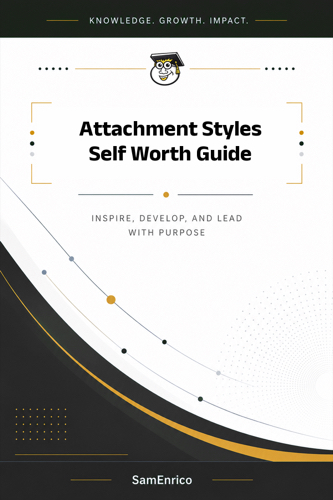
Attachment Styles Self Worth Guide
Understand how insecure attachment predicts low se
Understand how insecure attachment predicts low self valuation.
Formats
About this book
Free sample
Chapter 1: The Mirror That Cracked--– You cannot heal your self-esteem by working on your self-esteem alone.This sentence may strike you as strange, even contradictory. After all, isn't that exactly what self-help books have been telling you for decades? Love yourself. Believe in yourself. Affirm your worth.
Look in the mirror and say, "I am enough." These are not bad suggestions. They are, however, incomplete. They treat self-worth as a solo project—as if you could build a house by hammering nails into thin air, with no foundation beneath your feet.But self-worth was never meant to be built alone. It was never meant to be built from the inside out, through sheer willpower and positive thinking. Self-worth is relational.
It is forged in the crucible of early attachments, shaped by the faces that first looked upon you, and carried forward in every relationship you have ever had. Before you learned your name, before you spoke your first word, before you could even hold up your own head, you were learning something far more consequential: whether you mattered.This chapter will take you back to the beginning—not to blame your parents, not to wallow in the past, but to understand why your self-worth feels the way it feels. Because once you understand the origin of the pattern, you can finally stop fighting yourself and start rewriting the story.The First Mirror Imagine, for a moment, that you are an infant. You cannot speak. You cannot move yourself toward food or warmth.
You have only one tool: your cry. When you cry, someone comes. That someone picks you up, holds you, feeds you, changes you, looks into your eyes with warmth or exhaustion or sometimes nothing at all. In that gaze, something profound is happening. You are not just being cared for; you are being mirrored.The concept of mirroring comes from developmental psychology and psychoanalysis, but it is simpler than those fields make it sound.
A caregiver’s face is the first mirror in which you see yourself. When that face lights up with joy at the sight of you…
This is the end of the free sample. Get the eBook to keep going. Buy now
Contents
- Chapter 1
- Chapter 2
- Chapter 3
- Chapter 4
- Chapter 5
- Chapter 6
- Chapter 7
- Chapter 8
- Chapter 9
- Chapter 10
- Chapter 11
- Chapter 12
Details
- Author
- Rhoades Booker
- Publisher
- SamEnrico
- Language
- English
- Genre
- Non-Fiction, Self-Help, Attachment Theory
- Released
- 2026-06-08
- Pages (approx.)
- 148
- Available as
- eBook, Audiobook

Read better in the ZLOADR app
Your eBooks on your phone or tablet. Sign in with your SamEnrico account and start reading.
More by Rhoades Booker
 Paleo Autoimmune Protocol PrimerRhoades Booker$11.99
 Conchita Martinez Wimbledon WinRhoades Booker$11.99
 Market Analysis For Business Plans GuideRhoades Booker$11.99
 Yahoo Spam Operation LinkRhoades Booker$11.99
 The Hollow Hill’s Last GuardianRhoades Booker$11.99
 Into the Heart of the Amazon: The Quest for the River's True SourceRhoades Booker$11.99
 Understanding Generalized Torsion DystoniaRhoades Booker$17.99
 How to Start a Catheter Business (Beginners Guide)Rhoades Booker$11.99
 Climate Tech Marketing HandbookRhoades Booker$12.99
 Travel Credit Card SpendingRhoades Booker$12.99
 Environmental AnalystRhoades Booker$11.99
You may also like
 Hong Kong Handover 1997Dunn Johnnie$11.99
 Zumba For Postnatal Recovery CourseNeal Christian$11.99
 Zumba for BeginnersLadner Nikia$11.99
 YouTube Comment Mining GuideHumes Pandora$12.99
 Worry Box MeditationCarlin Rudy$11.99
 Workplace Stress MeditationNguyen Lynn$11.99
 Workplace Stress and Sleep RepairHawley Ivory$11.99
 Workplace Perfectionism CureDelaney Jeffry$11.99
 Workplace Injustice Anger GuideWallen Isabelle$11.99
 Work Addiction and Burnout LinkGreenwood Ester$11.99
 Women in Yoga and WellnessBeattie Galina$11.99
 Women in Stand Up ComedyChun Evangeline$11.99