
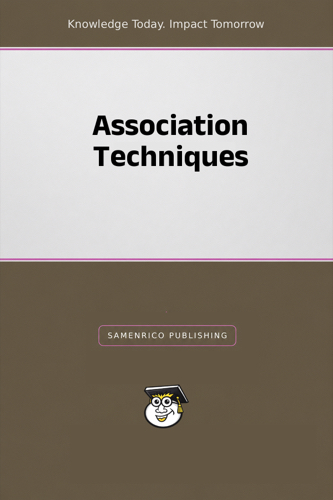
Association Techniques eBook
undefined
undefined
Formats
Free sample
Chapter 1: The Indexing Brain...--–- Your brain is not a computer. It never was. And every time you forget a name, draw a blank during a presentation, or fall back into a habit you swore you had broken, you are experiencing the gap between how you think your mind works and how it actually works.The computer metaphor is seductive because it feels right. You input information, you store it somewhere in memory, and when you need it, you retrieve it. Schools reinforce this model.
So do to-do lists, filing cabinets, and the way we talk about "uploading" knowledge. But the metaphor is wrong in a way that matters enormously. If you believe your brain is a hard drive, you will spend your life frustrated by its apparent failures—forgetting, distraction, irrationality, creative blocks. If you understand what your brain actually is—an association machine, not a storage device—you can stop fighting your own biology and start using it.This chapter dismantles the computer myth and replaces it with the associative index model. You will learn about spreading activation, the neurological cascade that drives every thought you have.
You will meet Carl Jung and his word-association tests, which revealed that your unconscious is not a quiet basement but a live wire of emotional connections. You will understand the difference between System 1 and System 2 thinking, and why your fast brain runs the show most of the time. Most importantly, you will learn the single most important fact about your own mind: the quality of your life is the sum of the associations you have forged. You cannot choose not to associate. You can only choose whether you drive the process or are driven by it.The Computer Metaphor Is a Lie Open any introductory psychology textbook from the 1970s, and you will find comparisons between the human brain and the computers of that era.
Information processing, encoding, storage, retrieval—the language of computing became the language of cognitive science. It was a useful analogy for its time. But analogies age, and this one has aged poorly.A computer stores data as discrete files in specific locations. Your hard drive does not confuse a photograph of your grandmother with a tax document. It does not suddenly associate the smell of coffee with a memory of your third-grade classroom.
It does not have feelings about spreadsheets. Your brain does all of these things constantly, not despite its design but because of it.The brain has approximately 86 billion neurons. Each neuron connects to thousands of others, forming somewhere around 100 trillion synapses. No file folders exist in this structure. No central processing unit retrieves data from a designated memory bank.
Instead, information is distributed across networks. A single memory—your first bicycle, for example—is not stored in one place. It is a pattern of connections involving visual cortex (the red paint), motor cortex (the feeling of pedaling), olfactory memory (the smell of the garage), and emotional centers (the pride or fear you felt). When you recall that bicycle, you are not "accessing a file." You are reactivating a pattern of associations across millions of neurons.This is not a philosophical distinction. It is the biological reality that determines what you can remember, what you can create, and what habits control you.
If you want to change your mind, you must change your associations. There is no other way.Spreading Activation: The Cascade of Thought Here is the most important neurological mechanism you have never heard of. Spreading activation is the process by which one thought triggers a cascade of related thoughts through your neural networks. Think of it as dropping a stone into a pond. The stone is the initial stimulus—a word, an image, a sound, a smell.
The ripples are the associated concepts that activate automatically, spreading outward through your associative web.Read the following word: LEMON.What happened? You did not simply register the letters. Within milliseconds, your brain activated a constellation of associations: yellow, sour, fruit, citrus, lemonade, the smell of lemon cleaner, the memory of a lemon tree, the feeling of puckering your mouth, the taste of lemon meringue pie. Some of these associations reached your conscious awareness. Most did not.
But every single one of them was triggered automatically, without your permission, by a single word.This is spreading activation in action. Your brain is constantly, relentlessly, involuntarily linking everything to everything else. You cannot stop it. Even trying to stop it—"Don't think of a pink elephant"—activates the very association you are trying to suppress. The brain does not have a "delete" button.
It only has links, stronger or weaker, active or dormant, but always present.The speed of this process is astonishing. Spreading activation occurs at approximately 120 meters per second along myelinated axons. A single word can trigger thousands of associations in less than a second. This speed is what makes fast thinking possible. It is also what makes fast thinking error-prone.System 1 and System 2: The Two Speeds of Thought Daniel Kahneman won a Nobel Prize in Economics for work that fundamentally changed how we understand human judgment.
His core insight, developed with Amos Tversky, is that the brain operates using two distinct systems.System 1 is fast, automatic, emotional, and associative. It runs constantly in the background. It recognizes a friend's face in a crowd, flinches at a loud noise, completes the phrase "bread and..." without conscious effort. System 1 is your brain on spreading activation. It is efficient, powerful, and largely outside your control.System 2 is slow, deliberate, logical, and effortful.
It calculates a tip, checks the logic of an argument, learns a new language. System 2 is what you think of as "you" making conscious decisions. But here is the uncomfortable truth: System 2 is lazy. It tires easily. It defaults to whatever System 1 suggests unless actively engaged.Kahneman uses a simple example: "What is 17 times 24?" Most people cannot answer immediately because the calculation requires System 2.
But "What is 2 plus 2?" activates System 1 immediately. The difference is not about mathematical ability. It is about whether the answer is already available through well-worn associative pathways.This matters for association techniques because association is the primary language of System 1. Every bias, every shortcut, every habit, every creative flash—these all originate in the fast, associative networks of your brain. System 2 can override associations, but it is slow and expensive in terms of mental energy.
Most of the time, you are running on association autopilot. The goal of this book is not to eliminate System 1—that would be impossible and undesirable. The goal is to understand your associative networks well enough to shape them deliberately, so that your autopilot flies in the direction you actually want to go.Carl Jung and the Feeling-Toned Complex In the early twentieth century, a Swiss psychiatrist named Carl Jung developed a technique that revealed the emotional power of unconscious associations. He called it the word-association test.The method was deceptively simple. Jung would read a list of one hundred words to a patient.
After each word, the patient responded with the first word that came to mind. Jung measured two things: the response time and any unusual reactions—stammering, laughing, sweating, a prolonged…
This is the end of the free sample. Get the eBook to keep going. Buy now
About this book
Details
- Author
- Beasley Werner
- Publisher
- SamEnrico
- Language
- English
- Genre
- Non-Fiction, Self-Help
- Released
- 2026-06-07
- Pages (approx.)
- 144
- Available as
- eBook, Audiobook

Read better in the ZLOADR app
Your eBooks on your phone or tablet. Sign in with your SamEnrico account and start reading.
More by Beasley Werner
 Fifteen Minute Micro BlocksBeasley Werner$11.99
 Nap WorkbookBeasley Werner$11.99
 Road Rage and Out of State DriversBeasley Werner$11.99
 MACRS Depreciation Schedule GuideBeasley Werner$11.99
 Crown Dream Jungian ViewBeasley Werner$11.99
 The 10 10 10 Morning RuleBeasley Werner$11.99
 Immigrant PR Agency Founder MemoirBeasley Werner$11.99
 NVC For Co ParentingBeasley Werner$11.99
 Pets.com: The $300 Million Puppy BowlBeasley Werner$11.99
 The Fox of the North: Peter the Great's War to Reshape RussiaBeasley Werner$11.99
 Bootstrapper Cash Flow Statement WorkbookBeasley Werner$12.99
 Resume With Only MOOC CertificatesBeasley Werner$12.99
You may also like
 Hong Kong Handover 1997Dunn Johnnie$11.99
 Zumba For Postnatal Recovery CourseNeal Christian$11.99
 Zumba for BeginnersLadner Nikia$11.99
 YouTube Comment Mining GuideHumes Pandora$12.99
 Worry Box MeditationCarlin Rudy$11.99
 Workplace Stress MeditationNguyen Lynn$11.99
 Workplace Stress and Sleep RepairHawley Ivory$11.99
 Workplace Perfectionism CureDelaney Jeffry$11.99
 Workplace Injustice Anger GuideWallen Isabelle$11.99
 Work Addiction and Burnout LinkGreenwood Ester$11.99
 Women in Yoga and WellnessBeattie Galina$11.99
 Women in Stand Up ComedyChun Evangeline$11.99