
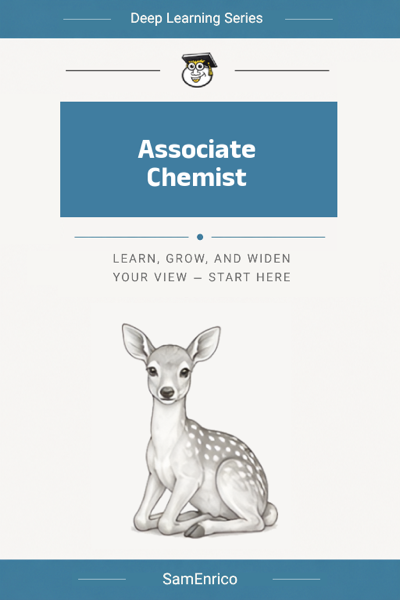
Associate Chemist eBook
A Coursebook on Associate Chemist
A Coursebook on Associate Chemist
Formats
Free sample
Chapter 1: The First Pipette...--–- The morning my lab coat still smelled like someone else's fear, I learned that an Associate Chemist isn't born in a classroom. It's forged in the space between a screaming HPLC and a silent senior colleague who expects you to know what you're doing. You've passed organic chemistry. You've survived analytical lab. You know what a burette is and you can recite the Beer-Lambert law in your sleep.
None of that matters at 8:47 AM on your first Tuesday, when a Quality Assurance manager hands you a chain of custody form and says, "Batch 2407-19 failed system suitability. You're on investigation duty."This book is not here to teach you chemistry. You already know chemistry, or you wouldn't have made it this far. This book is here to teach you everything they forgot to mention between the textbook and the bench: the unwritten rules, the career-ending traps, the five-second decisions that separate a thirty-year career from an embarrassing exit interview. Welcome to the real life of an Associate Chemist.The Hierarchy That Nobody Explains Let's start with a truth that no university lab coordinator ever told you: the laboratory hierarchy is not a meritocracy, and understanding who does what will save you from volunteering for work that isn't yours to do.The Laboratory Assistant sits at the foundation of the pyramid.
This role handles basic sample preparation, washes glassware, stocks consumables, and performs routine tasks under close supervision. A Laboratory Assistant might label vials, filter mobile phase, or dry glassware in an oven. They do not interpret data. They do not make decisions about method compliance. They are the vital, unsung backbone of every functional lab, and if you mistreat them, you will find yourself without clean glassware for a week.The Associate Chemist – that's you, or soon will be – occupies the entry-level professional tier.
You perform routine analysis under supervision. You generate raw data. You draft report sections. You recognize when an instrument is lying to you, even if you don't yet know how to fix it. You follow Standard Operating Procedures (SOPs) without deviation because deviation is not innovation – it's a compliance violation with your name on it.
You do not design methods. You do not sign off on final reports. You do not make the call about whether a batch passes or fails. Your job is to execute, document, and escalate.The Senior Chemist sits above you on the org chart, and the distance between your bench and their desk is measured in years of hard-won experience. Senior Chemists design methods, validate procedures, interpret complex data, review your work, and sign off on final reports.
They are the ones who walk over when your HPLC pressure crashes, tighten one fitting, and say "there" while you try not to cry. They are not being condescending. They are being efficient. Someday, if you survive long enough, you will be that person.The Hierarchy Table: Who Does What Task Lab Assistant Associate Chemist Senior Chemist Wash glassware Yes No No Prepare mobile phase Under supervision Yes No Run routine samples No Yes Occasionally Integrate peaks No Yes (manual and auto)Reviews Reinstate a failed batch No No Yes (with QA approval)Design a validation protocol No No Yes Sign off on a regulatory report No No Yes Train new hires No After 1 year Yes Memorize this table. Print it out.
Tape it to your notebook. Because on your second week, someone will ask you to do something that belongs to a Senior Chemist, and you need to know the difference between "being helpful" and "practicing outside your scope."The Four Worlds You Might Inhabit Not all Associate Chemist jobs are the same. The work, the pressure, the documentation requirements, and the career trajectory vary wildly depending on which industry you land in. Here are the four major environments, described by people who survived their first year.Pharmaceutical Quality Control (QC)The pharmaceutical industry runs on c GMP – current Good Manufacturing Practices. Every batch of medication must be tested before release.
Every instrument must be qualified. Every analyst must be trained and documented. The pace is relentless, the paperwork is crushing, and the stakes are literal life and death. One analyst I know spent three months testing the same product because the method kept failing system suitability. She learned more about chromatography in those three months than in four years of graduate school.The pressure: High.
Batch release deadlines are real. If you hold up a batch, you will hear about it.The reward: Job security. Pharma is regulated, which means labs cannot be outsourced as easily as other industries.The documentation: Extreme. Expect to sign your name fifty times per day. Every reintegration, every deviation, every out-of-specification result requires a written investigation.Environmental Testing Environmental labs analyze water, soil, air, and waste for contaminants regulated by the EPA.
The methods come from the EPA, not your company. You don't get to change them. Chain of custody is sacred – if you break it, the sample becomes legally worthless, and someone might avoid a cleanup they should have paid for. Environmental work often involves unpleasant matrices: sludge, leachate, industrial effluent. You will smell things.
You will get used to it.The pressure: Moderate to high. Deadlines are driven by client contracts and regulatory reporting periods.The reward: Variety. One day you're testing drinking water for lead. The next day you're analyzing soil from a superfund site.The documentation: Chain of custody forms are unforgiving. Every transfer, every opening, every analysis must be logged.Food Safety Food labs test for pathogens, contaminants, allergens, and nutritional labeling compliance.
The methods come from the FDA, USDA, or AOAC International. The samples are often messy – pureed chicken, melted chocolate, fermented dairy. Allergen testing is particularly unforgiving: a false negative for peanut residue can kill someone. Food labs run on speed because raw ingredients are perishable and finished products are waiting to ship.The pressure: High during harvest seasons (for agricultural testing) or holiday rushes (for finished products).The reward: You're protecting public health in a very direct way.The documentation: Slightly less intense than pharma, but still rigorous.Government and Public Health Laboratories Government labs – think state public health, forensics, or regulatory enforcement – operate on civil service rules. The pay is often lower than private sector.
The benefits are often better. The pace is slower, but the scrutiny is higher because your results can send someone to prison or trigger a public health emergency. Government labs are where many Associate Chemists start their careers before moving to industry, or where they settle after burning out of pharma.The pressure: Variable. Forensic labs have backlogs measured in months or years. Public health labs surge during outbreaks.The reward: Mission-driven work.
Pensions. Predictable hours.The documentation: Chain of custody is paramount for forensic work. Quality systems follow ISO 17025 standards.Which environment is right for you? If you want to learn fast and don't mind pressure, choose pharma. If you want variety and don't mind unpleasant samples, choose environmental.
If you want to protect the food supply, choose food safety. If you want stability and public service, choose government. You can move between them…
This is the end of the free sample. Get the eBook to keep going. Buy now
About this book
Details
- Author
- Paulson Kenda
- Publisher
- SamEnrico
- Language
- English
- Genre
- Non-Fiction, Informative, Educational
- Released
- 2026-06-02
- Pages (approx.)
- 134
- Available as
- eBook, Audiobook

Read better in the ZLOADR app
Your eBooks on your phone or tablet. Sign in with your SamEnrico account and start reading.
More by Paulson Kenda
 OCD Mindfulness Based TherapyPaulson Kenda$11.99
 Proxemics Personal Space HandbookPaulson Kenda$11.99
 The Daily Win ReplacementPaulson Kenda$11.99
 Parenting with Addiction RecoveryPaulson Kenda$11.99
 Survey Dashboard Creation with AIPaulson Kenda$11.99
 The Phantom of the Opera House: The True Story Behind the 1905 FirePaulson Kenda$11.99
 The Berlin Tunnel: The Cold War’s Forgotten Underground HeistPaulson Kenda$11.99
 Understanding Camfak SyndromePaulson Kenda$17.99
 Settling In Canada First YearPaulson Kenda$12.99
 Technical Reports as Publication EvidencePaulson Kenda$12.99
 How to Start a Construction of Multi-family Buildings, Including High-rise Buildings Business (BeginPaulson Kenda$11.99